






Key takeaways
- Revenue leakage is real: Clinics and departments across OHIP, AHCIP, MSP, and RAMQ may be losing 5–8%+ of earned revenue due to preventable claim rejections before adjudication.
- Speed protects cash flow: Reviewing and resubmitting rejected claims within 3–5 days significantly improves recovery rates and reduces the risk of missed provincial filing deadlines.
- Systems drive first-pass success: Standardized intake, real-time code validation, and automated billing workflows can help practices reach 95%+ first-pass acceptance rates while reducing administrative burden.
Your clinic, department, or medical group could be losing 5–8% (or more) of earned revenue due to rejected billing claims, often before those claims are ever adjudicated.
In provinces like Ontario (OHIP), Alberta (AHCIP), British Columbia (MSP), and Quebec (RAMQ), small billing errors prevent a claim from being processed at all. An incorrect health card number, an invalid fee code, a mismatch between service location and billing designation, or a missing diagnostic code have the ability to trigger an automatic rejection.
For physicians, especially locums, department leads, or administrators tasked with overseeing billing, rejected claims create a ripple effect:
- Delayed payments
- Increased administrative workload
- Rework for billing staff
- Revenue leakage that quietly compounds over time
Often, rejected claims are not even reviewed because of administrative delays and backlogs.
The good news? Managing rejected claims doesn’t require working longer hours or scrutinizing every submission manually. It requires building a clear, repeatable system.
Here are three practical steps to help reduce rejections, recover revenue faster, and create more predictable billing outcomes across your organization.
Step 1: Eliminate the most common rejection triggers
Goal: Stop preventable errors before claims are submitted
Across provincial payers, whether OHIP, AHCIP, MSP, or RAMQ, the most common rejection reasons are rarely complex. They are procedural, and in many cases, preventable at the front end.
Typical rejection triggers include:
- Invalid or expired health card numbers (PHN in BC, ULI in Alberta, Health Card Number in Ontario, NAM/RAMQ number in Quebec)
- Incorrect fee codes or outdated billing codes
- Incompatible code combinations
- Service location mismatches (e.g., hospital vs. community billing)
- Duplicate submissions
- Incorrect physician billing numbers or group numbers
Standardize intake and documentation
The first line of defense against rejections starts before the service is even billed.
At every visit:
- Verify patient demographics and provincial insurance details
- Confirm active coverage (particularly for out-of-province patients)
- Ensure documentation supports the service level billed
- Align service location codes with where care was delivered
Much of this is done before the patient walks into an exam room or even the waiting room, but these patient identifiers remain one of the most significant sources of claim rejection.
For group practices and hospital departments, consistency is critical. Variability between providers increases rejection risk. A standardized intake checklist across sites and providers dramatically reduces preventable claim failures.
Track first-pass acceptance rates
If you’re responsible for billing oversight, ask:
- What is our first-pass acceptance rate?
- Which fee codes are most frequently rejected?
- Are rejections clustered by provider, site, or service type?
Most high-performing practices aim for 95%+ first-pass acceptance. If your rate is lower, the issue is likely systemic rather than individual.
By identifying the top rejection categories, you can correct root causes instead of fixing claims one by one. Easily implement a first-pass acceptance system at your clinic and start seeing higher claim rates.
Physicians using Petal gained an average of $34,346 annually compared to manual billing.
Step 2: Build a rapid rejection response workflow
Goal: Recover revenue quickly and prevent permanent losses
Even with strong front-end processes, some rejections are inevitable. Payer rule changes, documentation discrepancies, or data-entry errors happen.
What separates high-performing clinics from struggling ones is not whether rejections occur, it’s how quickly they respond.
Delayed resubmissions result in:
- Missed provincial filing deadlines
- Revenue write-offs
- Cash flow instability
- Administrative backlog
Assign clear ownership
Rejection management must be structured. Avoid shared accountability that leads to confusion.
For departments, establish a clear escalation pathway when clinical clarification is required. This prevents billing teams from chasing physicians repeatedly for missing information.
Define:
- Who reviews rejection reports (daily or weekly)?
- Who investigates and corrects claims?
- Who resubmits?
- Who confirms payment?
Set internal service-level targets
Speed matters. The faster a claim is corrected and resubmitted, the more likely it is to convert into paid revenue rather than becoming a write-off.
Consider internal benchmarks such as:
- Review rejections within 24–48 hours
- Correct and resubmit within 3–5 business days
- Conduct monthly rejection trend analysis
Close the loop
Rejection management should follow a consistent cycle:
Rejected → Reviewed → Corrected → Resubmitted → Confirmed
Just as importantly, recurring rejection reasons should trigger workflow improvements. If OHIP repeatedly rejects a specific premium code due to documentation gaps, that signals a training or process issue, not isolated mistakes.
This closed-loop approach transforms rejection management from reactive firefighting into continuous improvement.
Step 3: Leverage systems that reduce manual errors
Goal: Improve consistency, reduce variability, and save time
Manual billing processes increase the likelihood of many challenges and gaps. This includes, but is certainly not limited to:
- Incorrect code combinations
- Missed modifiers
- Outdated provincial billing rules
- Incomplete encounter documentation
- Data entry errors
Across provinces, payer rules evolve. Fee schedules are updated. Eligibility requirements shift. Keeping up manually is difficult, especially for physicians balancing clinical demands with leadership responsibilities.
Modern billing platforms and managed service solutions offer the ability to:
- Validate health card formats in real time
- Flag incompatible fee codes before submission
- Ensure alignment with updated OHIP, AHCIP, MSP, and RAMQ billing rules
- Standardize workflows across multiple providers and sites
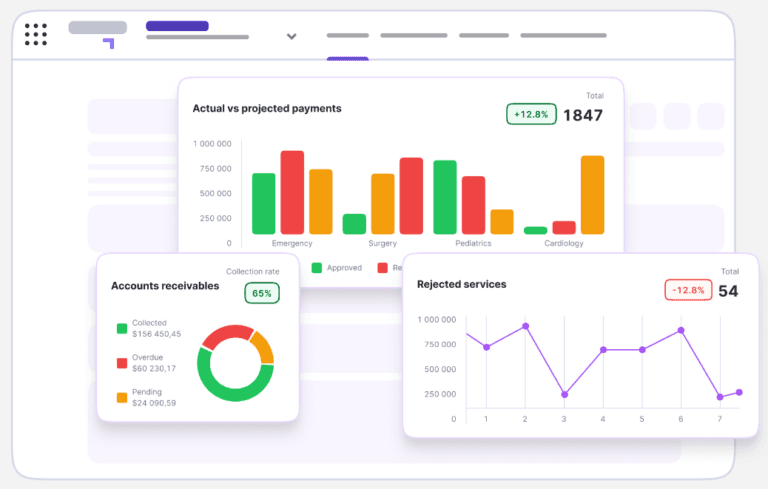
- Generate performance dashboards and rejection reports
Why this matters for physicians and departments
Administrative burden is one of the leading contributors to physician burnout, to the tune of 19.8 million hours per year in Canada. Every rejected claim represents duplicated effort.
By embedding automation and validation into billing workflows:
- First-pass acceptance improves
- Staff spend less time correcting preventable errors
- Physicians receive fewer billing clarification requests
- Revenue becomes more predictable
- Cash flow stabilizes
For locums and department leads, this consistency is particularly valuable. It reduces variability between providers and ensures billing quality remains stable regardless of staffing changes.
Did you know physicians save an average of 161 hours a year using Petal Billing solutions?
Key metrics to monitor
What gets measured gets improved.
Visibility turns billing from an opaque administrative function into a strategic financial lever.
To maintain strong performance, track:
- First-pass acceptance rate (target 95%+)
- Rejection rate by payer (OHIP, AHCIP, MSP, RAMQ)
- Top 5 rejection reasons
- Average time to resubmission
- Percentage of revenue recovered from rejected claims
Turning billing into a strategic advantage
Rejected claims disrupt operations; it’s as simple as that. They consume administrative time, strain physician-staff relationships, and introduce financial unpredictability.
By focusing on:
- Eliminating common rejection triggers
- Establishing a rapid response workflow
- Leveraging systems that reduce manual errors
… you create a more resilient and efficient billing operation.
These steps won’t eliminate every rejection. But they will dramatically reduce preventable errors, accelerate resubmissions, and strengthen your revenue cycle.
You don’t have to do it alone
Optimizing billing workflows across multiple provincial payers is complex. Each province, whether OHIP in Ontario, AHCIP in Alberta, MSP in British Columbia, or RAMQ in Quebec, has its own rules, codes, and compliance nuances.
That’s where the right partner makes a difference.
Petal, through solutions like Medcom Medical Billing and Xacte, has supported Canadian physicians and healthcare organizations for over 30 years. Our teams understand provincial billing intricacies and help clinics and departments:
- Reduce rejected claims
- Improve first-pass acceptance rates
- Standardize billing workflows across providers
- Navigate complex payer rules
- Save hours of administrative time each month
Thousands of clinicians across Canada rely on Petal to streamline their operations and connect delivered care to predictable revenue.
Rejected claims may be part of the system, but revenue loss doesn’t have to be.
Explore how Petal can help your team reduce rejections, simplify workflows, and strengthen financial performance—every step of the way.