








Key takeaways
- Manual scheduling creates hidden operational costs: Spreadsheet-based and disconnected scheduling systems increase administrative burden, reduce visibility, and contribute to clinician burnout.
- Automated scheduling improves efficiency and clinician satisfaction: Healthcare organizations using automated scheduling reduce manual work and improve schedule fairness toward achiever more comprehensive shift coverage.
- Modern scheduling systems support long-term clinical capacity: Real-time visibility and integrated workflows help physician groups and hospitals reclaim time for redistributing into care delivery.
As healthcare organizations grow, disconnected scheduling tools become increasingly difficult to manage. Compared to manual scheduling, automated workforce scheduling platforms centralize scheduling operations to improve coverage visibility and reduce manual coordination that slows operations.
Manual scheduling is more than handwriting shift changes and Post-it notes. It still relies on spreadsheets, email chains, phone calls, and disconnected systems. At first glance, these tools may appear manageable. What’s a extra phone call or Excel update?
But as physician groups grow, departments expand, and staffing demands become more complex, manual scheduling becomes one of the largest operational bottlenecks in healthcare. Who is filling a shift? Do they have the expertise needed? Are they on vacation? Did they already work an extra shift? Does it violate internal rules?
What starts as a coordination problem eventually becomes a clinical one.
Last-minute coverage gaps create stress. Physicians stay late completing documentation after overloaded clinics. Administrators spend hours managing schedule conflicts manually or take on an extra headcount to manage it all.
On top of that, teams lose visibility into staffing availability across sites or departments. Over time, these inefficiencies compound into burnout, workflow disruption, and reduced clinical capacity.
This is why healthcare organizations are increasingly moving away from manual scheduling toward automated workforce scheduling systems. The shift is no longer about convenience. It’s about sustainability.
In brief: Manual scheduling vs. Automated scheduling
Manual
scheduling
Automated
scheduling
Spreadsheet-based workflows
Reactive conflict resolution
Limited staffing visibility
Manual shift swaps
Higher admin workload
Greater burnout risk
Centralized scheduling platform
Real-time conflict detection
Organization-wide visibility
Self-service scheduling
Reduced coordination burden
Improved workload balance
Why manual scheduling breaks down in healthcare
Taking a look at manual scheduling, we see its limitations very quickly. Manual scheduling works best in stable environments with minimal complexity. Healthcare is neither.
Modern hospitals, clinics, and physician groups operate with:
- Rotating schedules.
- Multiple care sites.
- On-call requirements.
- Vacation rules and leave requests.
- Specialty-specific coverage requirements.
- Union or compliance constraints.
- Constant last-minute adjustments.
Managing all of this manually introduces significant operational friction.
In Petal’s experience working with departments and HDOs across Canada, scheduling coordinators spend hours building schedules that still require extensive revisions. This isn’t even factoring in distribution.
Physicians depend on administrators to swap shifts, request changes, or resolve conflicts, allowing them to focus on patient care. Important coverage gaps that go unnoticed become urgent and appear fast.
The biggest problem with manual scheduling is visibility
When schedules exist across spreadsheets, emails, and disconnected calendars, no one has a reliable real-time view of staffing capacity. Teams become reactive instead of proactive.
At scale, these inefficiencies become expensive, and create downstream consequences across the organization:
- Increased administrative workload
- Uneven physician coverage
- Delays in documentation and billing
- Greater risk of scheduling errors
- More after-hours coordination
- Higher clinician frustration and fatigue
Proof: A cost-benefit analysis conducted at CHUM found that manual scheduling processes created a significant operational burden before automation was introduced. After implementing automated scheduling, CHUM reduced scheduling time by 98%, improved staff satisfaction to 92%, and reduced scheduling costs by 70%.
What automated scheduling changes
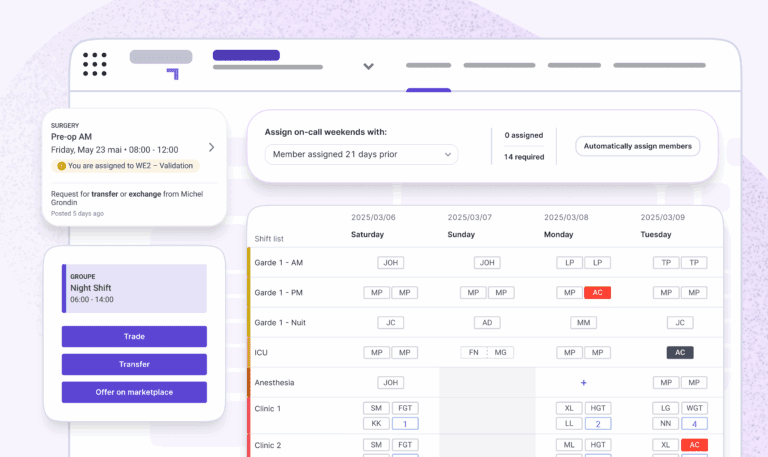
Automated scheduling replaces fragmented coordination with a centralized, rules-based system designed specifically for healthcare complexity.
Instead of building schedules manually, organizations define operational rules, staffing requirements, physician preferences, and compliance constraints directly into the system. The platform then generates optimized schedules automatically while continuously updating changes in real time.
This fundamentally changes how scheduling operates across healthcare organizations.
Rather than reacting to conflicts after schedules are published, teams identify and resolve issues proactively. Physicians gain greater transparency into schedules and shift coverage. Administrators spend less time coordinating logistics manually.
Automated scheduling platforms also improve fairness and workload balance, two major contributors to clinician satisfaction, in large part due to a more predictable clinical environment.
Petal Automated Scheduling, for example, enables organizations to:
- Generate compliant schedules in minutes
- Reduce overtime and scheduling conflicts
- Automate vacation and absence management
- Enable self-service shift swaps
- Identify coverage gaps in real time
- Centralize scheduling across departments and sites
Impact: More time for patient care and less burnout and physician stress through streamlined and transparent scheduling.
The operational impact goes beyond scheduling
One of the biggest misconceptions about workforce scheduling is that it only affects staffing coordination. In reality, scheduling influences nearly every downstream operational workflow in healthcare.
Poor schedules create cascading problems:
- Overbooked clinics lead to rushed documentation
- Uneven workloads contribute to burnout
- Last-minute gaps increase overtime costs
- Documentation delays affect billing timelines
- Inconsistent staffing reduces continuity of care
Automated scheduling helps stabilize these workflows because schedules become more accurate, predictable, and visible across the organization.
This is particularly important for physician groups balancing clinical operations with billing and documentation requirements.
When schedules align properly with workflow capacity, physicians have more time to complete documentation accurately during clinical hours instead of after hours. Billing submissions become more consistent. Operational disruptions decrease.
Petal found that physicians using integrated billing workflows save an average of 161 hours annually while increasing revenue by 9.4%.
The key insight is that scheduling should not operate independently from the rest of healthcare operations. High-functioning organizations increasingly treat scheduling as infrastructure that supports clinical capacity, operational performance, and physician well-being simultaneously.
Automation reduces cognitive burden for clinicians
Administrative overload remains one of the biggest drivers of physician burnout in Canada.
The issue is not simply the amount of work physicians perform. It is the constant context switching created by fragmented operational systems.
Every time a physician checks multiple systems for coverage updates, resolves scheduling confusion, or manually coordinates changes, cognitive load increases. These interruptions accumulate throughout the day and often continue after clinical hours.
Automation reduces this friction.
With automated scheduling systems:
- Scheduling rules are embedded directly into workflows
- Conflicts are flagged automatically
- Shift exchanges occur within predefined guardrails
- Availability updates happen in real time
- Teams access a single source of truth
This reduces the need for repetitive coordination and manual intervention.
For healthcare leaders, these outcomes represent more than efficiency gains. They represent reclaimed clinical capacity.
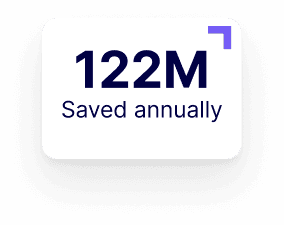
Proof: At CHUM, implementing Petal Workforce created approximately 8,000 hours saved annually through reduced manual coordination and improved workforce visibility. The organization also saw a 407% increase in daily self-service schedule searches, reducing dependence on switchboard and administrative teams.
The future of healthcare scheduling is connected, real-time, and automated
Healthcare organizations are under growing pressure to do more with limited staffing resources. Physician shortages, burnout, and rising patient demand are forcing leaders to rethink operational infrastructure.
Manual scheduling systems were not built for today’s healthcare environment.
As organizations grow more complex, disconnected scheduling processes become increasingly unsustainable. The operational cost is no longer limited to administrative inefficiency. It directly affects clinician experience, patient access, and organizational performance.
Automated scheduling changes that dynamic.
By centralizing scheduling, improving visibility, and reducing manual coordination, healthcare organizations create more sustainable workflows for both physicians and administrators.
Petal Automated Scheduling helps healthcare organizations simplify complex scheduling workflows, reduce operational friction, and improve clinician satisfaction through intelligent workforce automation. Healthcare teams using Petal report reduced scheduling workload, faster coordination, and stronger operational visibility across departments and sites.
Ultimately, the organizations that modernize scheduling today will be better positioned to protect the resource healthcare systems can least afford to lose: clinician time.
Upgrade your scheduling process! Contact a Petal scheduling expert to launch your digital transformation.
FAQ: Manual vs Automated scheduling in healthcare
What is manual scheduling in healthcare?
Manual scheduling refers to creating and managing staff schedules using spreadsheets, paper systems, emails, phone calls, or disconnected software tools without centralized automation.
What are the risks of manual healthcare scheduling?
Manual scheduling increases administrative workload, creates visibility gaps, raises the risk of scheduling errors, and contributes to clinician burnout through reactive coordination and inconsistent workflows.
How does automated scheduling improve healthcare operations?
Automated scheduling centralizes workforce management, applies scheduling rules automatically, improves visibility into staffing needs, and reduces the time spent managing schedules manually.
Can automated scheduling reduce physician burnout?
Yes. Automated scheduling reduces administrative burden, limits manual coordination, improves workload balance, and creates more predictable clinical workflows for physicians.
What features should healthcare scheduling software include?
Healthcare scheduling software should include real-time schedule updates, automated conflict detection, shift swap functionality, compliance management, workload balancing, and multi-site visibility. Secure messaging for simple and easy schedule communications play an additional part in streamlining operations and user satisfaction.
Why are healthcare organizations moving away from spreadsheets for scheduling?
Spreadsheets become difficult to manage as healthcare organizations grow. They lack real-time visibility, increase coordination burden, and create operational inefficiencies that automated scheduling systems solve more effectively.