







Key takeaways
- Good billing habits compound over time: Strong documentation, consistent submissions, and regular payment reviews improve revenue and support a more stable practice.
- Consistent billing protects your income: Submitting claims regularly and reviewing payment statements prevents backlogs and missed deadlines.
- Documentation is key to stability: Complete clinical notes support accurate billing, simplify corrections, and prepare you for potential payment reviews or audits.
The first 90 days of medical billing are when new physicians build routines that shape how quickly they get paid and how much administrative burden they take on. Although billing rules vary across Canada’s provinces and territories, the same fundamentals apply: complete the right administrative setup, submit claims consistently, document thoroughly, and review your payments regularly.
Once you’ve finished residency and are ready to begin independent practice, one responsibility remains: setting up your medical billing.
The habits you establish now will influence your revenue and administrative workload for years to come. From documentation to submission, review, and improving your workflow are all essential to keeping the funds you’ve worked hard for steadily coming in.
- Did you know that if Canadian physicians were freed of paperwork burden, the time saved would equal 7,052 more doctors? Less paperwork means meeting Canada’s patient demand!
Small improvements made early tend to compound. Consistent billing leads to fewer claim corrections, steadier cash flow, more predictable clinic operations, and more time for other priorities.
Read on for a practical overview of the first 90 days of physician billing in Canada.
Note: This guide doesn’t replace your provincial billing manuals, medical association guidance, or payer requirements, but will help you understand what to prioritize as you start independent practice.
Before you see your first patient
Aim to complete the administrative work determining your first payment before your first clinic day.
Across Canada, most physicians will need to:
- Obtain a license or practice permit through the provincial regulatory college.
- Register with the provincial health insurance plan or billing authority.
- Set up direct deposit and confirm banking information.
- Ensure professional liability coverage is active.
- Understand how to be compensated, whether through fee-for-service, salary, sessional, blended, or alternative funding arrangements.
- Decide how to manage billing once they begin seeing patients.
The ideal situation is to establish your billing workflow before your first patient arrives. Determine how encounters will be documented, who will submit billing claims, and how rejected claims will be corrected.
Physicians using Petal gained $34,346 more annually on average compared to manual billing.
Build three billing habits during your first month
Your first month isn’t about mastering every billing rule. Use it to build routines that become second nature.
Start with these three proven billing habits:
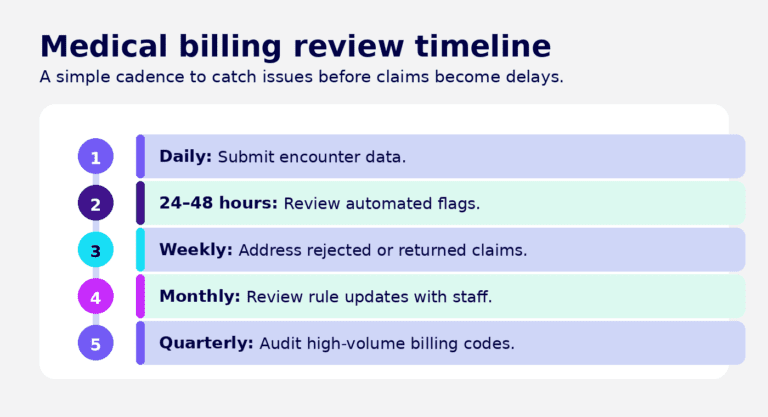
1. Submit claims consistently
2. Document every encounter thoroughly
Every billing claim should be supported by clear clinical documentation.
Your notes should explain:
- Why the patient was seen
- The assessment or service provided
- Clinical decision-making where appropriate
- Any details supporting the billed service
Complete documentation simplifies payment corrections, supports future reviews, and prepares you should your billing ever be audited.
3. Learn your most common billing codes
Fact: Few new physicians overbill.
Many underbill by overlooking eligible codes, premiums, modifiers, or compensation adjustments.
- For example, providing virtual care in Alberta may include 03.03CV – Virtual assessment, 03.08CV – Comprehensive consultation, or 08.19CX – Psychiatric consultation. Explore the Alberta virtual care billing codes cheat sheet for more.
Rather than memorizing an entire fee schedule, focus on understanding the services you perform most often and when additional billing rules apply.
Over time, familiarity with your province’s billing agreement helps ensure you’re appropriately compensated for the care you provide.
Understand how the billing cycle works
Billing doesn’t end when you submit a claim.
Although each province follows its own processes, most physician billing follows a similar cycle:
- See the patient
- Confirm patient eligibility and record the clinical encounter.
- Document the visit
- Complete documentation while details remain fresh.
- Submit your claim
- Enter the required billing information and submit within your province’s deadlines.
- Review your payment statement
- Compare what you submitted against what was paid. Look for:
- Rejected claims
- Payment reductions
- Missing payments
- Correction opportunities
- Compare what you submitted against what was paid. Look for:
- Correct issues promptly
- Many rejected claims can be corrected and resubmitted within established timelines. Reviewing payment statements regularly helps prevent small issues from becoming significant revenue losses.
Five billing mistakes to avoid during your first 90 days
Even experienced physicians occasionally receive claim rejections.
Common mistakes include:
- Waiting too long to submit claims
- Billing backlogs increase stress, reduce accuracy, and make missed deadlines more likely.
- Not understanding your compensation model
- Fee-for-service, salary, blended, and alternative payment models each follow different billing rules. Understanding your agreement helps ensure you’re paid correctly.
- Treating documentation as an afterthought
- Strong documentation protects both patient care and billing accuracy.
- Starting practice without a billing workflow
- Knowing who submits claims, who reviews payments, and how corrections are handled prevents unnecessary administrative work later.
- Ignoring rejected claims
- Claim refusals are feedback. Reviewing payment reports consistently allows you to resolve issues while correction windows remain open.
To go more in-depth on billing mistakes, explore the full blog.
56,000+ providers and administrators trust Petal to simplify their billing.
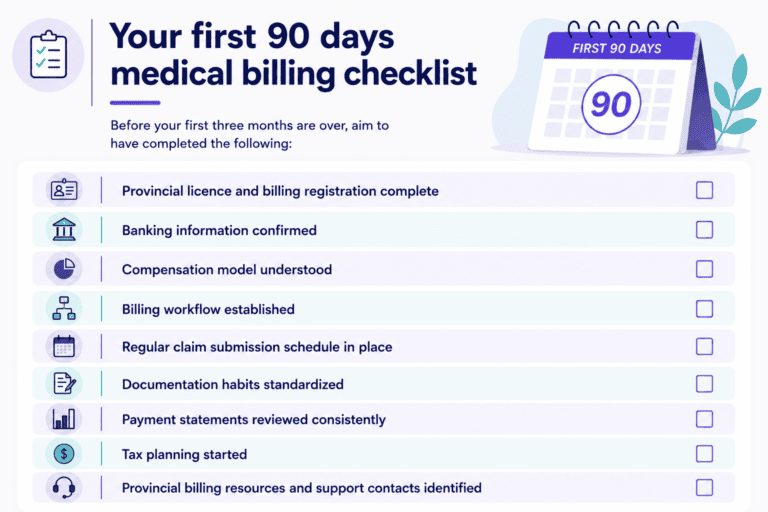
Your first 90 days medical billing checklist
There’s a lot to remember to set up medical billing with confidence.
Use this checklist in conjunction with your province’s specific requirements to ensure you don’t miss a thing:
You don’t have to manage medical billing alone
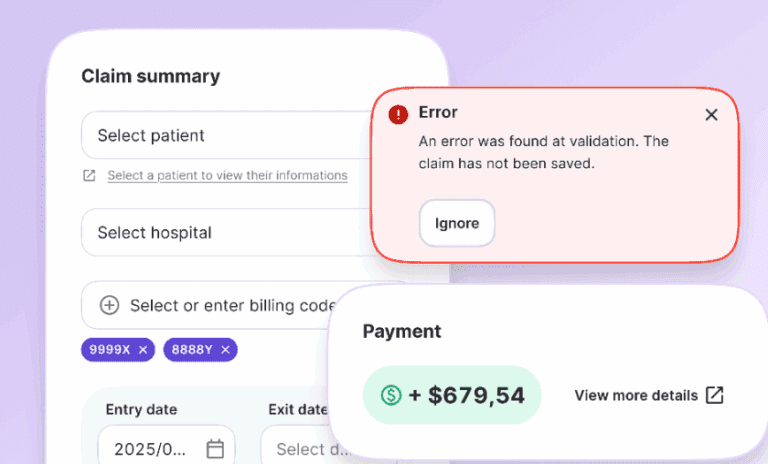
Your attention is better served away from managing billing claims.
Trust Petal Billing’s user-friendly tools and live support agents based in your province to successfully launch your practice.
A higher claim acceptance rate means more stable revenue, fewer hours managing rejected claims, and greater confidence that your delivered services will be compensated right.
- Our independent study found physicians using Petal Billing reported an average revenue increase of 9.4% and 3.1 hours saved per week compared to manual billing.
Choose simpler medical billing to stay focused on your patients.
Make medical billing your strength:
FAQs: New physician billing
When should I start learning medical billing?
Before your first day of independent practice. Completing your administrative setup early helps prevent payment delays and makes the transition into practice much smoother.
Do billing rules differ across Canada?
Yes. Every province has its own billing authority, fee schedule, deadlines, and compensation agreements. Always consult your provincial resources for specific requirements.
How often should I submit billing claims?
Many physicians benefit from submitting claims daily or weekly. Regular submissions reduce backlog, improve accuracy, and support more predictable cash flow.
Why is documentation so important?
Clinical documentation supports every billing claim. Complete notes make it easier to justify billed services and respond to reviews or audits if necessary.
Should I manage billing myself?
That depends on your comfort level, practice environment, and available support. Some physicians manage billing independently, while others work with billing agencies, clinic staff, or hybrid solutions.
What should I review after submitting claims?
Review every payment statement to confirm what was paid, as well as to identify rejected claims or payment reductions and correct issues before provincial deadlines expire.