







Key takeaways
- Reconciliation confirms you’re paid correctly: Comparing submitted claims with provincial payment reports reveals discrepancies that could otherwise go unnoticed.
- Accepted claims can still lead to lost revenue: Reduced payments, missing premiums, and overlooked adjustments affect physician compensation.
- Every province follows its own reconciliation process: Payment terminology and correction requirements differ, but the fundamentals apply across Canada.
Medical billing reconciliation is the process of comparing submitted medical claims against provincial payment reports, as well as actual payments, to confirm physicians receive the correct compensation.
It’s an essential step in protecting revenue.
In Canada, this involves reviewing submitted claims to identify discrepancies and correct errors. These actions need to take place within applicable provincial deadlines.
Submitting a claim is one thing. Knowing you’ve been paid correctly is another.
- Did you know? A successful submission doesn’t guarantee the correct payment.
Across Canada, physicians submit thousands of claims for the care they deliver. While many are processed as expected, others may be rejected, reduced, or adjusted.
That’s why reconciliation deserves a regular place in your medical billing workflow.
What's medical billing reconciliation?
Medical billing reconciliation verifies whether the payments you receive accurately reflect the services you’ve provided and the compensation you’re entitled to.
This involves comparing three records:
- Submitted claims: The services, billing codes, premiums, and amounts originally claimed.
- Provincial payment reports: The payer’s decision to approve, reject, reduce, or adjust each claim.
- Actual payments: The funds deposited into your account.
Let’s say a physician submits a $150 claim but receives $120.
That $30 difference deserves attention, not least because if you submit for the same service 300 times a year, then that’s $9,000 possibly left on the table.
Was the original claim incorrect? Did the provincial payer apply a billing restriction? Was an eligible premium excluded?
Reconciliation allows physicians to investigate discrepancies and determine whether corrective action is necessary.
Remember: A payment difference doesn’t automatically mean your provincial payer made a mistake. Here are five things provinces look for when reviewing claims.
Petal survey: 54% of physicians say personal time suffers when the workday runs behind.
How does medical billing reconciliation work?
Although provincial billing requirements differ, the reconciliation process generally follows five steps:
1. Gather your submitted claims
Start with a record of the claims submitted during the relevant billing period. Include service dates, patient identifiers, billing codes, submitted amounts, and applicable premiums or modifiers.
2. Review your remittance statements
Once claims are processed, provincial payers issue payment reports detailing their outcomes.
Look for claims that were:
- Paid as submitted
- Paid at a reduced amount
- Rejected or returned
- Adjusted after initial processing
3. Compare expected and actual payments
Match submitted claims with their corresponding payment results.
Confirm that paid amounts align with applicable provincial fee schedules and billing rules. Then verify that the payment total reconciles with the funds received.
4. Investigate payment discrepancies
For any difference, review the payer’s explanatory codes and your original submission, as well as supporting documentation. Determine whether the issue involves a billing error or an adjustment requiring follow-up.
5. Correct and confirm
Where permitted, correct and resubmit claims or request an adjustment.
Track each outstanding discrepancy until it’s resolved, including confirmation that any additional payment or recovery has been recorded.
Here’s a Petal Billing leader describing the impact of reconciliation:
“Imagine a physician submits 100 claims and receives payment for 95. At first glance, everything looks fine. But when they reconcile their billing, they discover three rejected claims and two that were paid at a lower amount than expected. That’s the value of reconciliation. Physicians catching discrepancies and recovering otherwise missed compensation leads to fewer headaches and more revenue.”
– Brennen Fule, Director of Medical Billing Operations in Alberta
What causes discrepancies in physician payments?
Payment differences arise at several stages of the billing process.
Keep in mind these four common causes of discrepancies:
1. Rejected claims
Payments are prevented by a variety of errors, including incorrect billing codes and missing referral details. For example, an Alberta virtual care consultation may require referral information that wasn’t included in the original claim.
- Billing virtual care in Alberta? Use this cheat sheet.
2. Reduced payments
A claim may be accepted but paid at a lower amount because certain billing conditions weren’t met. This makes reduced payments particularly important to investigate.
3. Missing premiums or modifiers
Eligible additional compensation may be excluded from the original submission.
In Quebec, for example, certain services qualify for additional compensation based on specific RAMQ billing requirements. Overlooking an eligible billing code results in underbilling without triggering a rejection.
4. Delayed payments or adjustments
Payments may change after corrections or provincial fee updates.
- For instance, Ontario’s 2026 emergency medicine billing changes included retrospective claim adjustments for eligible services following updated rules.
Key action: Investigate discrepancies before assuming a claim’s original payment represents its final value.
How does reconciliation differ across Canada?
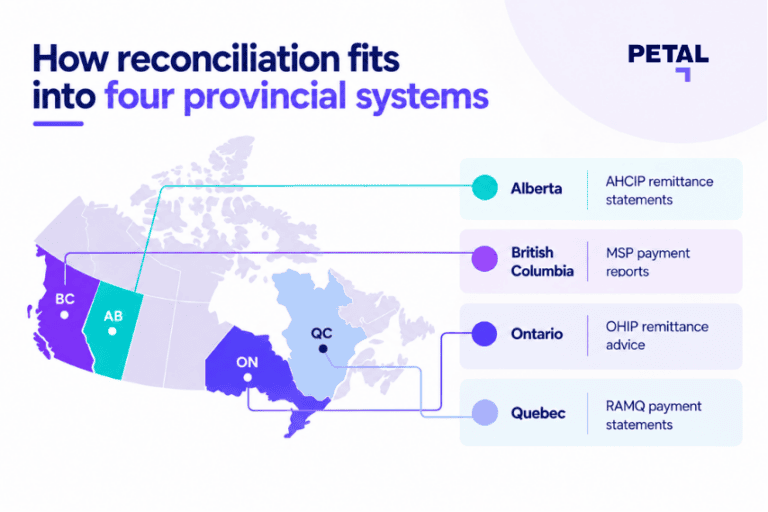
Every province administers physician billing according to its own payment systems, fee schedules, and correction procedures.
While terminology differs, physicians need to verify that their compensation aligns with the applicable provincial billing rules.
Your compensation model also matters.
Fee-for-service physicians can reconcile individual service payments against submitted claims. Those working under blended or alternative payment arrangements may also need to verify applicable incentives and other compensation components.
Important: Provincial deadlines for submissions and adjustments vary.
Three habits that improve billing reconciliation
Accurate reconciliation begins with a repeatable process.
Here are three habits worth establishing:
1. Review payments every billing cycle
Don’t wait until the end of the month or quarter to discover something went wrong.
Regular reviews support quicker follow-up while documentation is accessible and correction windows remain open.
2. Track discrepancies until they're resolved
A correction isn’t complete because you’ve resubmitted a claim.
Maintain a record of outstanding issues, including:
- Original claim and service date
- Reason for the discrepancy
- Correction or adjustment requested
- Relevant submission deadline
3. Look for recurring patterns
Are certain codes repeatedly rejected? Do particular services consistently receive lower payments than expected?
These patterns reveal weaknesses in your billing process.
Reviewing recurring issues gives you an opportunity to improve documentation and reduce future corrections.
In practice: Whether you manage billing independently or work with clinic staff or a billing provider, establish who’s responsible for reconciliation.
Choose a solution with experts in reconciliation

Care with confidence that your revenue reflects your effort.
12,000+ physicians trust Petal Billing to simplify their billing and maximize their return for care delivered.
Advanced features paired with province-specific expertise help you achieve your practice goals faster.
- Proof: An independent study commissioned by Petal found that physicians using medical billing solutions reported an average 9.4% increase in revenue and 161 hours saved annually compared with manual billing.
Earn more from less effort through a billing solution tailored to your needs.
Improve your reconciliation process and earn more:
FAQs: Medical billing reconciliation in Canada
What is medical billing reconciliation?
Medical billing reconciliation compares submitted physician claims, provincial payment reports, and received payments to confirm accurate compensation and identify discrepancies requiring follow-up.
How do physicians know if they’ve been paid correctly?
Physicians review remittance statements, compare paid amounts against submitted claims and applicable fee schedules, and investigate rejected, reduced, or adjusted payments.
How often should physicians reconcile medical billing payments?
Ideally, physicians should review every payment cycle. Regular reconciliation identifies discrepancies early and creates time to resolve issues before provincial correction deadlines expire.
What’s the difference between a rejected claim and a reduced payment?
A rejected claim hasn’t been approved for payment. A reduced claim has been processed but reimbursed at a lower amount than originally submitted.
Can physicians correct a medical billing claim after it’s been paid?
Yes, certain claims can be corrected or adjusted after payment. Eligibility, procedures, and deadlines depend on the provincial payer and the reason for correction.
Can medical billing software automate reconciliation?
Medical billing software can streamline reconciliation by matching submitted claims with payment results, flagging discrepancies, and tracking outstanding issues. Available capabilities vary by provider and provincial integration.