





Key takeaways
- Common assessment codes form the foundation of family medicine billing: Knowing when to use A001, A007, A003, and A004 supports accurate claims for everyday encounters.
- Counselling codes come with specific requirements: Services such as K013, K033, and K005 require appropriate documentation, including the clinical purpose and eligible treatment time.
- Chronic disease management creates additional billing opportunities: Codes such as K030 and Q040 recognize qualifying diabetes care when physicians meet the relevant service and documentation requirements.
Ontario family physicians use OHIP billing codes to claim payment for services ranging from patient assessments to preventive care and counselling. This delivery sees codes become common, such as A001, A007, and A003 for assessments. Understanding which codes apply, as well as their eligibility requirements, reduces claim rejections and supports accurate compensation.
Whether you’re a new family physician or have years of experience, navigating Ontario’s Health Insurance Plan (OHIP) takes practice. That’s because each service has specific billing requirements.
Choosing incorrect codes or overlooking eligible incentives leads to less earned revenue down the line, as well as wasted time fixing rejected claims.
- Did you know? Ontario family physicians already spend 19 hours per week on average on admin tasks.
This guide explains common OHIP billing codes for family physicians and what to check before submitting claims.
Understanding OHIP billing codes for family physicians
Ontario’s Ministry of Health maintains the Schedule of Benefits for Physician Services, which outlines insured services, fee codes, payment amounts, and billing requirements.
Before choosing a code, consider:
- Service provided: Was it an assessment, counselling session, or procedure?
- Clinical requirements: Does the encounter meet the code’s criteria?
- Patient circumstances: Do age or medical history affect eligibility?
- Practice model: Does your payment arrangement affect how the service is compensated?
Family physicians working under fee-for-service (FFS) arrangements and alternative payment models may follow different payment rules.
Key action: Consult the current OHIP Schedule of Benefits when billing a service that’s new to you or reviewing changes to existing codes.
Clinicians increase revenue by an average of 9.4%, or $36,570 in Ontario, using Petal.
Common OHIP assessment and visit codes
Assessment codes are among the most important to understand because they apply to everyday encounters in family medicine.
OHIP code | Service | What it covers |
A001 | Minor assessment | Brief history, examination or medical advice for a limited concern. |
A007 | Intermediate assessment | A more extensive assessment of a presenting complaint or condition. |
A003 | General assessment | Comprehensive history and examination meeting the Schedule’s requirements. |
A004 | General reassessment | A comprehensive reassessment for an established clinical situation, with modified history requirements. |
The distinctions depend on the exact clinical work completed and the Schedule’s requirements.
In practice: Let’s consider a patient visiting for a minor skin irritation. A brief examination and treatment advice may support A001, while a patient presenting several symptoms requiring a broader assessment may qualify for A007.
Periodic health visit codes
Family physicians also provide preventive visits based on patients’ ages and individual health needs.
OHIP code | Patient group |
K017 | Children after their second birthday |
K130 | Adolescents |
K131 | Adults aged 18–64 |
K132 | Adults aged 65+ |
Periodic health visits have specific service requirements and frequency limits. They’re distinct from assessments performed solely to investigate presenting complaints.
In practice: Let’s consider a 45-year-old patient attending a scheduled visit within preventive health. If the physician completes the required assessment and meets the eligibility criteria, K131 may apply. But for a patient aged 70 receiving a comparable service, K132 might be appropriate.
Billing virtual care in Ontario?
OHIP counselling and mental health billing codes
Counselling and mental health services are important components of family medicine, and this is particularly true when physicians provide ongoing support.
Common codes include:
- K013: Individual counselling within the initial eligible units.
- K033: Additional individual counselling units after the applicable threshold.
- K005: Individual primary mental health care.
- K007: Individual psychotherapy.
These services have defined clinical and time-based requirements. Under the Schedule, the applicable unit is generally 30 minutes or the major part thereof, subject to specific timekeeping rules.
A physician providing structured counselling for a patient managing a significant health concern must ensure the encounter meets the applicable counselling definition.
- Keep in mind that a brief discussion during a routine office assessment doesn’t automatically qualify as a separately billable counselling service.
In practice: A patient experiencing anxiety may require a dedicated counselling session. Depending on the clinical service provided, K005 could apply for eligible primary mental health care, while K013 may be appropriate for qualifying individual counselling.
Preventive care and chronic disease management codes
Family physicians regularly guide patients through ongoing disease management and preventive interventions.
For patients with diabetes, two codes are particularly relevant:
OHIP code | Service | Important consideration |
K030 | Diabetic management assessment | Requires qualifying assessment and management activities, with appropriate records. |
Q040 | Diabetes management incentive | Requires documented comprehensive diabetes management and sufficient eligible K030 services. |
K030 is designed for physicians providing continuing diabetes management. It includes defined clinical activities and documentation.
Q040 recognizes eligible ongoing management over a 12-month period. Under the Schedule’s established requirements, physicians must complete at least three eligible K030 services during that period to qualify.
Day-to-day, you’ll benefit from maintaining an organized diabetes management record, including relevant clinical indicators, preventive measures, and follow-up activities.
In practice: Consider a patient with type 2 diabetes attending regular appointments. Eligible management assessments may qualify for K030, while completing at least three qualifying K030 services within 12 months may support the Q040 incentive.
Virtual care billing codes for Ontario family physicians
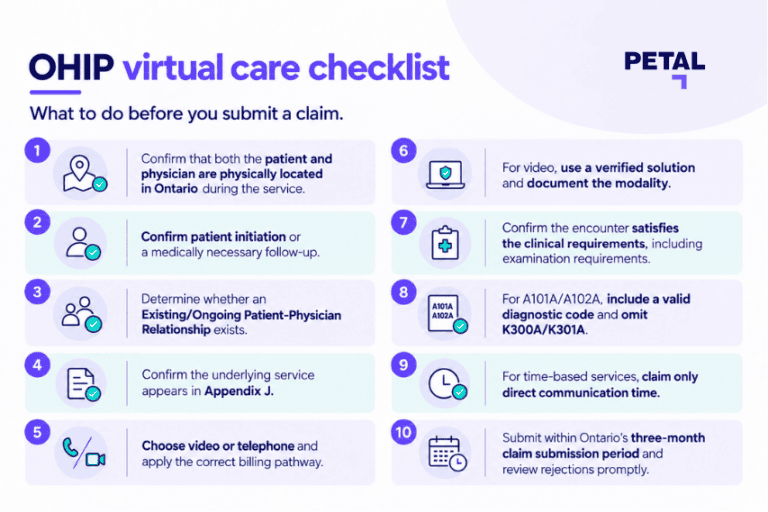
OHIP distinguishes between comprehensive virtual care for patients with an existing physician relationship and limited virtual care when that relationship didn’t yet exist.
OHIP code | Service |
K300A | Comprehensive virtual care video indicator |
K301A | Comprehensive virtual care telephone indicator |
A101A | Limited virtual care assessment by video |
A102A | Limited virtual care assessment by telephone |
For eligible comprehensive virtual care, physicians submit the underlying service code with the appropriate modality indicator.
K300A and K301A don’t carry separate payment values.
A101A and A102A apply to eligible limited virtual encounters and follow different payment rules.
- Don’t miss earned revenue! Use our Ontario virtual care billing codes cheat sheet.
In practice: A family physician conducts a video consultation with an existing patient. If the encounter meets comprehensive virtual care requirements, the physician may submit the appropriate assessment code with K300A. For an eligible telephone consultation, K301A would be the corresponding modality indicator.
Additional OHIP codes and premiums worth knowing
Depending on where and when you practice, your care may qualify for additional premiums or payments.
Examples include:
- After-hours services: Eligible services provided during designated evening, overnight, weekend, or holiday periods.
- Special visits: Certain services provided in qualifying hospital or other care settings.
- Primary care incentives: Eligible preventive care and disease management activities under specific payment models.
Remember: Eligibility varies. Premiums generally have specific requirements concerning service type, location, timing, and more.
Common OHIP billing mistakes to avoid
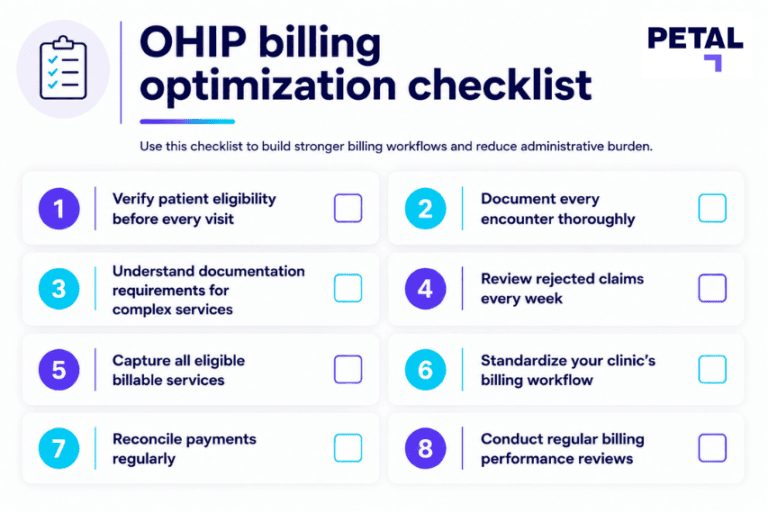
Knowing which code describes a service is an important starting point. A consistent billing workflow protects the value of that knowledge.
Before submitting claims:
- Confirm the service: Ensure the code reflects the clinical work performed.
- Check eligibility: Review frequency limits, patient criteria, and payment-model requirements.
- Document thoroughly: Include clinical findings, time spent, and other mandatory details.
- Review additional payments: Check for applicable premiums and incentives.
- Monitor remittances: Investigate rejected or reduced claims promptly.
Additionally, Ontario generally requires physicians to submit OHIP claims within three months of the service date.
Learn more: Our Ontario OHIP billing optimization checklist offers more guidance to improve claim accuracy and maximize the return from your delivered services.
Increase your practice revenue with less effort
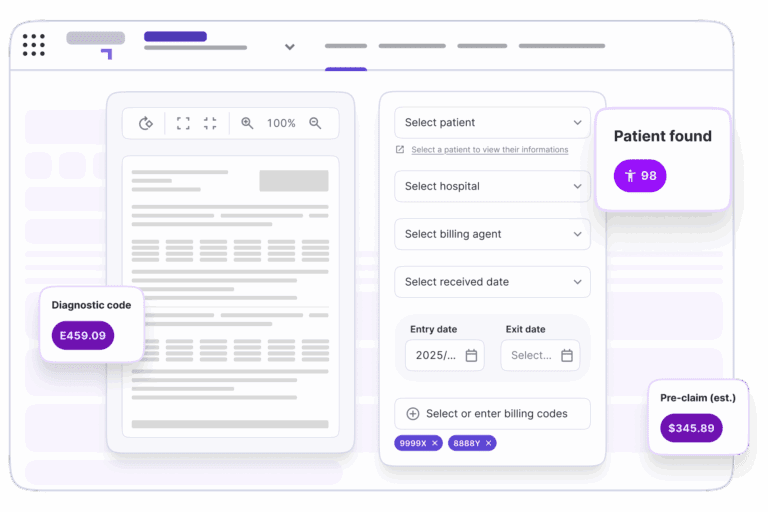
You can memorize every code and perform billing yourself… but you don’t have to.
Petal Medical Billing Ontario combines OHIP expertise, claim management, and reconciliation support for physicians and groups across more than 40 specialties.
- Our team will manage your billing to maximize the revenue from delivered care and decrease the burden of medical billing.
Take your practice further by removing billing burden and saving time for patients.
Discover simpler, more effective revenue management:
FAQs: OHIP billing codes for family physicians
What are the most common OHIP billing codes for family physicians?
Common codes include A001 for minor assessments, A007 for intermediate assessments, A003 for general assessments and A004 for general reassessments. Family physicians also use codes for counselling, chronic disease management, preventive care and virtual visits.
What’s the difference between A001 and A007?
A001 applies to minor assessments involving brief clinical evaluations or advice. A007 covers intermediate assessments requiring a more extensive history and examination. The appropriate code depends on the services performed and documented.
What OHIP codes can family physicians use for counselling?
Family physicians may use K013 and K033 for eligible individual counselling, K005 for primary mental health care and K007 for psychotherapy. Each code has specific clinical, documentation and time requirements.
What OHIP codes apply to diabetes management?
K030 covers eligible diabetic management assessments, while Q040 provides an incentive for qualifying ongoing diabetes management. Both require specific clinical activities and documentation, and Q040 has additional eligibility conditions.
Can family physicians bill multiple OHIP codes for one patient visit?
Sometimes. Whether multiple services can be claimed depends on the applicable Schedule of Benefits rules, including restrictions on billing combinations. Physicians should verify that each service meets its individual requirements.
How long do Ontario family physicians have to submit OHIP claims?
The standard OHIP submission period is three months from the date of service. Physicians should submit claims regularly to identify errors early and leave sufficient time for necessary corrections.