






Points clés à retenir
- Define fairness upfront: Agree on equity factors and measurable targets with your physician group.
- Automate where possible: Manual scheduling is time-consuming and error-prone—automated scheduling tools streamline fairness and save hours.
- Monitor and adjust: Use reporting and equity tracking to maintain balance across multiple scheduling periods.
Fair shift distribution isn’t just about keeping the peace—it’s about improving physician satisfaction, reducing burnout, and ensuring consistent patient care. Staffing shortages and rising patient volumes are unfortunately common, and workforce management strategies that prioritize equity are essential.
Without a clear process, inequities creep in—leading to frustration, fatigue, and even retention issues. Fortunately, with the right steps and tools, you can create schedules that feel fair and sustainable.
Below are seven practical steps to help you build equity into your scheduling process while leveraging automation for efficiency.
Step 1: Define what “fair” scheduling means for ynotre team
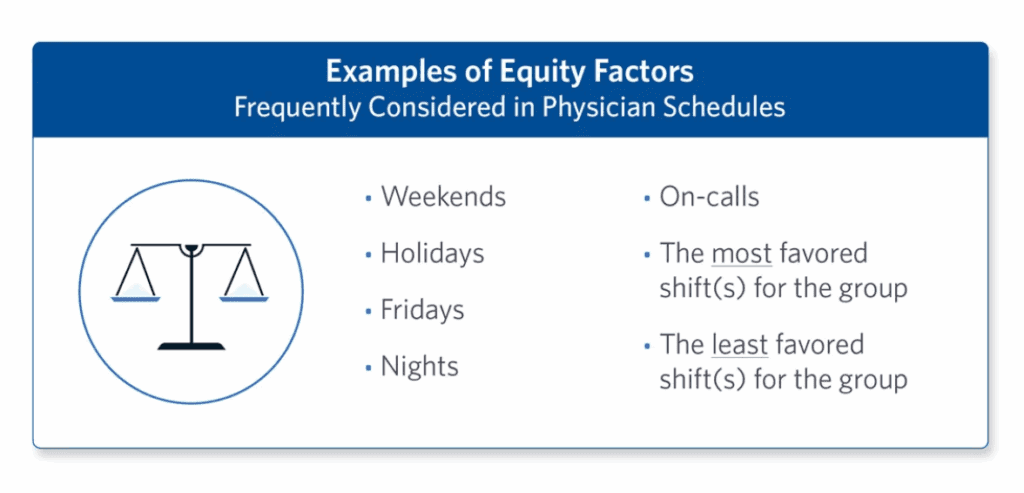
Fairness starts with clarity. Gather your physician group and identify equity factors. This includes the shifts or tasks that need balanced distribution. These often include:
- Time-based shifts: nights, weekends, holidays.
- Task-based shifts: on-call duties, procedures, or exams.
These factors usually involve the least desirable shifts, but they should reflect your team’s priorities. Document them so everyone understands what fairness looks like.
Step 2: Set measurable equity targets
Once equity factors are clear, set specific, measurable targets. There is no way to assess the success or impact of your scheduling efforts without defining targets or expectations.
For example:
- “Each physician covers at least two weekends every three months.”
Targets should be agreed upon collectively and serve as the foundation for your schedule. Without measurable goals, fairness becomes subjective and hard to enforce.
Step 3: Account for exceptions
Not every physician can follow the same rules. Part-time roles, specialties, hospital contracts, or personal preferences often require adjustments. Document these exceptions upfront to avoid conflicts later. For example:
- Dr. A prefers weekends.
- Dr. B works part-time and should have fewer night shifts.
These don’t need to be made into laundry lists of exceptions, but defining them first and then inputting them into your scheduling tool makes future schedule building much easier.
Step 4: Automate the process
Manual scheduling for large teams, such as hospital departments, is time-consuming and error prone. This is where automated scheduling solutions like Petal Health make the process streamlined. These platforms use built-in and established rules to apply fairness rules, saving hours of planning time and reducing mistakes.
Benefits of automation include:
- Equity enforcement: Targets and exceptions are applied consistently.
- Real-time monitoring: See fairness metrics as you build the schedule.
- Flexibility: Adjust priorities without starting from scratch.
Automated scheduling isn’t just about convenience. It’s at the heart of creating a sustainable, scalable scheduling process for modern healthcare workforce management. There’s no reason to continue using manual processes with Excel spreadsheets or handwritten calendars for adjustments.
Step 5: Balance equity over time
Consistency is key when building shift distribution that has fairness and equity at its core. It’s easy to create an initial schedule, but without established rules and definitions, holding onto that equity is hard. Use cumulative data to ensure equity holds over months or even years. For example, if holidays were uneven last quarter, adjust the next schedule accordingly.
This long-term view prevents recurring imbalances that erode trust in fairness being maintained in the long-term.
Step 6: Distribute shifts evenly within each period
Avoid front-loading undesirable shifts. If a physician needs 18 night shifts over three months, spread them evenly rather than clustering them. This approach reduces fatigue and improves morale. Studies show that clinician burnout has a direct impact on patient care and outcomes, making a balanced schedule important to everyone.
Step 7: Review and report
After publishing the schedule, generate a fairness report. This helps you:
- Confirm equity targets were met.
- Provide transparency to your team.
- Improve future schedules based on past performance.
Reports also support compliance and audit requirements, making them a critical part of workforce management. Laying out KPIs and reporting on them makes future improvements easier and more transparent for everyone involved.
Benefits of automated scheduling for workforce management
- Time savings: Reduce schedule creation time by up to 98%.
- Cost efficiency: Lower scheduling costs by replacing manual tools.
- Improved accuracy: Eliminate human error and ensure compliance.
Ready to simplify equitable scheduling?
Discover how Petal Health’s automated scheduling platform can help you enforce fairness, save hours of planning time, and optimize your workforce management strategy.
Frequently asked questions
Petal remplace-t-il nos outils de planification, de DSE ou de RH existants ?
No. Petal integrates with your existing systems and enhances their capabilities with real-time visibility and intelligent scheduling. This means you can improve fairness and efficiency without disrupting your current workflows.
Petal peut-il gérer la planification multi-sites et multi-départements ?
Absolutely. Petal is designed for large, complex organizations with region-wide workforce requirements. Whether you manage multiple hospitals or departments, Petal ensures fair shift distribution across all locations.
Petal est-il adapté aux appareils mobiles du personnel ?
Yes. The Petal mobile app gives physicians and staff on-the-go access to schedules, on-call information, and team communications—making it easier to manage shifts and stay connected.
Comment Petal soutient-il une planification équitable ?
Petal’s equity engine ensures fair shift distribution by applying agreed-upon rules, considering physician preferences, and avoiding bias. Automated scheduling helps maintain fairness consistently across multiple scheduling periods.
What kind of training and support are available?
We provide full onboarding, training sessions, and ongoing support tailored to your organization’s needs. Our goal is to make sure your team feels confident using Petal from day one.