







Key takeaways
- Most billing problems start long before a claim is submitted. Missing documentation during the patient encounter often leads to rejected claims, missed premiums, and preventable revenue loss.
- Documenting the service isn’t enough. Physicians also need to capture the circumstances surrounding care, including timing, location, complexity, and other details that support billing eligibility.
- The strongest billing workflows continue after the appointment ends. Regular claim review and reconciliation help physicians identify discrepancies and recover compensation they’ve earned.
Accurate medical billing starts with thorough clinical documentation. Canadian physicians should record essential patient information, assessments, treatments, procedures, and billing-specific details. Use a consistent medical billing documentation checklist to reduce your claim rejections and simplify payment reconciliation.
Every physician understands the importance of clinical documentation. It’s built into standard diagnostics and patient care.
Accurate records support care, continuity, quality improvement, and medicolegal protection. Documentation also is the foundation of medical billing.
When claims are rejected, reduced, or questioned, the issue is rarely the claim submission itself.
- More often, the problem traces back to the encounter. A required detail wasn’t recorded. A procedure wasn’t documented completely. A premium-eligible circumstance wasn’t captured in the chart.
Days or weeks later, the physician is left trying to reconstruct details from memory.
Here’s a practical documentation checklist organized around the full patient journey.
Before the appointment: Document the factors that determine billing eligibility
The standard thought around billing is that it only begins after the patient visit is complete.
By then, important information may already have been missed.
Some of the most common billing issues originate before care is delivered. The encounter type, referral status, service location, and planned intervention may all influence which billing rules apply.
Before the appointment, physicians should verify and document:
- Referral requirements, where applicable
- Consultation versus follow-up encounter type
- Virtual, telephone, or in-person visit status
- Time of day for potential after-hours rates
- Service location
- Planned procedures or interventions
- Program-specific eligibility requirements
- Information from previous related encounters
While these details may seem administrative, they often determine whether a service qualifies under specific billing rules.
Example: A specialist consultation and a specialist follow-up visit may involve similar clinical work, but different billing requirements.
- If the referral information supporting the consultation isn’t properly documented, the physician may spend time addressing billing questions later, despite having delivered appropriate care.
Key action: Think of the encounter eligibility as part of clinical preparation. A few moments spent confirming billing-impacting details before the visit often prevents significantly more administrative work afterward.
Wondering how shadow billing works?
During the appointment: Document not only the care provided, but how it was provided
A physician may deliver an entirely appropriate service, yet fail to document a detail necessary to support the claim.
When billing specialists investigate discrepancies, they frequently discover that the care occurred exactly as described. What is missing is the documentation connecting the care delivered to the service billed.
Core encounter documentation should include:
- Presenting concern
- Relevant history
- Assessment findings
- Clinical impression
- Medical decision-making
- Treatment provided
- Procedures performed
- Follow-up planning
But physicians should also capture the details that explain the scope and complexity of the encounter.
In practice: Imagine seeing three patients with the same diagnosis in a single afternoon.
The diagnosis may be identical, but the encounters aren’t.
One patient required extensive counselling and coordination with family members. Another required a straightforward assessment. A third required a procedure and significant follow-up planning.
From a billing perspective, those distinctions matter.
The chart should tell the complete story of what occurred during the visit, not simply the final diagnosis.
Tip: Document clinically significant details in real time whenever possible.
Don't document the service only. Document the circumstances around the service.
This is where many physicians unknowingly leave revenue on the table.
The primary billing code often reflects only one aspect of an encounter. Compensation may also depend on contextual factors that are easy to overlook when documentation is completed quickly or retrospectively.
This means routinely documenting:
- Time spent when services include time-based requirements
- Start and end times where applicable
- Procedure complexity
- Number of treatments or interventions performed
- Multiple services provided during a single encounter
- Counselling activities
- After-hours care
- Weekend or holiday services
- Location-specific circumstances
- Other premium-eligible conditions
These details often feel secondary during a busy clinic day. From a billing perspective, they aren’t. For example, in Ontario, emergency physicians saw important code changes in after-hours billing taking effect in August 2026. This makes time of day an important factor in logging the right code and getting paid what you’ve earned.
In practice: A physician performs an assessment and a procedure during the same visit.
Several days later, the physician remembers the procedure but can’t recall whether additional counselling occurred before or after treatment. Documentation contains sufficient clinical detail to justify patient care, but not enough information to support every service provided during the encounter.
After the appointment: Build documentation into your billing workflow
The strongest billing processes include documentation habits that support claim preparation, submission, and follow-up. The correct workflow makes the difference in ensuring documentation accuracy, timeliness of claims, and lowering the chances of claim rejection.
Here are some of the items to document and verify after each patient encounter:
- Final billing code selection
- Applicable modifiers and premiums
- Supporting diagnosis information where required
- Service date and timing details
- Submission status
- Corrections or adjustments made
- Rejected claim follow-up actions
This step is especially important because small documentation gaps become harder to resolve over time.
Tip: Review billing information while the encounter remains fresh in your mind. A five-minute review today is often more effective than a thirty-minute investigation several weeks later.
12,000+ physicians trust Petal to simplify their billing.
One of the most overlooked documentation habits: Payment reconciliation
Many physicians assume billing ends once a claim is submitted.
In reality, submission is only one milestone in the revenue cycle.
Claims may be processed differently than expected. They may be reduced, adjusted, returned, or require follow-up. Without reconciliation, physicians may never identify these discrepancies.
Documentation related to reconciliation should include:
- Submitted claims
- Payment reports
- Detected discrepancies
- Rejected claims
- Follow-up activities
- Corrections submitted
Example: A physician submits a claim expecting full payment.
Weeks later, the payment statement reflects a different outcome. Without a documented process for reviewing remittances and investigating discrepancies, the issue may go unnoticed until correction timelines become more difficult to manage.
Key action: Treat reconciliation as a documentation exercise, not simply an accounting exercise. The goal isn’t only to track payments. It’s to confirm that billed services resulted in the compensation expected
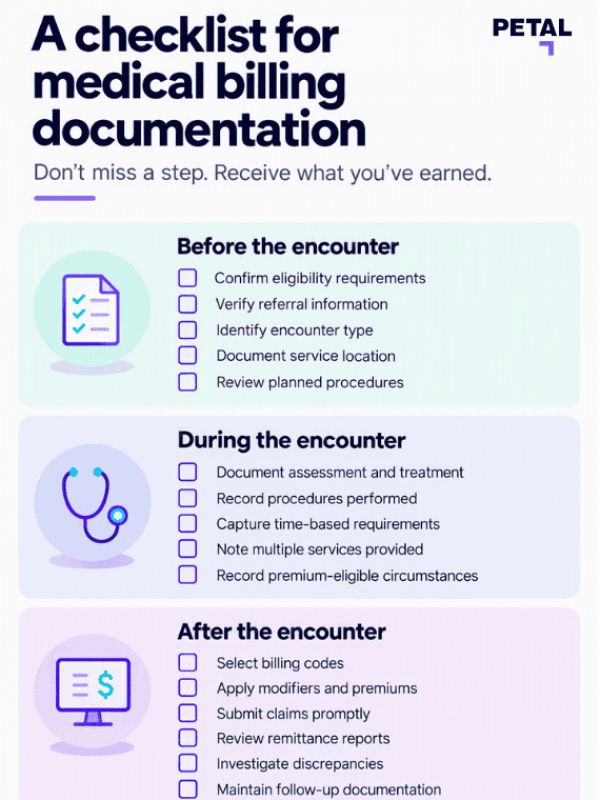
Medical billing documentation checklist
Before the encounter
- Confirm eligibility requirements
- Verify referral information
- Identify encounter type
- Document service location
- Review planned procedures
During the encounter
- Document assessment and treatment
- Record procedures performed
- Capture time-based requirements
- Note multiple services provided
- Record premium-eligible circumstances
After the encounter
- Select billing codes
- Apply modifiers and premiums
- Submit claims promptly
- Review remittance reports
- Investigate discrepancies
- Maintain follow-up documentation
Better documentation protects physician revenue
Physicians don’t lose revenue because they forgot to provide care.
They lose revenue because critical details weren’t captured when the care occurred.
At Petal Billing, we help physicians strengthen every stage of the billing process, from claim preparation and submission to reconciliation and payment review.
- By combining billing expertise with purpose-built technology, our clients gain greater confidence that eligible compensation is captured accurately and consistently.
We know your goal isn’t more paperwork.
Let’s ensure that the work you’ve already performed is documented clearly enough to support compensation earned.
Get paid for the care you provide, not just the care you remember documenting.
Connect with a Petal billing expert.
FAQs: Medical billing documentation for physicians
What documentation is required to support a medical billing claim?
Requirements vary by province and service type, but physicians should generally document the assessment, treatment provided, medical decision-making, procedures performed, and any details that support specific billing requirements.
Why are billing claims rejected when patient care was provided?
In many cases, the issue isn’t whether care occurred. The issue is whether the documentation adequately supports the claim being submitted.
Should physicians document modifiers separately?
Any circumstance that supports an additional billing modifier or premium should be documented clearly at the time of service to reduce the risk of missed compensation or future claim questions.
Why is documenting time important?
Certain services include time-based billing requirements. Without appropriate documentation, it may be difficult to support the claim if questions arise later.
What details are most commonly missed?
After-hours services, multiple services during one encounter, counselling activities, timing requirements, and premium-eligible circumstances are among the details physicians are most likely to overlook.
How often should physicians review remittance statements?
Reviewing payment reports each payment cycle helps identify discrepancies while correction opportunities remain available.
Can billing software help identify documentation gaps?
Many billing solutions include validation tools and workflows that help identify missing information before claim submission, reducing administrative rework and improving billing accuracy.