





Key takeaways
- Good billing habits start before you submit a claim. Most avoidable billing issues are caused by documentation, eligibility, or workflow gaps rather than incorrect fee codes.
- Small process improvements compound over time. Reviewing rejected claims, verifying patient information, and documenting services consistently can recover thousands of dollars annually.
- Billing optimization is about billing accurately and consistently. Long-term, you’ll earn more for the services you provide.
Ontario OHIP billing optimization refers to the habits and workflows that help physicians submit accurate claims while limiting administrative work. From verifying patient eligibility and documenting encounters to reviewing rejected claims and reconciling payments, small process improvements have a significant impact on your practice.
Few physicians receive extensive billing training during residency. Yet from the first day of independent practice, accurate billing becomes part of running an efficient, financially healthy medical practice.
- Did you know Ontario’s Health Insurance Plan (OHIP) includes hundreds of fee codes, numerous payment models, documentation requirements, and rules that continue to evolve?
And even experienced physicians occasionally miss billable services or submit claims that require correction.
The good news is that memorizing every fee code isn’t required. It comes down to building reliable habits that reduce administrative work while improving claim accuracy.
Whether you’re opening your first clinic, joining a family health organization, or beginning locum work, this checklist outlines practical steps that help physicians submit cleaner claims, avoid common mistakes, and spend less time dealing with billing issues later.
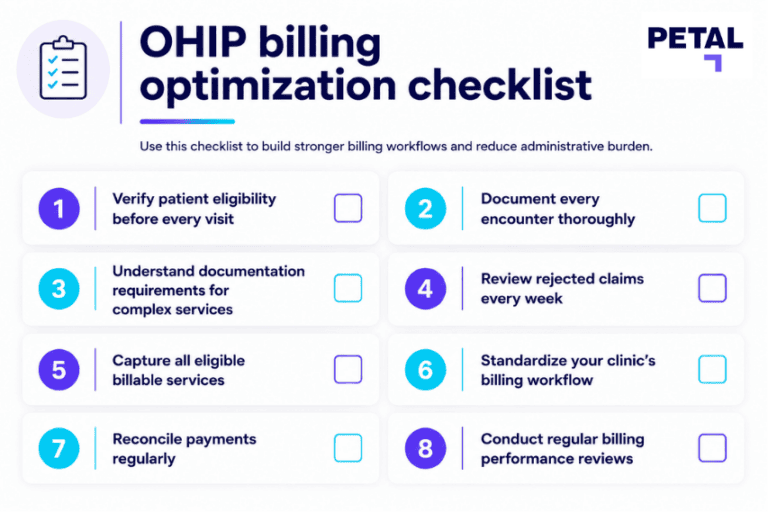
OHIP billing optimization checklist
Use the checklist below to accelerate your billing workflow!
Then, read on for key details into each step. With practice, you’ll save time and achieve otherwise missed earnings.
Verify patient eligibility before every visit
One of the simplest ways to avoid rejected claims is confirming that patient information is current before care begins.
It’s as easy as having reception staff verify:
- OHIP health card validity
- Correct version code
- Date of birth
- Demographic information
- Insurance eligibility when applicable
Even minor discrepancies delay payment and create unnecessary follow-up work. It’s about limiting the number of simple errors right up front.
Example: A family physician sees 25 patients a day. Two health cards contain outdated version codes. Catching these before the visit prevents rejected claims and saves staff from resubmitting corrections later. Depending on billing operations support internally or through a trusted billing partner, these resubmissions often go unattended.
Ontario physicians using Petal gained $36,570 more annually on average compared to manual billing.
Document while the encounter is fresh
Strong documentation protects both your clinical record and your billing.
Rather than documenting hours later, record important billing details immediately after each patient encounter, including:
- Reason for visit
- Assessment performed
- Clinical decision-making
- Procedures completed
- Time-based services where applicable
- Required supporting documentation
The more complete your chart, the easier it becomes to support the billed services if questions arise later. This level of upfront documentation makes any potential OHIP audit or resubmission easy and simple.
Understand which services require additional documentation
Certain OHIP services involve more detailed requirements than a routine office visit.
Examples include:
- Counselling services
- Chronic disease management
- Procedures
- Hospital-based services
- Virtual care
- Consultations
- Time-dependent assessments
Before routinely billing these services, review current Ministry of Health Schedule of Benefits requirements to ensure documentation supports payment.
Example: A physician completes a 20-minute video follow-up with an established patient. Without documenting that the service was delivered virtually and recording the required encounter details, the chart may not fully support the submitted claim if questions arise later.
Review rejected claims weekly
Rejected claims have the advantage of revealing systemic workflow problems rather than isolated mistakes.
Instead of simply correcting and resubmitting, look for patterns such as:
- Missing referral information
- Invalid patient identifiers
- Incorrect service locations
- Incomplete documentation
- Ineligible combinations of services
A brief weekly review helps prevent the same issue from occurring dozens of times.
It’s vital to do this work regularly. OHIP enforces a 3-month submission window from the service date. While previously rejected claims submitted within that window can be corrected later, doing so after three months requires specialized manual resubmissions. Plus, you aren’t going to be paid until the rejection is amended.
Don't overlook small billable services
Many physicians naturally focus on larger procedures or consultations while unintentionally overlooking smaller services completed throughout the week.
Examples might include:
- Minor procedures
- Medical forms where appropriate
- Telephone or virtual services (when eligible)
- Care conferences
- Specific counselling encounters
Individually these may seem insignificant.
Over the course of a year, however, consistently capturing legitimate billable work can have a meaningful impact on practice revenue.
Standardize billing workflows across your clinic
If multiple physicians or administrative staff participate in billing, consistency matters.
Develop simple internal checklists covering:
- Daily claim submission
- Required documentation
- Error review
- Outstanding claim follow-up
- Monthly reconciliation
Standardized processes reduce variation and make onboarding new staff significantly easier.
Reconcile payments regularly
Submitting claims is only one part of the billing cycle.
Physicians should routinely compare:
- Submitted claims
- Payments received
- Adjustments
- Rejections
- Outstanding claims
Without regular reconciliation, payment issues may go unnoticed for weeks or months.
Many modern billing platforms automate much of this process, making discrepancies easier to identify.
Learn the common billing rules in your specialty
Each specialty develops its own billing patterns.
For example:
Family Medicine
- Preventive care
- Chronic disease management
- Office visits
- Minor procedures
Internal Medicine
- Consultations
- Follow-up assessments
- Hospital care
Psychiatry
- Psychotherapy
- Consultations
- Collaborative care
- Virtual services
General Surgery
- Procedures
- Assistant surgeon rules
- Post-operative visits
Standardized processes reduce variation and make onboarding new staff significantly easier.
Audit yourself every few months
Even experienced physicians benefit from reviewing their own billing.
Ask questions such as:
- Which claims are most frequently rejected?
- Are certain services consistently underused?
- Is documentation supporting billed services?
- Are claims submitted promptly?
- Has billing volume changed unexpectedly?
A simple quarterly review often identifies opportunities to improve both efficiency and accuracy.
Discover what not to do:
Real-world example: Small changes, big results
Imagine a physician seeing approximately 28 patients per day.
After reviewing three months of billing activity, several issues emerge:
- Health card validation isn’t performed consistently.
- Documentation for counselling visits varies between encounters.
- Rejected claims are corrected individually but never analyzed collectively.
- Payment reconciliation occurs only once every several months.
None of these issues involve intentional underbilling or incorrect coding.
Instead, they reflect common workflow gaps.
By introducing a simple billing checklist, assigning weekly rejection reviews, standardizing documentation templates, and reconciling payments monthly, the clinic reduces administrative workload while improving overall claim accuracy.
In turn, physicians are appropriately paid for medically necessary services already delivered.
Billing optimization is really workflow optimization
Many physicians think of billing as a financial task.
In reality, it’s an operational one. The result of good operations is time back in your pocket and peace of mind, just as much as cashflow.
Practices with consistent documentation, organized administrative workflows, and regular payment reviews typically experience:
- Fewer rejected claims
- Less time spent correcting errors
- Better financial visibility
- Faster payment cycles
- Lower administrative burden
The earlier these habits become routine, the easier it is to scale your practice as patient volumes grow.
Earn more from your OHIP billing
Ontario’s billing system can feel overwhelming when you’re first entering practice, but most billing success comes from consistency.
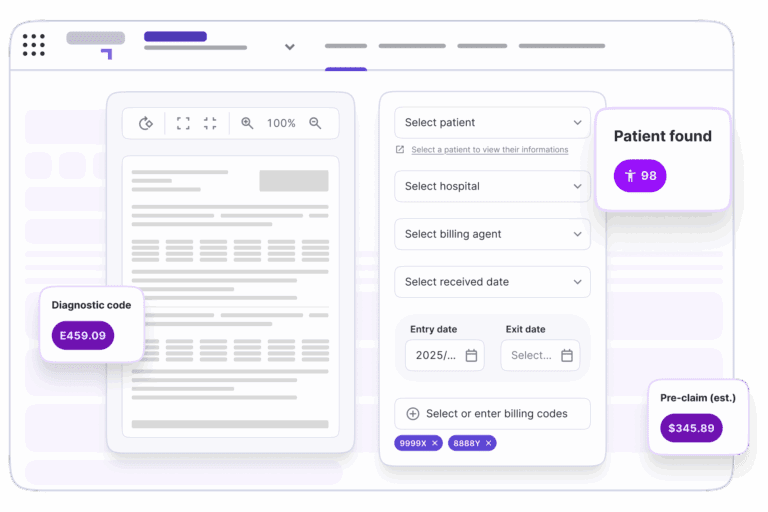
Petal Billing Ontario’s expert team helps you verify patient information, manage rejected claims, reconcile payments, and more.
- With 20+ years of OHIP expertise, we understand how medical billing drives compounding advantages.
Whether you manage billing yourself or work with dedicated billing professionals, building a reliable workflow helps ensure you’re paid appropriately for the care you provide while allowing you to spend more time where it matters most: with your patients.
Contact with a Petal billing expert to simplify OHIP billing today.
Wherever you’re billing, make sure it’s done right:
FAQs: OHIP medical billing
What is the biggest billing mistake new Ontario physicians make?
One of the most common mistakes is inconsistent documentation. Even when the correct fee code is selected, insufficient supporting documentation can result in payment issues or difficulties during an audit.
How often should physicians review rejected OHIP claims?
A weekly review is generally recommended. Looking for recurring rejection patterns helps prevent repeated errors and improves billing efficiency over time.
Should I submit OHIP claims every day?
Many practices submit claims daily or several times per week. Regular submissions improve cash flow, identify issues sooner, and reduce administrative backlog.
How often does OHIP update billing rules?
The Ministry of Health periodically updates the Schedule of Benefits and billing policies. Physicians should routinely review official updates and communications from professional organizations such as the Ontario Medical Association.
Can billing software help improve OHIP billing accuracy?
Modern physician billing software can automate claim validation, flag missing information, simplify reconciliation, and provide greater visibility into rejected or outstanding claims. While software supports more efficient workflows, physicians remain responsible for ensuring claims accurately reflect the services provided and comply with OHIP requirements.
Is it worth working with a medical billing service?
It depends on your practice. Some physicians prefer managing billing internally with software, while others choose professional billing services to reduce administrative workload, improve claim follow-up, and navigate complex billing scenarios. Many practices benefit from combining both technology and expert billing support.