








Points clés à retenir
- Small inefficiencies lead to structural instability. You’ll unlock a world of opportunity by grounding operations in strategic, systematic decisions made today.
- The Clinic Efficiency Audit solves through signals. Identify what’s not working, prioritize, and then build processes that support clinic-wide gains.
- Evolving operations requires ongoing improvement. Auditing isn’t a one-off solution—it’s a tool to be used regularly and objectively to protect your progress.
Your clinic is likely losing time and revenue. But how do you know for sure? And where are the leaks?
Finding the sources of this loss is critical to your patients and team, because your operational effectiveness relies on it.
The risks of unsustainable clinic operations are well established in Canada: 39% of adults are unsatisfied with wait times for primary care appointments; 5.9 million adults lack primary care access; and 20% of Canadians have ended up in hospital while waiting for primary care.
Combining these outcomes with Canada’s deficit of 22,823 family physicians and only approximately 1,300 new graduates per year, it’s clear the country needs more from existing clinic capacity.
This playbook is for physician leaders who see their clinical operations running less than perfect. There’s always room for improvement, and here’s how.
Follow the steps below to 1) understand the impacts of today’s loss 2) audit your operation effectively 3) prioritize accordingly 4) build future-proof scheduling and billing processes and 5) renew these processes for continued success despite evolving conditions.
Step 1: Recognize the downstream impacts of loss
The immediate impacts of lost time and revenue are known to physicians.
But from lost billable opportunities to delayed cash flow and increased admin workload, the downstream impacts of inefficient systems are harder to see or measure.
Here are four downstream impacts that clinicians will feel—if they aren’t already:
Physician burnout: Care faces a negative feedback loop when burnt-out providers decrease their hours or leave the profession. Today, 46% of Canadian physicians report high levels of burnout and more than half of doctors plan to cut their hours. This leaves patients waiting longer for care or going to emergency departments where capacity is already limited.
Revenue unpredictability: Industry benchmarks suggest that 7–9% of medical billing submissions are rejected on first pass. For physician groups, this translates into hundreds of hours spent reviewing, correcting, and resubmitting claims. This work often comes weeks after care delivery.
Reduced clinic capacity: Hours spent on administrative burden, such as manual scheduling or rejected billing claim resubmission, drain clinician energy and restrict opportunities for professional or personal growth. In Canada, 75% of physicians report unnecessary administrative tasks worsening job satisfaction.
Poor patient access: Clinicians overburdened with inefficiency systems can’t see their optimal number of patients, worsening care outcomes for many seeking treatment. This is especially problematic given that 70% of Canadians already worry they won’t be able to get good quality medical care if they or a family member need it.
These downstream impacts are not inevitable! You’ll halt negative consequences or current loss through analysis and action.
Key takeaway: Small inefficiencies compound into structural instability.
CHUM saves 1,100+ scheduling hours per year using Petal Workforce.
Step 2: Implement an Efficiency Audit Framework
To identify where and how your clinic is losing time and revenue, deploy an Efficiency Audit Framework.
It’s a signal-based framework as opposed to an audit spanning your entire workflow. These signals will help ground your findings in action and improve your likelihood of pulling tangible insights to improve your operations.
Imagine this as a lightweight, deployable tool that is dropped onto the organization now and later. It’s designed to surface high-impact leaks quickly. It’s here to make prioritization easier.
Audit structure: Signal-based framework
Start by reviewing recent clinic activity with your team. Look for patterns across four core signals:
- Timeliness: How quickly are visits turned into submitted billing claims?
- Accuracy: How often do billing claims require correction or resubmission? Where do errors originate?
- Utilization: Are clinic schedules consistently filled and balanced? Where are gaps occurring?
- Intervention: Where are staff stepping in manually to chase billing information, or adjust schedules?
Identify these signals through team discussions, qualitative reflection, and simple observation. Additionally, if you have recorded data on billing management or schedule creation, feed non-sensitive information into an LLM of your choosing and use its findings to compliment your initial signal identification.
Remember: The goal is to find patterns. This shouldn’t look like a report.
These signals create a shared understanding of where your system is underperforming and make it easier to decide what to fix first. It also provides evidence to help you justify your strategic pursuits to colleagues or explain changes to patients.
Key takeaway: A small set of observable signals is enough to reveal where time and revenue are being lost.
Step 3: Interpret results and prioritize
After completing your audit, the next step is prioritization.
Most clinics will uncover multiple issues. Delayed submissions, recurring billing corrections, uneven schedules, and manual workarounds will appear concurrently. These are common, but not something to ignore.
Changing everything overnight is daunting, so choose a small number of high-impact priorities.
Use three criteria for evaluating each issue you’ve identified:
- Frequency: How often does this issue occur?
- Impact: Does it affect revenue, time, or both?
- Effort to fix: Can this be improved quickly with process changes?
Patterns that occur frequently and delay revenue or require repeated effort should rise to the top. Typically, clinicians see these patterns in billing accuracy, documentation completeness, and scheduling consistency.
Next, group issues together. For example, repeated billing corrections and delayed submissions may both stem from gaps in documentation or unclear workflows. Your goal should be to treat these issues at the source; we’re stopping leaks, not mopping water.
Then, anchor your priorities in outcomes. Abstract aims will lead to misguided—if well-intentioned—execution. As examples:
- Reduce time from visit to submission
- Decrease claim rework
- Improve schedule utilization
- Reduce manual interventions
These targets provide direction and make progress measurable over time.
Finally, assign ownership. Each priority should have a clear lead responsible for implementing and monitoring changes. You’ll know who to contact if things go wrong and celebrate when things to right.
Key takeaway: Your priorities are the foundation of system transformation. Select a small number of high-impact issues to improve performance quickly and build momentum.
Clinicians increase revenue by an average of 9.4% using Petal Billing.
Step 4: Build processes that prevent leakage
Now that your priorities are clear, it’s time to introduce tangible, actionable systems to take your clinic from reactive to proactive.
Here are three places to start:
First-pass billing systems
Billing setbacks are avoided through a compliant first-pass acceptance medical billing process tailored to your clinic’s and your patients’ needs. After aligning team members with a comprehensive billing structure, you’ll find greater productivity.
Here are five steps to launch:
- Build billing accuracy into patient intake: Deploy a single, connected process for documentation with eligibility checks and billing logic as its foundation.
- Use automation to simplify operations: Deploy advanced tools to reduce variability and human error toward freeing time and energy for patient care.
- Follow a timeline to standardize workflows: Start by submitting encounter data daily to reduce backlog and prevent missing details from causing friction later.
- Monitor performance to identify areas for improvement: Clinics that reduce rejections treat billing performance like other operational metrics: monitored, measured, and refined.
- Manage rejections when they occur: Rejections often stem from payer-side errors, documentation requirements, or edge-case rule interpretations. What matters is responding quickly.
Structured scheduling systems
Manual scheduling through Excel spreadsheets, email chains, text messages, and phone calls introduces time-losing friction.
A structured scheduling system brings consistency and visibility to how clinical time is allocated. Your schedules should be built with both patient demand and provider capacity in mind to stand the test of time.
- Start by standardizing how schedules are created by defining rules for coverage, availability, and shift distribution.
- Align scheduling with visit types and documentation requirements
- Reduce last-minute changes by improving forecast accuracy
With a structured approach, gaps and overloads become visible earlier. This allows teams to adjust proactively instead of reacting to daily disruptions. Over time, consistent scheduling improves clinic flow, supports better documentation, and reduces the likelihood of downstream billing issues.
Automation layer
In most clinics, inefficiencies appear where staff need to intervene.
From correcting claims to updating schedules and chasing missing information, human intervention slows operations. Automate where possible. This isn’t about removing humans from your workflow but rather letting teammates focus on rewarding work: improving care programs, connecting with patients, improving team performance, and supporting colleagues.
Think of an effective automation layer as a quiet system sitting between each step of your clinic’s operations. It soothes friction by:
- Validating information at intake to prevent downstream errors.
- Supporting real-time billing checks to reduce rework.
- Enabling dynamic scheduling adjustments based on availability and demand.
- Reducing the need for follow-ups by ensuring information is complete upfront
Automation should simplify workflows. It should reduce cognitive load on clinicians and staff while improving system-wide consistency. As manual intervention decreases, teams spend less time fixing issues and more time delivering care.
Key takeaway: Don’t assume loss. Strategic scheduling and billing decisions today will improve financial hygiene throughout your organization.
Step 5: Re-audit (now and forever)
Your operation is an organic entity. Audit regularly to see how it’s growing.
As patient demand shifts, new staff join the team, and billing requirements evolve, inefficiencies will surface. Without a way to regularly assess performance, your well-designed system will become ineffective.
Maintaining momentum requires flexibility. A simple, consistent signal review cadence performed monthly paired with a full audit performed bi-annually will illustrate signals that suggest action. This rhythm keeps performance visible and ensures that small issues are addressed before they grow into larger problems. Over time, this creates a natural cycle of improvement.
Re-auditing also strengthens accountability. Performance remains part of regular conversations, and improvements become embedded in day-to-day operations. Teams gain clarity on what is working, what needs adjustment, and where to focus next.
Clinics that adopt this approach are better equipped to adapt. They sustain financial performance and support both providers and patients over the long term. Make sure your clinic is among them!
Key takeaway: The Efficiency Audit Framework isn’t a one-time fix. Use it at least every six months to maintain your clinic’s performance and identify fresh areas for improvement.
Use smarter tools to save you trouble
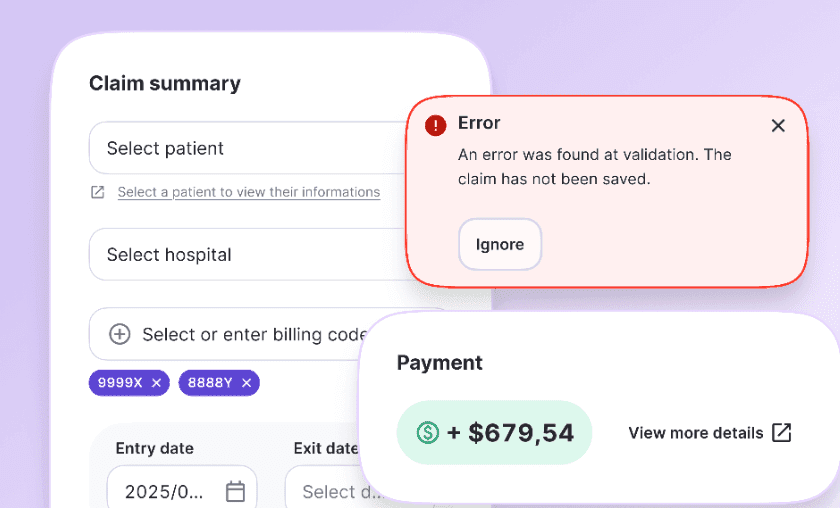
After you audit, choose the right scheduling and billing tools to leave your losses in the past.
Gestion des effectifs is proven to save time by simplifying workforce operations. Build and publish optimized schedules in minutes while reducing manual errors and administrative overhead.
Proof: CHUM reduced scheduling time by 98% using Petal.
Facturation médicale automates billing processes using tools designed for unique billing rules across Canada. Live agents are ready and based in your province. You’ll access stable, predictable revenue through end-to-end claim management.
Proof: Our independent study found physicians using Petal Billing reported an annual average of 161 hours saved and 9.4% more revenue or $24,123 per year.
Seize your clinic’s full potential. Contact a Petal expert today to get more from your efforts.