






Key takeaways
- Clinicians face annual losses of 7% or more of their total billings due to rejected claims. This equates to thousands of dollars of missed earned revenue.
- Billing code errors drive rejected claims. Premium codes, given their financial value, have an especially negative influence on revenue when missed.
- Most claim rejections are preventable. Effective structures and tools, such as standardized workflows, real-time validation, and expert support, improve first-pass claim acceptance.
Clinicians miss earned revenue due to rejected claims every day. Most rejections are easily avoidable.
Medical billing processes should bridge physicians’ hard work with revenue growth. Instead, clinicians miss thousands of dollars of earned revenue annually due to billing code errors, missing patient information, diagnosis-procedure mismatch, and more.
Read on for common reasons underlying rejected claims in Canada and tips to submit more successful claims.
Billing codes lead to lost revenue
A 2019 study examined how accurately physicians bill in Canada. The study asked 17 staff physicians and 16 residents to assess what they would bill for 10 different case scenarios. The researchers then compared what physicians would have billed with the correct billing codes. The results were stark: physicians are missing a significant portion of their billings.
The study notes that these potential billing losses represent “a revenue loss that would be catastrophic to any small business.” So, what are physicians missing?
The study found residents achieved only 82.3% of eligible billings. This may be unsurprising, because residents are new to billing. But staff physicians achieved only 93.1% of eligible billings. This means physicians were missing almost 7% of their eligible income.
- These losses represent a major financial impact to physicians. For example, the average internal medicine physician in Alberta earns $521,610, meaning their losses could be $35,000+ per year.
Most lost billings are due to missed codes or incorrect codes. Among missed codes, premium codes (in provinces where utilized) account for most of the losses. These may include:
- Admission codes
- After hours codes
- Procedure codes
- Travel codes
It’s advantageous to spend time identifying premium codes in your province and reviewing carefully before submitting.
Note: The above study only examined billing scenarios related to provincial insurance plans. Billing errors and omissions with other payers, including workers’ compensation boards, specialty billings, and private claims, are often much higher.
12,000+ providers and clinics trust Petal to simplify their billing.
Missing patient information and diagnosis-procedure mismatch
Incomplete patient data and diagnosis–procedure mismatch are two common, and preventable, reasons for claim rejections.
Missing or inaccurate patient information stops claims before they’re assessed. Errors like invalid or expired health card numbers, missing version codes, incorrect dates of birth, or name mismatches with provincial records prevent payers from confirming patient eligibility.
- These issues are especially common in high-volume clinics, walk-in clinics, and other settings where patient details are entered manually or inconsistently.
Diagnosis–procedure mismatch is another frequent rejection trigger. Fee codes may require a compatible diagnostic code to demonstrate medical necessity. The claim is rejected when the diagnosis submitted does not justify the service billed (or when the diagnostic code is missing, outdated, or invalid).
This typically occurs if clinicians rely on memory instead of fee schedule logic, documentation is incomplete, or diagnosis and billing workflows are disconnected.
CHUM reduced scheduling time by 98% using Petal Workforce Management.
Tips for submitting successful claims
You don’t need to become a billing expert to improve your claim success rate. Clear processes, consistent data, the right tools, and expert billing support will position your team for long-term billing success.
Here are eight tips for getting started today:
- Verify patient eligibility at each visit: Confirm health card number, version code, and coverage status on the date of service.
- Standardize patient intake: Use consistent workflows and templates to capture information accurately.
- Document clearly and regularly: Clinical notes support the service billed, so add time, complexity, and medical necessity as required.
- Match diagnosis codes to procedures billed: Confirm that your diagnostic codes align with fee schedule requirements.
- Stay updated on current fee codes: Provincial fee schedules change often across specialties! Use your province’s web bulletins to stay informed.
- Respect frequency and timing limits: Check daily, weekly, and annual caps, as well as minimum time thresholds, for time-based services.
- Track claim status and rejections consistently
Follow your claims through submission, adjudication, and payment to catch issues and resubmit when necessary. - Leverage automation and expert support
Use an automated billing solution with built-in validation and access to billing experts to reduce manual errors and administrative burden.
Trust a proven billing solution: Fewer rejections, more revenue
Petal is here to ensure you’re paid what you deserve. Petal Billing features robust tools— and live support agents—to fulfill your unique billing needs.
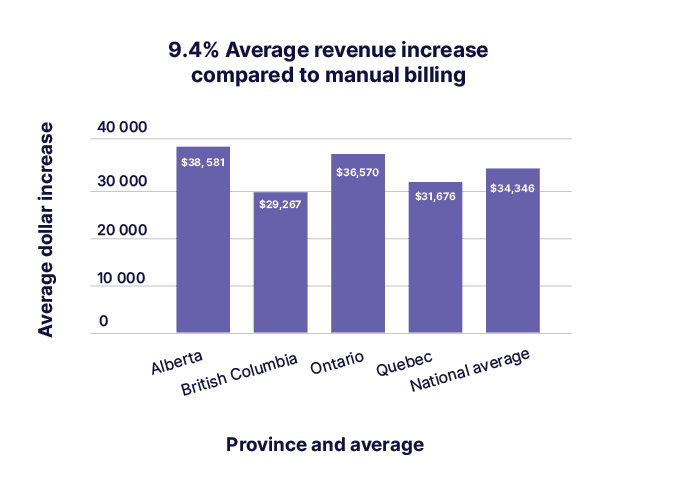
Proof of impact: Our recent independent study found physicians using Petal Billing reported an average revenue increase of 9.4% compared to manual billing.
Petal combines automation, personalized support, and end-to-end claim management to eliminate the friction that slows clinics down. You’ll receive faster, more intuitive billing workflows to support short- and long-term success.
Gain confidence knowing every claim is complete, compliant, and optimized before submission. Talk to a Petal expert to get started today.