






Key takeaways
- Psychiatry billing follows the encounter. Consultations, psychotherapy, medication reviews, collateral interviews, case conferences, and virtual visits can each require a different billing approach.
- Time-based codes need defensible documentation. Start and stop times, service details, participants, and chart notes must clearly support the duration claimed.
- Missed billing often happens outside the standard patient visit. Collateral calls, family interviews, care conferences, and complex follow-up work may be billable when the right criteria and documentation are in place.
Depending on the encounter, psychiatrists may bill consultations, psychotherapy sessions, medication management visits, virtual appointments, collateral interviews, or multidisciplinary case conferences. Each service has unique billing requirements based on documentation standards and provincial rules.
Psychiatry is one of the clearest examples of why medical billing requires a more than “submitting a code.”
That matters because provincial systems are not interchangeable. British Columbia’s MSP Payment Schedule, Ontario’s OHIP Schedule of Benefits, Alberta’s AHCIP Schedule of Medical Benefits framework, and Quebec’s RAMQ environment all organize psychiatry billing differently.
The result is clear: Psychiatrists need a workflow that reflects how they practice. Generic billing checklists won’t suffice as their unique needs require a unique approach.
1. The correct code depends on the service
Psychiatry billing starts with the clinical purpose of the encounter. Was it a formal consultation? A repeat consultation? A treatment visit? Psychotherapy? A collateral interview? A patient management conference?
In BC, MSP’s Psychiatry section lists specific referred-case items such as 00610 for an individual full consultation, including diagnostic interview or examination, history, mental status exam, treatment recommendation, and written report.
It also lists continuing care and psychiatric treatment items such as 00630, 00631, and 00632 for individual treatment by 30, 45, or 60 minutes, with start and end times required in the claim and chart.
This structure is not universal across Canada.
In Ontario, the OHIP Schedule of Benefits sets the fees and payment requirements for insured physician services, and psychiatry-specific billing guides commonly identify consultation codes, such as A195 for consultation, A395 for limited consultation, A196 for repeat consultation, and A190 for special psychiatric consultation with a minimum direct-contact time requirement.
Billing tip: Build code selection around the service type first, then confirm referral status, patient age, location, time, and documentation requirements.
These controls help demonstrate that a vendor has established processes to protect data while supporting reliable system performance.
56,000+ providers and administrators trust Petal to simplify their billing.
2. Time-based billing requires clean time capture
Psychiatry relies heavily on time-based work. Whether it’s a 15-minute evaluation or a full psychotherapy session, time matters. That creates revenue opportunities but also audit risks when start and stop times are missing or when the chart doesn’t support the time claimed.
Alberta’s Fee Navigator lists 08.19G for direct contact with an individual patient for psychiatric treatment, including medical psychotherapy, medication prescription, reassessment, patient education, or psychiatric counselling, billed per 15 minutes or major portion. Its billing tips specify that only face-to-face time is counted, not charting or other management time.
For more complex Alberta psychiatry cases, 08.19GB applies to direct contact with a complex patient, but the patient must meet defined GAF or CGAS criteria, and the score must be identified in the chart at least once every six months.
Billing tip: A psychiatry note should make the time claim easy to defend. Record start time, stop time, service focus, who was present, diagnosis or working diagnosis, treatment provided, and plan.
3. Virtual psychiatry and collateral care can be billable, but not automatic
Virtual psychiatry has firmly become a mainstay, but billing rules still vary widely.
BC MSP lists dedicated telehealth psychiatry items, including 60610 for telehealth individual full consultation and 60630, 60631, and 60632 for individual telehealth psychiatric treatment by 30, 45, or 60 minutes. MSP also requires start and end times for individual telehealth psychiatric treatment.
Alberta’s 08.19CV covers telephone or secure videoconference with a patient for psychiatric treatment, psychiatric reassessment, patient education, or psychiatric counselling. The patient record must include a detailed summary, time spent, and start and stop times, and administrative time can’t be claimed.
Collateral and team-based work also need careful handling. In BC, 60624 covers telehealth clinical evaluation or interview of a family member, close acquaintance, or knowledgeable professional involved in the patient’s care, while 60645 covers a telehealth patient management conference with third parties, subject to documentation requirements.
- Note: Alberta also lists 08.19F for formal scheduled professional conferences related to a psychiatric patient’s care, with Fee Navigator noting that this team conference may be claimed by telephone or secure videoconference.
Billing tip: Don’t treat every phone call as billable. This isn’t to say you should underbill, but it’s important to confirm whether the code allows virtual care, who must participate, whether the patient must have been seen recently, and whether the chart identifies participants and timing.
Clinicians save 3.1 hours per week using Petal Billing.
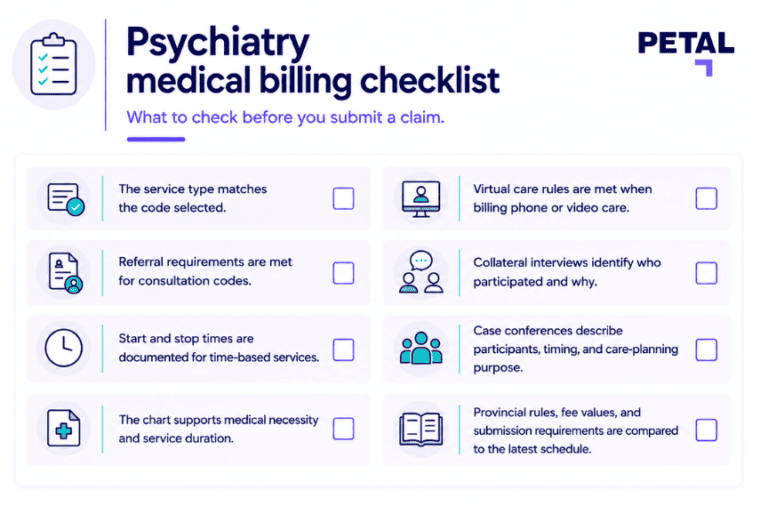
Psychiatrist billing checklist
Before submitting a psychiatry claim, confirm your information is complete using this checklist:
Common psychiatry billing mistakes
The highest-risk errors usually happen when psychiatrists under-document time, bill a visit when a consultation code was more appropriate, miss eligible collateral or case conference work, or use an in-person habit for a virtual service.
Another common issue is underbilling complex care.
For example, a psychiatrist may spend significant time coordinating with family, social workers, schools, or inpatient teams, but fail to document the participants, purpose, and timing needed to support a billable conference or collateral interview.
Make your psychiatry billing more efficient
Psychiatry billing is detailed because psychiatry care is detailed. The work often extends beyond a standard patient visit into psychotherapy, medication management, family interviews, case conferences, virtual care, and complex longitudinal treatment.
For psychiatry practices, the opportunity is not only to submit claims faster. It is to build a billing workflow that captures the full scope of care, prompts the right documentation, and reduces avoidable rejections.
Explore how Petal billing experts help psychiatrists improve claim accuracy, reduce administrative rework, and get paid for the care they provide.
Have confidence in your security infrastructure:
FAQs: Psychiatry billing in Canada
What should psychiatrists document for time-based billing?
Psychiatrists should document start time, stop time, service type, clinical purpose, who was present, treatment provided, and the plan. Some provincial codes explicitly require start and stop times.
Can psychiatrists bill for virtual care?
Yes, but the rules vary by province. BC and Alberta both list psychiatry-specific virtual or telehealth items, but each code has its own documentation and same-day billing rules.
Why do psychiatrists need specialized billing support?
Psychiatry billing includes consultations, psychotherapy, virtual care, collateral interviews, team conferences, and complex patient rules. A specialized workflow helps prevent missed revenue and unsupported claims.
What is the difference between a psychiatry consultation and psychotherapy billing?
A consultation typically involves assessment, diagnosis, and treatment recommendations, while psychotherapy billing relates to therapeutic interventions delivered over a defined period.
Can psychiatrists bill for family meetings?
In some provinces, psychiatrists may bill for collateral interviews or family meetings when specific billing criteria and documentation requirements are met.
Can psychiatrists bill for case conferences?
Many provincial billing schedules include billable conference or care-planning services when participation, purpose, and timing are properly documented.