






Points clés à retenir
- Early billing preparation saves headaches and time: Completing registration and establishing billing workflows supports a smoother transition into independent practice.
- Billing code knowledge protects physician revenue: Understanding eligible services, modifiers, and provincial requirements reduces the risk of underbilling.
- Compensation models shape how you get paid: Whether you choose fee-for-service, salaried, or blended, each arrangement carries different admin requirements and earning considerations.
Before getting paid, new physicians in Canada must register with their provincial health insurance plan, understand applicable billing codes, choose a compensation model, and establish reliable claim submission habits. Getting these fundamentals right prevents avoidable delays and protects earnings.
Medical residents in Canada have important questions about billing and compensation ahead of independent practice.
Yet medical billing receives relatively little attention during clinical training.
Through recent webinars and conversations with residents across Canada, our medical billing experts have heard firsthand which questions are top of mind for tomorrow’s physicians.
We’ve answered 10 common questions to guide your transition into practice, whether you’re in British Columbia, Alberta, Ontario, or Quebec.
- What do I need to set up before I can start billing as a physician?
- How does medical billing actually work, from seeing a patient to getting paid?
- How do I know which medical billing codes to use?
- Can I bill multiple services for the same patient on the same day?
- What’s the difference between fee-for-service, salary, and blended remuneration?
- Can I earn more for working evenings, weekends, or in rural areas?
- How much documentation do I need to support my billing claims?
- How long do I have to submit medical billing claims?
- What happens if my medical billing claim is rejected or paid incorrectly?
- Should I manage my own medical billing or use a billing service?
1. What do I need to set up before I can start billing?
Before submitting your first claim, you’ll need a licence to practice medicine and registration with your provincial health insurance plan.
These are separate requirements, and completing one doesn’t automatically complete the other.
Here’s where you’ll start:
- British Columbia: Register with the College of Physicians and Surgeons of British Columbia (CPSBC) and enroll with MSP.
- Alberta: Obtain your College of Physicians & Surgeons of Alberta (CPSA) practice permit and Alberta Health Practitioner ID (Prac ID).
- Ontario: Register with the College of Physicians and Surgeons of Ontario (CPSO) and obtain your OHIP billing number.
- Quebec: Register with the Collège des médecins du Québec (CMQ) and complete your RAMQ registration.
You’ll also need to confirm your banking information, professional liability coverage, and preferred billing methods.
Tip: Start these steps before your first day of independent practice to avoid delayed payment.
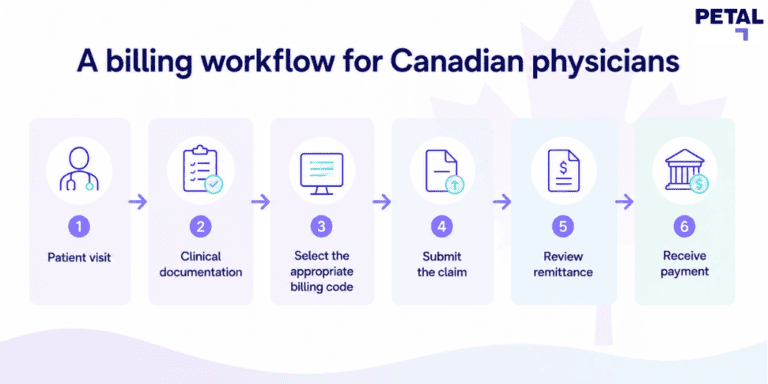
2. How does medical billing work, from seeing a patient to getting paid?
Medical billing follows a similar process across Canada, although each province uses its own billing codes and payment schedules, as well as administrative requirements.
The basic process involves five steps:
- Provide care: Confirm patient eligibility and document the encounter.
- Select codes: Identify the appropriate services and applicable modifiers.
- Submit claims: Send your billing information to your provincial payer.
- Review payments: Check your remittance statement for adjustments or refusals.
- Receive payment: Confirm that the deposited amount matches your eligible claims.
For example, Ontario physicians submit claims through OHIP, while Alberta physicians bill Alberta Health through AHCIP.
Remember: Submitting a claim doesn’t guarantee full payment. Reviewing the outcome is an essential part of medical billing.
3. How do I know which medical billing codes to use?
The correct medical billing code depends on the service provided, your practice setting, and the applicable provincial rules.
Every province maintains a fee schedule that defines eligible services and their billing requirements.
- These include BC’s MSP Payment Schedule, Alberta’s Schedule of Medical Benefits, Ontario’s OHIP Schedule of Benefits, and Quebec’s RAMQ billing manuals (family physicians or specialists).
Begin by learning the codes associated with your most frequent activities. Here are a few examples to watch for:
- OHIP for family physicians: A001, A007, A003, and A004 for assessments depending on type.
- BC virtual care for family physicians: 13236, 13436, 13536, 13636, 13736, 13836 for telehealth consultations depending on patient age.
- Alberta virtual care billing: 03.01AD for advice to patients, 03.03CV for initial assessments, and 03.03FV for follow up assessments.
Pay particular attention to assessment requirements and eligible premiums and modifiers, as well as the documentation requirements for each submitted claim.
For instance, Ontario physicians must distinguish between different assessment levels, while Alberta physicians should understand when time-based modifiers apply.
Tip: Learn your common codes early to reduce the risk of underbilling.
Physicians using Petal earned $34,346 more annually on average compared to manual billing.
4. Can I bill multiple services for the same patient on the same day?
Yes, in certain circumstances.
But billing multiple services for the same patient depends on the nature of the care provided and whether the codes can be combined.
- For example, a physician may perform an assessment and a separately billable procedure during the same encounter. Depending on the province and specific services, both may qualify for payment.
However, some services are included within other fees or have restrictions on same-day billing.
Before submitting multiple codes, confirm:
- Each service meets the applicable billing criteria.
- The codes are compatible.
- Your clinical documentation supports each claim.
In practice: Never assume that two individually valid codes are automatically billable together.
5. What's the difference between fee-for-service, salary, and blended remuneration?
Canadian physicians are compensated through several models, depending on their province, specialty, and practice environment.
Three common approaches include:
- Fee-for-service (FFS): Physicians submit claims for eligible services, with payment based on applicable fee schedules.
- Salary or sessional compensation: Physicians receive predetermined compensation based on their employment or contractual arrangements.
- Blended remuneration: Compensation combines elements of different models, potentially including FFS, salary, capitation, or incentives.
For example, Alberta offers Alternative Relationship Plans, while BC offers the Longitudinal Family Physician payment model for eligible family physicians. Quebec also has hourly and mixed remuneration arrangements.
Key action: Understand your payment agreement before starting a new position.
6. Can I earn more for working evenings, weekends, or in rural areas?
Yes. Depending on your province, specialty, and care setting, certain services may qualify for additional compensation.
For example:
- Alberta: Eligible services may receive modifiers based on timing, location, or patient complexity.
- Ontario: Certain after-hours services qualify for additional payments under OHIP.
- British Columbia: Specific services and practice arrangements may include after-hours payments or rural incentives.
- Quebec: Physicians practicing in designated regions may qualify for additional remuneration under applicable agreements.
These payments aren’t always automatic, and eligibility depends on specific conditions.
Tip: Record accurate service times and locations to support eligible premiums and modifiers.
7. How much documentation do I need to support my billing claims?
Your clinical documentation should clearly support the services you’re billing.
While requirements vary by province and service, your notes should establish:
- Why the patient was seen
- Which assessments or procedures were performed
- Relevant findings and decisions
For example, Ontario counselling claims may require documented service duration and clinical assessment, while BC virtual care claims have specific documentation requirements, including medical necessity and patient consent.
Remember: Reliable documentation is completed while the encounter is fresh.
8. How long do I have to submit medical billing claims?
Medical billing deadlines vary by province, and missing them can mean losing payment for services you’ve already provided.
- For example, Alberta and Quebec generally require initial claims to be submitted within 90 days of the service date, while BC and Ontario have their own submission timelines and correction rules.
But the official deadline shouldn’t determine your daily billing routine.
Our experts recommend:
- Daily: Record completed encounters and relevant billing information.
- Weekly: Submit outstanding claims and investigate flagged errors.
- Every payment cycle: Review remittances and identify discrepancies.
Frequent submissions make it easier to correct mistakes and maintain predictable cash flow.
Key action: Confirm the current billing deadlines in your province.
9. What happens if my medical billing claim is rejected or paid incorrectly?
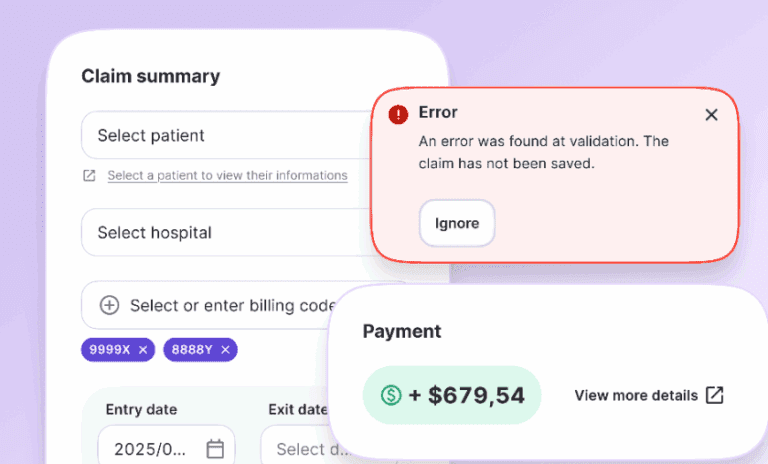
A rejected or incorrectly paid claim doesn’t necessarily mean you’ve lost the associated revenue.
Provincial payment statements identify refused, adjusted, and processed claims. When something looks wrong, review the explanatory information to identify the issue.
Common causes include:
- Incorrect patient information
- Missing or incompatible billing codes
- Incomplete referral details
- Unmet service requirements
- Missing modifiers or premiums
Once you’ve identified the issue, correct and resubmit the claim within the applicable provincial deadline.
And don’t overlook claims that were accepted but paid at a reduced amount! Learn more about medical billing reconciliation.
10. Should I manage my own medical billing or use a billing service?
The best approach depends on your needs and situation.
Physicians generally have four options:
- Self-managed software: Maintain control over claim submission and follow-up.
- Clinic administrative support: Rely on workplace staff to manage billing tasks.
- Billing agency: Outsource claims management to specialists.
- Hybrid solution: Combine billing software with expert review and support.
If you’re starting independent practice, consider how much training you’ll receive (or are willing to receive) and who monitors rejected or underpaid claims.
Remember: Physicians remain responsible for their billing accuracy, even when someone else manages submissions.
Start your medical billing career with confidence
Your first years of independent practice come with plenty of new responsibilities.
At Facturation médicale, we know that every physician’s billing needs are different. That’s why we combine intuitive technology with local billing expertise to help you understand the requirements of your province and specialty.
- From your first claim to your growing practice, our solutions simplify billing workflows and reduce preventable errors to give you greater visibility into your revenue.
You don’t have to become a billing expert overnight. You only need the right knowledge and trusted support.
Make your first year of billing count:
FAQs: Medical billing for residents in Canada
Can medical residents bill for services during residency?
In certain circumstances, residents may be eligible to bill for clinical services outside their regular training responsibilities. Eligibility depends on provincial licensing requirements, supervision rules, and the specific clinical arrangement. Confirm your authorization before beginning independent or additional clinical work.
Can I change medical billing providers after starting practice?
Yes. Physicians can generally switch billing providers as their needs evolve. Before making a change, verify how outstanding claims, payment reports, billing records, and provincial account authorizations will be transferred.
Do I need to incorporate when I finish residency?
No. Incorporation isn’t automatically required when transitioning into independent practice. The best business structure depends on your income, employment arrangements, and financial circumstances. Consult an accountant familiar with Canadian medical practice before deciding.
What is shadow billing in Canada?
Shadow billing involves submitting service information for reporting or tracking purposes when physicians are compensated through certain alternative payment models. Requirements vary by province and agreement, even when individual claims don’t directly determine a physician’s compensation.
Can I bill patients who live in another province?
In many circumstances, yes. Reciprocal interprovincial billing arrangements allow physicians to seek payment for eligible insured services provided to residents of other provinces. However, exceptions exist, including special arrangements involving Quebec and certain excluded services.
How can I tell whether I’m underbilling?
Compare your documented services with applicable fee schedules, review eligible modifiers and premiums, and reconcile payments against submitted claims. Patterns of reduced payments or unusually low billing totals may indicate missed opportunities or workflow problems.