





Points clés à retenir
- Billing code eligibility matters. An OHIP fee code can be valid but still generate a rejection when patient age, physician specialty, or service requirements don’t align.
- Missing prerequisites lead to rejected claims. Some codes require a previously paid service, an appropriate diagnostic code, or a qualifying consultation.
- Keeping up with OHIP changes protects revenue. Updated fee codes and eligibility rules make previously accepted billing practices invalid.
There are thousands of OHIP billing codes covering everything from assessments to tests and counselling. It’s tough to keep track of all of them when each one has specific payment rules. Even experienced physicians encounter claim rejections when those rules change or when a service is billed under the wrong circumstances.
A rejected claim translates to additional administrative work, delayed reimbursement, and potentially lost revenue if the problem isn’t corrected in a timely manner.
We’ve previously explored the common reasons for medical billing rejections across Canada. But which individual OHIP billing codes deserve closer attention?
Here are five codes worth reviewing and the practical steps physicians can take to avoid preventable billing errors.
1. Q053A: Health Care Connect complex or vulnerable patient fee
Why claims get rejected: Incorrect patient eligibility or using a discontinued fee code.
Q053A was used by eligible physicians enrolling complex or vulnerable patients referred through Ontario’s Health Care Connect (HCC) program.
This code had strict eligibility requirements. Patients needed to be identified by Health Care Connect as complex or vulnerable and meet the required referral and enrolment conditions.
One significant development makes this code particularly important in 2026.
As of November 1, 2026, Q053A was replaced by Q058A for new eligible service dates. The replacement code supports an expanded definition of eligible complex or vulnerable patients and a $500 payment.
Example: A family physician enrolls a qualifying complex patient through Health Care Connect on November 6, 2026, but submits Q053A using the previous billing rules. Because Q053A was discontinued for new service dates after October 31, the claim may be rejected. The physician should use the replacement code, Q058A, provided all eligibility requirements are met.
How to avoid rejections:
- Confirm the patient’s Health Care Connect eligibility and referral status.
- Verify that the appropriate enrolment documentation is complete.
- Use Q058A for qualifying service dates beginning November 1, 2026.
Review Ontario’s updated patient attachment fee rules before submitting claims.
2. K130A: Adolescent periodic health visit
Why claims get rejected: The patient falls outside the eligible age range.
For adolescent patients, age requires a sliding scale of codes to ensure accurate billing. The code K130A covers periodic health visits for adolescents aged 16 and 17.
An otherwise valid claim can be rejected when the patient’s age on the service date doesn’t match the code’s eligibility requirements.
Example: A family physician completes a periodic health visit for a patient who recently turned 18 but submits K130A, the code for patients aged 16–17. OHIP rejects the claim because the patient exceeds the permitted age range. The physician should use K131A, the appropriate code for adults aged 18–64, assuming the visit meets its billing requirements.
Ontario uses different codes depending on age. Here’s a breakdown for quick reference:
OHIP code | Eligible age |
K017A | 2–15 years |
K130A | 16–17 years |
K131A | 18–64 years |
K132A | 65 years and older |
Periodic health visits are also subject to frequency restrictions. OHIP generally limits them to one per patient, per physician, within a 12-month period.
How to avoid rejections:
Verify the patient’s age on the actual service date, select the appropriate periodic health visit code, and review previous claims before submission. It’s important to note that an A2A rejection indicates that the patient falls outside the fee code’s permitted age range.
12,000+ physicians trust Petal to simplify their billing.
3. E078A: Chronic disease assessment premium
Why claims get rejected: Ineligible physician specialty, diagnosis, service location, or associated assessment.
Chronic disease offers a very specific set of premium riles. E078A provides a 50% premium for eligible chronic disease assessments performed by certain specialists. It’s important to note that the presence of a chronic condition doesn’t automatically qualify the assessment for this premium.
The OHIP Schedule of Benefits restricts eligibility to designated specialties, qualifying assessment codes, and specific care settings.
Example: A specialist assesses a patient with a qualifying chronic condition in the emergency department and submits E078A alongside the assessment code. Although the condition may qualify, the emergency department setting doesn’t meet the premium’s payment requirements. The additional premium may be rejected or disallowed during adjudication.
How to avoid rejections:
- Verify specialty and assessment code eligibility.
- Use a qualifying chronic disease diagnostic code.
- Confirm the service location meets payment requirements.
- Submit the premium with an eligible underlying assessment.
For physicians regularly managing complex chronic conditions, these checks help protect appropriate premium reimbursement.
4. H010A: Anesthesia stipend unit
Why claims get rejected or delayed: Incorrect group billing numbers, physician eligibility, missing submission requirements, or misinterpreting the adjudication process.
Introduced in August 2026, H010A allows eligible anesthesiologists and family practice anesthetists to claim Ontario’s new tiered daily stipend for qualifying in-hospital anesthesia services (retroactive to April 1, 2026).
Submission requirements for H010A differ significantly from standard fee-for-service anesthesia billing:
- Physicians must submit claims under a dedicated hospital anesthesia stipend group billing number rather than their usual clinical group number.
- Claims must reflect total eligible hours worked on the service date, with patient health number, version code, and date of birth fields left blank.
- Adjudication note: Approved H010A claims initially process with an explanatory code appearing at $0.00 on your Remittance Advice (RA) before being paid via scheduled Ministry adjustment payments. A $0 entry on your RA for H010A doesn’t automatically indicate a claim error—it reflects the standard two-step adjudication path.
Example: An anesthesiologist provides six hours of eligible anesthesia services at an Ontario hospital and submits H010A using their standard clinical group number instead of the hospital’s dedicated stipend group number. The claim fails initial validation because H010A requires the dedicated stipend group identifier. Once resubmitted under the correct group number with patient ID fields left blank, the claim accepts and appears on the RA at $0.00 pending the Ministry’s stipend reconciliation payout.
How to avoid rejections:
- Confirm the correct anesthesia stipend group number and physician affiliation before submitting.
- Record eligible hours accurately and submit one consolidated claim per service date.
- Leave the required patient identification fields blank.
- Distinguish between a true system rejection (e.g., wrong group number) and a standard $0 RA line item awaiting Ministry adjustment.
- Exclude ineligible hours, including periods covered by after-hours premiums.
Review Ontario’s H010A billing guidelines before submitting claims.
Billing anesthesiology in Ontario?
5. A005A: Family practice consultation
Why claims get rejected: Missing referral information, consultation requirements, or applicable service limits.
A005A is used for eligible family practice consultations.
However, providing a detailed assessment doesn’t necessarily mean the encounter qualifies as a consultation.
OHIP consultations have specific requirements, including an appropriate request from a referring practitioner and the necessary consultation documentation.
Claims may encounter problems when the referring provider’s information is missing, incorrect, or ineligible for the service.
Example: A family physician conducts a consultation requested by another practitioner and submits A005A but enters an incorrect referring practitioner billing number. The claim is rejected because OHIP can’t validate the referral information. Correcting the referral details and resubmitting the claim can resolve the issue, provided the consultation meets all other eligibility requirements.
How to avoid rejections:
- Confirm that a valid consultation request exists.
- Record the referring practitioner’s correct billing information.
- Document the consultation findings and required report.
- Review previous consultations for applicable payment limits.
How to prevent OHIP billing code rejections: Checklist and cheat sheet
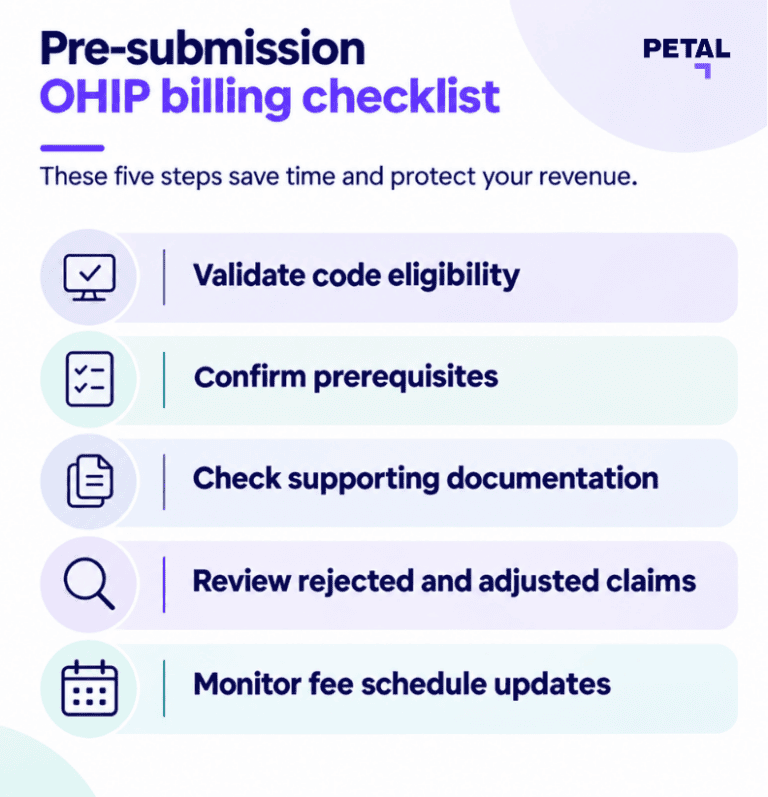
Knowing individual codes helps, but maintaining consistent billing practices is equally important.
Before submitting OHIP claims, physicians and billing teams should:
- Validate code eligibility: Check physician specialty, patient age, service date, and care setting.
- Confirm prerequisites: Review previous services, referral requirements, and eligible code combinations.
- Check supporting documentation: Ensure diagnoses, consultation records, and other required details are complete.
- Review rejected and adjusted claims: Use error reports and remittance advice to identify recurring problems.
- Monitor fee schedule updates: Ensure billing software reflects current Ontario requirements.
These steps support stronger first-pass acceptance and reduce the time spent correcting preventable mistakes.
To help down the road, use this quick cheat sheet on the codes mentioned above:
|
Fee Code |
Service Description |
Common Rejection Reason |
Key OHIP Error / Outcome |
|
Q053A / Q058A |
Health Care Connect Enrolment |
Q053: Code discontinued post-Nov 1, 2026 |
Date-of-service invalid |
|
K130A |
Adolescent Periodic Visit (16–17) |
Patient turned 18 prior to visit |
A2A (Age mismatch) |
|
E078A |
Chronic Disease Premium (50%) |
Ineligible location (e.g., ER / Inpatient) |
Premium disallowed |
|
H010A |
Anesthesia Stipend Unit |
Billed under standard group number |
Rejected / Appears $0 on RA |
|
A005A |
Family Practice Consultation |
Incorrect referring provider details |
AC4 (Invalid referral #) |
Reduce billing rejections and protect your earned revenue
Even small billing errors can accumulate across hundreds of monthly claims, creating additional administrative work and delaying payment.
Petal Medical Billing helps Ontario physicians manage billing submissions, reconcile payments, identify errors, and navigate complex OHIP requirements.
- With expert billing support and tools designed for Ontario’s billing environment, physicians spend less time managing rejected claims and more time focused on patient care.
Discover Petal’s Ontario medical billing solution and learn how to improve billing accuracy while protecting your earned revenue.
FAQs: Ontario billing rejections
What is the difference between an OHIP billing code and an OHIP rejection code?
An OHIP billing code identifies a medical service provided, such as K039A or A005A. An OHIP rejection code identifies why a submitted claim failed validation. For example, A2A indicates that the patient’s age falls outside the permitted range.
Can an OHIP claim be accepted but paid at a reduced amount?
Yes. Some claims pass initial validation but receive reduced or zero payment following adjudication. These adjustments appear on remittance advice and require different follow-up from rejected claims.
How can physicians correct rejected OHIP claims?
Review the error report, identify the underlying issue, correct the claim, and resubmit when permitted. Check submission deadlines and avoid resending claims that have already been processed successfully.
Where can physicians find current OHIP billing rules?
The official Ontario OHIP Schedule of Benefits provides current fee codes, payment requirements, and eligibility rules.