





Key takeaways
- Digitization is no longer enough: More than 90% of Canadian health providers have access to digital health systems, but only 52% report electronically sharing clinical information with providers outside their practice.
- Interoperability becomes more important as care becomes more complex: Patients increasingly move between care settings, making secure information exchange essential to continuity of care.
- The next opportunity is to connect the care journey. Interoperability helps healthcare organizations move beyond exchanging information toward better coordinating access and, capacity.
Healthcare interoperability is the ability of different health technologies and information systems to securely exchange and use information across care settings. As patients increasingly move between care settings, the next stage of Canada’s digital health evolution is about connecting the entire patient journey.
The desire to move toward a digital future in healthcare among patients, physicians, administrators, and policy makers alike has been strong.
The data shows progress in some respects but needs in others. This includes the need for the entire healthcare continuum to be connected.
Electronic medical records, provincial health portals, digital diagnostic results, and other technologies have changed how health information is created, stored, and accessed.
- Today, more than 90% of Canadian health providers have access to a digital health system, according to CIHI’s 2026 report on digital health information in Canada.
But digitizing the record was never the final destination. A record, file, history, or physician availability is only good if it can be leveraged in more than one place.
As patients move between family physicians, specialists, diagnostic services, pharmacies, hospitals and community care, the value of digital health information increasingly depends on whether those different parts of the healthcare system securely exchange and use it.
Canada has digitized much of the health record. The next challenge is connecting the care journey around it. The issue at hand is that access points inherently aren’t speaking to one another.
Canadians increasingly expect connected care
Few healthcare journeys now exist entirely within a single organization.
A patient might begin with their family physician, visit an imaging centre, see a specialist, fill a prescription at a community pharmacy and eventually require hospital or community-based care.
Each interaction generates information that could affect what happens next.
That creates an increasingly important expectation: patients shouldn’t have to personally connect the dots between every provider involved in their care.
CIHI describes the goal of connected care as a healthcare environment where a patient’s medical history can follow them from a family physician to an emergency department, specialist or pharmacy.
- This includes prescriptions, test results and referrals available when and where they are needed. Its latest national analysis says Canada has made progress toward that vision, but it is not yet the reality for many Canadians.
Canada Health Infoway is seeing the same expectation from patients. Its 2025 Canadian Digital Health Survey tracks Canadians’ experiences with connected care, including information sharing between providers, coordination across care settings and expectations that relevant health information can be shared between hospitals, labs, clinics and other providers.
The provinces are also listening with more RFPs and pilot programs showing that connected care is seeing careful investment.
The expectation is shifting from “Is my health record digital?” to “Can the healthcare system safely use my information when I need care?”
Digital doesn’t automatically mean connected
That’s where an important gap remains.
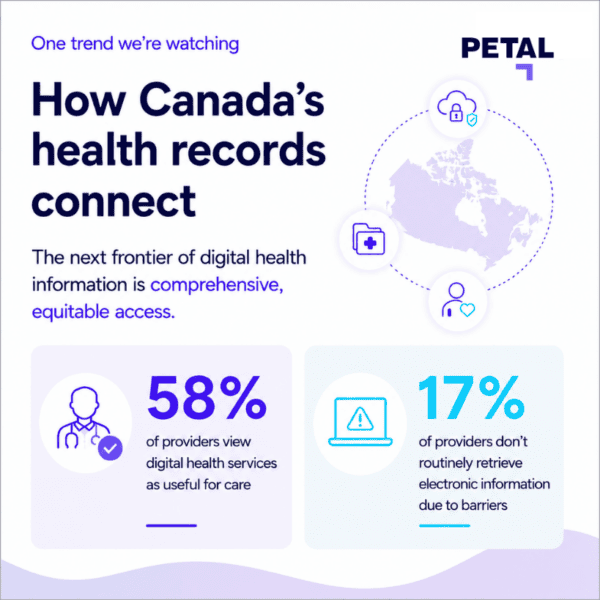
While more than 90% of Canadian health providers have access to a digital health system, only 52% reported electronically sharing patient clinical information with providers outside their practice setting in 2025.
Even more revealing is why information sometimes doesn’t move.
Among providers reporting barriers to accessing electronic health information from other care settings, the most common problem was insufficient integration between different systems, cited by 47%.
Other barriers included time-consuming or multiple sign-ins and insufficient permissions. CIHI’s provider data explores the interoperability gap in more detail.
The patient experience remains fragmented too.
In 2025, 69% of Canadians reported having online access to at least one type of electronic health information. But only 13% said they could access all four core components measured by CIHI: laboratory results, imaging results, immunization records, and medication history and renewals.
Digitization, in other words, is still producing digital silos.
Health records need systems that speak to each other
This is why interoperability has become such an important part of Canada’s digital-health conversation.
Interoperability allows different technologies to exchange information in a way that other systems can understand and use.
That requires more than simply transferring information from one database to another.
What we see in the healthcare record landscape are two camps: the closed solution and the interoperable solution.
Common standards are needed so that medications, allergies, procedures, referrals ,and other health information retain a consistent meaning as they move between technologies and care environments. But also, the willingness, architecture, and security needed to bring it into fruition.
Through initiatives such as the pan-Canadian Patient Summary and FHIR-based standards, Canada is building more of that common digital foundation. Several non-profit organizations are taking this head on including CIHI’s core data efforts and Infoway’s interoperability roadmap is specifically focused on breaking down data silos and improving continuity of care, provider collaboration, and patient access to information.
But connected care has to go one step further.
3,500+ worldwide customer deployments benefit from Petal’s top-grade security.
Interoperability shouldn't stop at the health record
Imagine that a patient is seeking care for a problem that doesn’t necessarily require an emergency department. Knowing that patient’s clinical history matters.
Navigating patients toward appropriate care also requires information about the healthcare system surrounding them: which services are appropriate, which providers are available, where capacity exists, and how the patient can access it.
This is where the conversation about interoperability begins to intersect with patient flow.
Health information needs to move. But so do patients.
The value of interoperability will ultimately be measured not only by whether System A can communicate with System B, but by whether that connection makes healthcare safer, faster or easier to navigate, and administrators can learn from the trends the potential data will offer.
Canada is beginning to make interoperability a requirement
The federal government is also signalling that disconnected health technology is no longer going to be accepted as the status quo.
Introduced in February 2026, Bill S-5, the Connected Care for Canadians Act, is aiming to establish requirements around health information technology interoperability and prohibit certain forms of data blocking by technology vendors.
The federal government framed the legislation around a straightforward problem: important health information still can’t always move securely and seamlessly between the systems Canadians encounter throughout their care.
- As of September 2026, Bill S-5 has passed the Senate and is at second reading in the House of Commons.
Legislation will not solve interoperability by itself. But it reinforces an important direction for Canada’s healthcare system: technology should make information easier to use across the patient journey, not create another barrier within it.
It also indicates that procurement requirements will likely need to change healthcare organizations and health authorities to adhere to these needs. These steps aren’t being taken in isolation, but with a view that closed systems are not going to create the efficiency and positive patient outcomes needed for a successful care continuum in Canada.
Building connected healthcare in Canada

Canada doesn’t need more isolated digital solutions.
It needs technologies capable of working within a complex healthcare ecosystem and alongside the infrastructure already in place.
That requires shared standards. It requires secure information exchange. And it requires healthcare technology companies to design interoperability into their products rather than treating it as an afterthought.
For Petal, there is also something distinctly Canadian about that challenge.
As a Canadian health technology company, we build for a healthcare system we know firsthand: one distributed across provinces and organizations, where patients routinely move between different providers, services and care environments.
The opportunity is to build a system in which information can follow the patient—and where connected technology helps make the patient’s next step easier to navigate.
That’s how Canada moves from digital records to truly connected care.
Thinking about your team’s data? World-class security works for patients and providers:
FAQs: Healthcare interoperability in Canada
What is healthcare interoperability?
Healthcare interoperability is the ability of different health technologies and information systems to securely exchange data in a format that other systems can understand and use. This can allow relevant patient information to move more easily between healthcare providers and care settings.
Why is healthcare interoperability important in Canada?
Canadian patients frequently receive care from multiple providers, organizations and care settings. Interoperability can help ensure relevant information follows the patient instead of remaining isolated within individual systems.
Are most Canadian health records already digital?
Digital health adoption is widespread. According to CIHI, more than 90% of Canadian health providers had access to a digital health system in 2025, but electronic information exchange between different practice settings remains less consistent.
What is the difference between digitization and interoperability?
Digitization converts information into an electronic form. Interoperability enables different digital systems to securely exchange, interpret, and use that information.
How can interoperability improve patient care?
Interoperability can give healthcare providers access to more complete and timely information, support continuity between care settings and reduce unnecessary information gaps. When extended beyond health records, connected technologies can also support patient navigation and coordination across a healthcare network.
What is Bill S-5, the Connected Care for Canadians Act?
Bill S-5 is proposed federal legislation intended to improve health information technology interoperability in Canada and address practices that unnecessarily prevent electronic health information from being accessed or exchanged.
How does interoperability relate to patient flow?
Patient flow depends on more than knowing a patient’s medical history. Healthcare organizations also need to understand available services, capacity and potential next points of care, making interoperability an important foundation for coordinating patients across complex healthcare networks.
What role does Petal Patient Hub play in connected care?
Petal Patient Hub is designed to work alongside existing healthcare technologies and connect patient demand with available services and capacity. Rather than replacing electronic health records, it uses interoperability to help healthcare organizations better coordinate access and navigation across networks of care.