







Key takeaways
- Medical billing technology cuts boring, repetitive work: Automation and purpose-built workflows streamline tasks that otherwise depend on manual entry and follow-up.
- Automated validation catches issues earlier: Software should flag missing information and incomplete claims before they reach your provincial billing authority.
- The right technology supports the whole billing cycle: Effective platforms extend beyond claim submission to payment reconciliation, expert support, and beyond.
Medical billing technology gives physicians and their teams digital tools to enter, validate, submit, monitor, and reconcile claims within their workflow. Modern solutions automate repetitive tasks and flag potential billing issues before submission, as well as connect physicians with expert support to manage complex situations.
For Canadian physicians, billing sits within a much larger administrative workload.
Each province has its own billing authority. There are fee schedules, compensation agreements, submission requirements, and deadlines. Physicians everywhere want to turn documented care into accurate claims, and ultimately, get paid.
- As 75% of Canadian doctors say administrative workload is an impediment to patient care and the country faces a deficit of 22,823 family physicians, it’s critical for providers and the healthcare system that billing burden is at a minimum.
Technology is vital to reducing the amount of repetitive work attached to billing.
That won’t mean that every digital billing experience is the same. As a physician, you may be entering claims through a basic portal that’s already billing electronically, while concurrently performing manual work like researching codes or managing rejected claims.
Purpose-built medical billing software brings these activities (and more) together and can even introduce automation throughout the billing cycle.
Here are five ways those capabilities simplify physician billing.
1. Enter claims with fewer repetitive steps
Every additional billing step means another administrative task competing for physician attention.
Dedicated medical billing technology streamlines claim entry. It includes capabilities like saved patient information, quick-entry functions, templates, and mobile tools. Some platforms also connect with electronic medical records to limit duplicate data entry.
- Looking forward to a billing demo? Ask these seven questions.
That makes billing easier to complete, because it’s closer to the patient encounter when the details remain fresh.
Let’s say a BC family physician providing virtual care needs to choose among age-specific MSP telehealth codes. Now that they’ve built patient age and other encounter information directly into their workflows, code selection is faster.
The alternative leads to backlogs. A physician who waits days or weeks to enter services may need to reconstruct where the encounter occurred, or which service was delivered.
Impact: The right medical billing solution will shorten your path between delivering care and submitting a claim.
2. Catch potential billing issues before submission
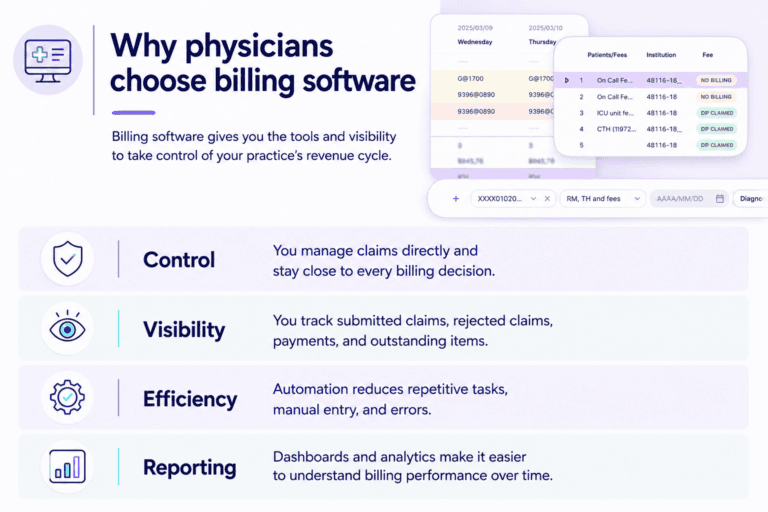
Accurate physician billing requires several pieces of information to align.
Depending on the province and service, a claim could include a range of information: patient details, billing codes, diagnoses, modifiers, premiums, locations, and more.
Automated validation gives physicians an additional layer of review before submission.
A billing platform may flag:
- Missing patient information
- Invalid billing codes
- Incompatible code combinations
- Missing diagnoses
- Required billing elements
As a physician, you remain responsible for ensuring the claim and supporting clinical documentation are accurate. Technology simply makes it easier to identify potential problems while they can still be corrected quickly.
For example, in Ontario, even small patient-information discrepancies cause admin burden. But by verifying OHIP health card validity and demographic information before submission, physicians limit avoidable rejections.
That supports stronger first-pass claim acceptance and fewer payment delays.
Impact: Missing or incompatible information delays payment or results in a rejected claim. The opposite guides strong, predictable revenue.
12,000+ providers and administrators trust Petal to simplify their billing.
3. Keep billing information in one place
Claim submission is only one stage of the billing cycle.
After a claim leaves the practice, physicians still need visibility into what happened next. Was it accepted? Was the expected amount paid? Does something require follow-up?
That becomes harder when billing information is in myriad places. When information lives across provincial portals, spreadsheets, remittance statements, and elsewhere, physicians require undue cognitive load to stay on top of all things billing.
A centralized billing platform maintains a record of:
- Claims entered
- Claims submitted
- Expected revenue
- Payments received
For physicians, that visibility can be as valuable as faster claim entry.
Let’s look at a physician in Quebec. RAMQ may pay their claim as submitted, modify it, reject it, or return it for correction. Keeping claim information and account-statement outcomes together makes it easier to identify which items still require attention.
Impact: Knowing what remains unresolved makes it easier to act before an overlooked claim becomes lost revenue.
4. Manage rejected claims more efficiently
Even accurate, well-documented billing will occasionally produce rejected or adjusted claims.
Technology supports a less disruptive response.
Instead of finding an issue during a later manual review, a billing system highlights rejected claims within an organized workflow and preserves information needed to investigate the cause.
- Some platforms also combine software with billing specialists who review remittance statements, interpret rejection reasons, support corrections, and more.
For example, an Ontario physician’s rejected claims reveal recurring workflow problems like missing referral information. Reviewing such issues systematically allows them to correct the immediate claim while decreasing the chance of repeating the same error in the future.
The objective is to turn rejection management into a consistent process that identifies issue and determines the required correction.
Impact: Evolving provincial billing rules demand significant attention; billing technology paired with experts does this work for you.
5. Build a billing workflow that adapts to your practice
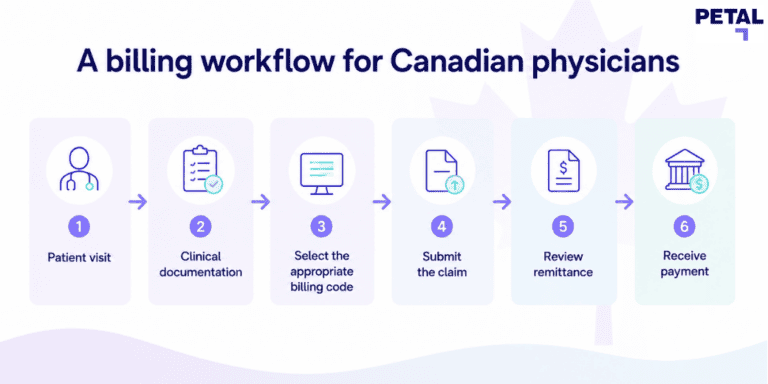
Physician billing changes throughout a career. It may even change throughout a week.
A new physician may initially work in one location with a relatively predictable mix of services. Over time, they may practice in multiple facilities, take on different patient populations, or move into different compensation arrangements.
For example, if an Alberta physician wants to expand from primarily in-person care into virtual services, AHCIP introduces different rules around minimum service times and frequency limits. A structured billing workflow makes it easier to incorporate those varying requirements.
Your billing process needs to accommodate those changes too.
- Remember: A technology-based workflow provides greater consistency as the underlying practice becomes more complex. It also supports different levels of physician involvement.
Do you want to remain closely engaged with every claim? Perhaps. Other physicians may delegate certain billing activities to administrative staff. Alternatively, a hybrid model gives physicians direct access to their billing information while specialists manage specific tasks.
Impact: Technology should fit the way you want to work today and in the future.
Physicians using Petal earned $34,346 more annually on average compared to manual billing.
What should you look for in medical billing technology?
Features matter, but a long feature list doesn’t automatically guarantee a better billing experience.
Start with the work you want the technology to simplify.
Consider whether the platform makes it easier to enter claims, verify information, understand billing rules, track expected revenue, and access support when questions arise.
Also consider where you work. Canadian medical billing is provincial, so the technology and support behind it need to reflect the requirements of the relevant billing authority.
Looking ahead: A strong solution should give physicians visibility across the complete billing cycle.
Make medical billing technology work for you
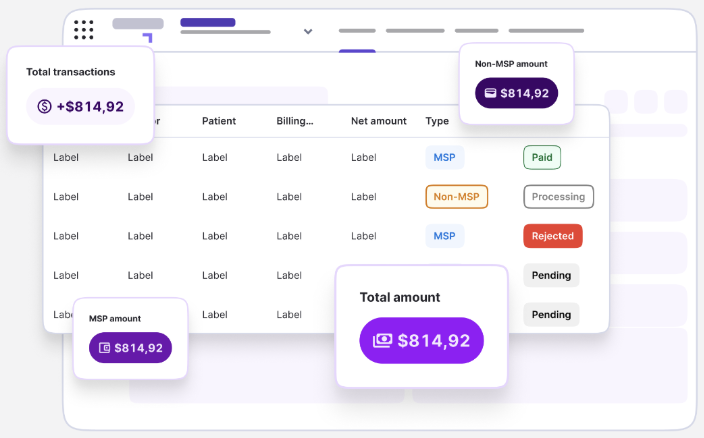
Medical billing will always require physician input, but every repetitive step need not be performed manually.
Petal Billing combines digital billing workflows with province-based support. Simplify your claim entry, validation, tracking, rejection management, and payment reconciliation.
- Proof: In an independent study, physicians using Petal Billing reported an average 9.4% increase in revenue and 3.1 hours saved per week compared with manual billing.
Medical billing technology is what you make of it.
And with the right solution, you’ll spend less time managing administration to gain more time for your patients.
Enjoy a simpler billing workflow:
FAQs: Medical billing technology
What is medical billing technology?
Medical billing technology refers to digital tools designed to support physician billing activities such as claim entry, validation, submission, payment tracking, reconciliation, reporting, and rejected-claim management.
How is medical billing software different from submitting claims electronically?
Electronic submission moves a claim digitally to a billing authority. Dedicated medical billing software can support a much broader workflow, including claim preparation, automated validation, revenue tracking, remittance review, payment reconciliation, and follow-up.
What can medical billing software automate?
Depending on the platform, software can automate or streamline data entry, claim validation, error detection, electronic submission, payment matching, rejection tracking, alerts, and reporting.
Can medical billing technology prevent rejected claims?
It can reduce preventable errors by flagging missing or incompatible information before submission, but no technology can guarantee that every claim will be accepted. Claims must still comply with provincial requirements and be supported by appropriate clinical documentation.
Does medical billing software replace billing expertise?
No. Technology can automate routine processes and surface potential issues, while billing expertise remains valuable for interpreting provincial rules, resolving unusual claims, and navigating complex compensation scenarios.
What should physicians look for in medical billing software?
Look for a solution that supports efficient claim entry, automated validation, mobile access, centralized claim tracking, revenue visibility, payment reconciliation, rejected-claim management, current provincial billing requirements, and access to support when needed.