





Key takeaways
- Effective billing starts at patient intake. Deploy a documentation process with eligibility checks and billing logic as its foundation.
- Automation simplifies workflows. Use advanced tools to reduce variability and human error to unlock more time for patients.
- Tailor a timeline to your clinic’s operations. This should include encounter data submitted daily to reduce backlog and prevent missing details.
Rejected billing submissions waste time and limit growth.
Wasted time comes through the hours required to prepare billings before submission, as well as after failure when billings must be analyzed and resubmitted. Clinicians stuck in a “figure it out later” mindset save minimal time before submission and lose much time once claims are rejected.
- Depending on specialty and practice type, up to 8% of manual claims get rejected on first submission.
These setbacks are avoided through a compliant first-pass acceptance medical billing process tailored to your clinic’s and your patients’ unique needs. Once you align team members with a comprehensive billing structure, you’ll find greater productivity through decreased administrative burden and increased opportunities to generate revenue.
Read on to explore key steps for structuring your first-pass acceptance medical billing process.
1. Build billing accuracy into patient intake
Your strongest defense against claim rejections starts well before you submit a claim. Deploy a single, connected process for documentation with eligibility checks and billing logic as its foundation.
Let’s start with patient intake. Accurate health card numbers and coverage statuses must be confirmed at every patient encounter. Even minor discrepancies like outdated cards often result in immediate rejection. Standardize your intake workflows across your clinic to ensure that every visit includes billable data.
- Remember: Premiums, modifiers, and other billing enhancements are more likely to be documented correctly when they’re embedded into your workflows.
After intake, clinical documentation must support billing requirements. Notes should clearly reflect both services delivered and diagnoses justifying care. When documentation and billing logic are disconnected, billing submissions will inevitably feature fragmented information.
Impact: An integrated approach to care and billing prevents rejections. You’ll reduce reliance on retroactive fixes while avoiding common rejection drivers, such as eligibility errors, missing information, and diagnosis–procedure mismatch.
Clinicians increase revenue by an average of 9.4% using Petal Billing.
2. Use automation to simplify operations
Attempting to memorize every billing code, as well as every billable interaction throughout the day, will leave you missing opportunities for billable earnings.
Even the most experienced clinicians can’t memorize everything. That’s where automation becomes essential. Use advanced tools to reduce variability and human error toward freeing time and energy for patient care. Your patients will achieve better outcomes when your team focuses on their needs rather than billing requirements.
Here are three more reasons that clinicians use automation:
- Flag incompatible codes, missing modifiers, and billing conflicts before submission.
- Improve traceability, making it easier to understand why claims were rejected and how to prevent similar issues in the future.
- Create consistency across clinicians, specialties, and clinic locations.
Impact: You and your team unlock time for patient care and reduce administrative burden when automation prepares successful billing submissions on your behalf.
3. Follow a timeline to standardize workflows
A billing timeline keeps teams accountable, and billings submitted—especially when work stacks up.
Submitting encounter data daily reduces backlog and prevents missing details from causing friction later. Automated flags identify issues, such as missing modifiers, incompatible codes, or incomplete notes. Even perfectly coded claims become unrecoverable if they’re submitted too late. Stay on top of billings before, during, and after patient care to promote fiscal predictability.
Here’s a solid billing timeline structure:
- Daily: Submit encounter data.
- 24–48 hours: Review automated flags.
- Weekly: Address rejected or returned claims.
- Monthly: Review rule updates with staff.
- Quarterly: Audit high-volume billing codes.
Plus, pairing with an automated billing system makes this cadence more achievable when programmed to match your timeline.
Impact: Timelines remove the guesswork of who should do what and when. Billings get submitted promptly, supporting predictable revenue generation to guide fiscal operations.
CHUM achieved 92% clinician satisfaction with the Petal Workforce Hub.
4. Monitor performance to identify areas for improvement
Limiting claim rejections is a process. Clinics that reduce rejections treat billing performance like other operational metrics: monitored, measured, and refined.
Tracking rejection rates by code, payer, specialty, and reason reveals patterns that aren’t visible on individual claims. Are certain codes repeatedly rejected? Are rejections clustered around specific providers or visit types? These insights allow clinics to correct root causes rather than repeatedly fixing symptoms.
Visibility is key. Revenue is gradually eroded without clear reporting. Choose an advanced billing tool with a dashboard featuring claim status, rejection reasons, and resolution progress, so nothing is overlooked. This data also supports training and process improvement. Clinics proactively update documentation practices and educate staff before issues escalate to structure long-term billing success.
Impact: Continuous monitoring makes billing an active system for protecting revenue and improving compliance rather than a passive administrative task.
5. Manage rejections when they occur
Some claims are rejected even with strong processes in place.
The difference between revenue loss and recovery lies in how those rejections are managed. These rejections often stem from payer-side errors, documentation requirements, or edge-case rule interpretations. What matters is responding quickly and within allowable timelines.
Rejected claims require review before resubmission, which takes time and attention. Clinicians may underestimate how much revenue is left unresolved or assume rejections are unavoidable. Effective billing operations provide full visibility into claim status—that means clear explanations for rejections and defined steps for correction.
Impact: Managing rejections as a structured recovery process reclaims thousands of dollars annually and promotes positive response to occasional rejections.
Simplify your medical billing to boost revenue
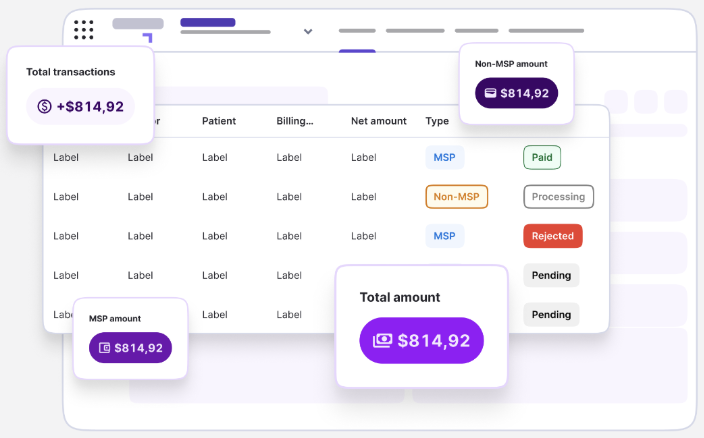
Your medical billing tool should support your first pass acceptance process through automation and live agent support.
Petal Billing does this and more. Our advanced medical billing tool provides:
- EMR-connected claim automation.
- Provincial code validation and error checking.
- Real-time claim status and remittance tracking.
Our recent independent study, found physicians using Petal Billing reported an average revenue increase of 9.4% compared to manual billing. This equates to 161 hours saved annually at a value of $24,123 per year.
When you make medical billing a strength, your bottom line will reflect it.
Reduce admin burden and save more time for patients: