









Points clés à retenir
- The right billing model depends on the practice: Physicians need different levels of billing support based on specialty, province, claim complexity, administrative capacity, and how much control they want over the process.
- Software improves visibility, but services reduce workload: Billing software helps physicians manage claims more efficiently, while billing services take on the follow-up, reconciliation, and expertise needed to reduce administrative burden.
- The strongest solution often combines both: Pairing billing technology with expert support helps physicians improve accuracy, reduce rejections, and adapt to provincial billing requirements across Alberta, BC, Ontario, and Quebec.
Medical billing software and medical billing services solve different problems. Billing software helps you submit, track, and manage claims yourself, while billing services provide experts who handle claim submission, rejection management, reconciliation, and payment follow-up on your behalf. The right choice depends on your practice’s needs and how involved you want to be in the billing process.
Medical billing software gives physicians the tools to manage claims themselves. Billing services provide expert support to manage more of the process on their behalf.
So, which one do physicians actually need?
Here’s the truth: it depends.
That may not sound like the simplest answer and a bit of a copout, but it’s the most accurate one.
- For example, a solo family physician in Ontario does not have the same billing needs as a specialist group in Quebec. A high-volume clinic in Alberta may not need the same support as a physician working across hospital, clinic, and virtual care settings in BC.
The right billing model depends on how complex your claims are, how much time your team has, and how much control you want over the process.
Because beyond claim submission, billing is coding, validation, tracking, reconciliation, rejection management, reporting, and follow-up. When it works well, physicians get paid accurately and on time. When it doesn’t, revenue is delayed, administrative workload increases, and physicians spend more time away from care.
Understanding the difference between billing software and billing services is the first step to choosing the right model.
A brief comparison: Billing software vs. Billing services | |
Billing software ✅ | Billing services 🤝 |
Control | Assistance |
Automation | Expertise |
Real-time visibility | Réduction de la charge administrative |
Self-managed workflows | Managed billing workflows |
Internal team ownership | Dedicated billing specialists |
Best for predictable billing | Best for complex or high-volume billing |
1. Billing software: Control over the process
Billing software helps physicians create, submit, track, and manage claims directly.
It’s the self-managed option. The physician, administrator, or clinic team remains responsible for the billing workflow, but the software makes that workflow faster, more organized, and easier to monitor.
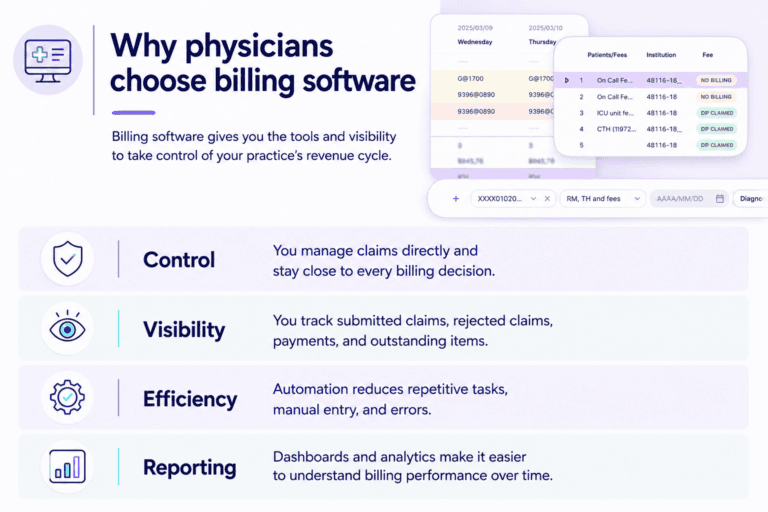
For physicians who already understand their billing codes and have manageable claim volume, software is often enough. A family physician in Ontario, for example, may prefer a platform that simplifies OHIP claim submission and lets their team manage day-to-day billing internally.
The trade-off: Software still requires time and expertise. It helps identify errors, organize claims, and streamline workflows, but someone still needs to manage the process.
That means someone—commonly an MOA, a group leader, or the physician themselves— reviewing claims, fixing rejections, monitoring payments, and staying current with provincial requirements.
Where it works best: Billing software is the right fit for physicians who want direct control, have internal administrative support, and feel confident managing claims themselves.
Clinicians increase revenue by an average of 9.4% using Petal Billing.
2. Billing services: Support for the work behind the claims
Billing services take a more managed approach.
Instead of only providing the tools, billing services provide people and processes to help manage the work. This includes claim review, submission, rejection correction, reconciliation, payment follow-up, reporting, and guidance on billing requirements.
Here’s why physicians choose billing services:
- Less admin work: Physicians and staff spend less time managing claims.
- Expert support: Billing specialists help address complex scenarios and rejection patterns.
- Consistency: Claims are monitored more actively, reducing the risk of missed follow-up.
- Province-specific knowledge: Teams support billing requirements with local support, such as RAMQ in Quebec, OHIP in Ontario, AHCIP in Alberta, and MSP in British Columbia.
For many physicians, this is where billing services become valuable. Submitting a claim is one thing. The challenge is knowing whether the claim is optimized, whether documentation supports it, whether a rejection should be corrected or resubmitted, and whether payments are being reconciled properly.
The trade-off: Billing services may feel less hands-on than managing everything yourself.
The right service model shouldn’t feel like losing control. It should feel like gaining time while keeping access to the information that matters.
Where it works best: Billing services are the right fit for physicians with complex billing, high claim volume, frequent rejections, limited admin capacity, or multiple practice locations.
3. How much billing do you want to manage?
The choice between billing software and billing services is not really about technology versus people.
It’s about your preference.
For example, imagine two physicians with very different priorities:
- Dr. Chen, a family physician with an experienced medical office assistant, wants to review claims personally, and keep full visibility into the process.
-
- Billing software gives her the tools to submit, track, and reconcile claims efficiently while maintaining control.
- Dr. Singh, an orthopedic surgeon with a high surgical volume and limited administrative support wants to spend more helping patients and less time reconciling payments.
-
- Billing services allow him to hand off those tasks to billing specialists while still receiving visibility into his practice’s financial performance.
Neither approach is inherently better. Billing software helps you manage billing more efficiently than a manual approach. Billing services help manage billing for you. One gives you better tools. The other gives you more support.
A software-first model may be right if:
- You want to stay close to the claims process.
- Your billing is relatively predictable.
- Your team has time to manage submissions and follow-up.
- You want reporting and automation, but not full-service support.
A services-first model may be right if:
- Billing is taking too much time.
- Claims are frequently rejected or delayed.
- Your specialty has complex billing rules.
- Your administrative team is stretched.
The answer often falls somewhere in the middle. That is why there’s also a billing model that combines both.
56,000+ providers and administrators trust Petal to simplify their billing.
4. Why many physicians need both software and services
Medical billing works best when technology and expertise support each other.
Software can automate workflows, flag missing information, centralize data, and provide reporting. Billing experts can interpret issues, resolve exceptions, manage follow-up, and help physicians adapt to changing requirements.
- Market insight: Many physicians are behind on their claim reconciliations. Maximizing revenue requires reconciling these claims promptly—for example, within two months. Effective services support software when physicians struggle to fix rejected claims.
This combination is especially important in Canadian healthcare, where billing is highly localized.
A clinic in Alberta may need help managing AHCIP workflows. A physician group in BC may need support across MSP, private billing, and other payer scenarios. A physician in Ontario may want more efficient OHIP claim tracking. A physician in Quebec may need support navigating RAMQ requirements.
The province matters. The specialty matters. The workflow matters.
The goal is not simply to submit more claims. The goal is to build a billing process that is accurate, consistent, visible, and easier to manage.
A combined model helps physicians answer important questions:
- Are claims being submitted on time?
- Are rejections being corrected quickly?
- Are payments being reconciled properly?
- Are certain codes being missed or underused?
- Is billing performance improving over time?
- Is administrative workload decreasing?
That is what physicians actually need: not just software, and not just service, but a billing model that fits how they practice.
Moving forward: Choose the model that matches your practice
Billing software and billing services both solve real problems.
Software helps physicians work faster, stay organized, and maintain control. Services help reduce administrative work, manage complexity, and improve follow-up. Neither is automatically better.
Where does Petal Medical Billing fit?
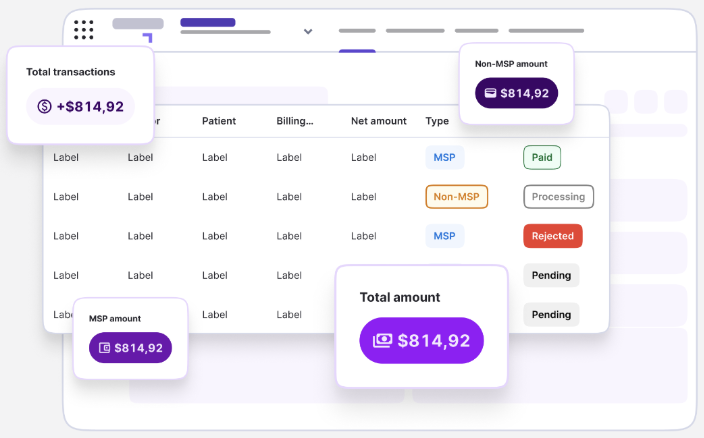
Petal Facturation supports both sides of the billing equation.
For physicians who want to manage billing themselves, Petal provides technology that helps simplify claim submission, tracking, reporting, and revenue visibility.
For physicians who want more support, Petal offers billing services that help reduce administrative burden and improve billing workflows with expert assistance.
That flexibility matters because physicians don’t all need the same solution.
Ready to simplify medical billing? Contact a Petal billing expert to find the right model for your practice
Improve your billing success rate:
FAQs: Billing software vs. billing services
What is the difference between billing software and billing services?
Billing software gives physicians tools to manage claims themselves. Billing services provide expert support to manage claim submission, rejection follow-up, reconciliation, reporting, and other billing tasks.
Is billing software enough for physicians?
It depends on the practice. Billing software may be enough for physicians with straightforward claims, internal administrative support, and confidence in their billing workflows. More complex practices may need additional service support.
When should physicians use billing services?
Physicians should consider billing services when billing takes too much time, claims are frequently rejected, payments are delayed, or provincial billing rules are difficult to manage internally.
Can physicians use both billing software and billing services?
Yes. Many physicians benefit from using both. Software provides automation and visibility, while services provide expert support and follow-up.
Does medical billing vary by province?
Yes. Billing requirements vary across provinces such as Quebec, Ontario, Alberta, and British Columbia. Physicians should choose a billing solution that understands their local billing environment.