





Points clés à retenir
- Start with the relationship: OHIP separates virtual care into Comprehensive Virtual Care for patients with an existing/ongoing physician relationship and Limited Virtual Care when that relationship doesn’t exist.
- Use visit format indicators for comprehensive care: Bill the eligible OHIP service plus K300A for video or K301A for telephone. Limited virtual care uses A101A for video or A102A for telephone.
- Check eligibility before submission: Patient and physician location, visit format, technology, documentation, and the underlying service all affect payment.
Ontario physicians bill virtual care through two OHIP pathways.
For an established or ongoing patient relationship, physicians generally bill the eligible underlying OHIP service and add K300A for video or K301A for telephone.
Without that relationship, physicians use A101A for a limited video visit or A102A for a limited telephone visit.
- Remember: The right claim starts with the relationship, then the service, then the visit format.
That order matters. Ontario’s model ties payment to the clinical service, the physician-patient relationship, and how the visit took place. It’s a simple step-by-step process, and one that is essential for getting paid right.
We’re going to go in-depth on each step in this cheat sheet, but it’s important to also consult the latest OHIP Schedule of Benefits and fees and the Ministry/OMA Virtual Care Billing Briefs for less common scenarios.
Step 1: Determine whether the visit is comprehensive or limited virtual care
Before choosing a code, determine whether an Existing/Ongoing Patient-Physician Relationship exists.
OHIP generally recognizes that relationship when the physician and patient had an insured in-person encounter within the previous 24 months; the patient is enrolled to that physician or another physician in the same eligible primary care enrollment group; or an eligible specialist or GP focused-practice video consultation establishes the relationship.
For many specialists and non-enrollment family practices, the 24-month window is critical. An in-person encounter resets the clock. An eligible specialist video consultation also establishes the relationship for subsequent comprehensive virtual follow-up.
Ontario OHIP virtual care billing codes cheat sheet
Scenario | What to bill | Payment | Key rule |
Comprehensive video | Eligible Appendix J service + K300A | 100% of corresponding in-person fee | Existing/ongoing relationship required |
Comprehensive telephone | Eligible Appendix J service + K301A | Usually 85% of corresponding in-person fee | Some listed services receive 95% |
Limited video | A101A | $20.00 | No K300A required |
Limited telephone | A102A | $15.00 | No K301A required |
Old COVID-19 virtual codes | K080A–K083A / K092A–K095A | Not payable for current services | Ended Nov. 30, 2022 |
K300A and K301A are visit format, or modality, indicators, not stand-alone visit fees. They pay $0 and identify whether an eligible comprehensive service occurred by video or telephone.
The former temporary pandemic K-codes stopped applying to services delivered on or after December 1, 2022.
Step 2: Match the service to the visit format
Appendix J identifies which insured services qualify for virtual delivery and which visit format applies.
For comprehensive virtual care, video generally receives the same payment as the corresponding in-person service. Telephone generally pays 85% of the in-person fee. OHIP pays K007, K005, K197, and K198 at 95% when delivered by telephone.
Physicians delivering video must use an Ontario Health Verified Virtual Visit Solution.
- Check the current Verified Virtual Visit Solutions list before adopting a platform. It’s important to remember that consultations and initial services require video rather than telephone.
Clinical requirements still apply. A virtual format doesn’t remove history, examination, or documentation elements attached to the underlying service. If the clinical situation requires a physical examination that the physician can’t complete virtually, the service requires an in-person encounter.
If a visit shifts between telephone and video, bill the visit format that represented more than 50% of the encounter. For time-based services, use the combined direct patient time and the dominant format.
12,000+ physicians trust Petal to simplify their billing.
Step 3: Use A101A and A102A only for limited virtual care
A101A and A102A apply to medically necessary virtual assessments delivered outside an existing/ongoing patient-physician relationship.
A101A — Limited Virtual Care by Video: $20.00
A102A — Limited Virtual Care by Telephone: $15.00
Both require a valid diagnostic code, and neither establishes an ongoing relationship. OHIP also pays only one limited virtual service per physician, patient, and day unless medical necessity supports manual review.
A common error follows from treating A101A or A102A as default virtual visit codes for established patients. When a qualifying relationship exists, select the eligible underlying service in Appendix J and add the correct modality indicator.
OHIP virtual care checklist before you submit
Follow these steps to confirm your claim is ready for submission:
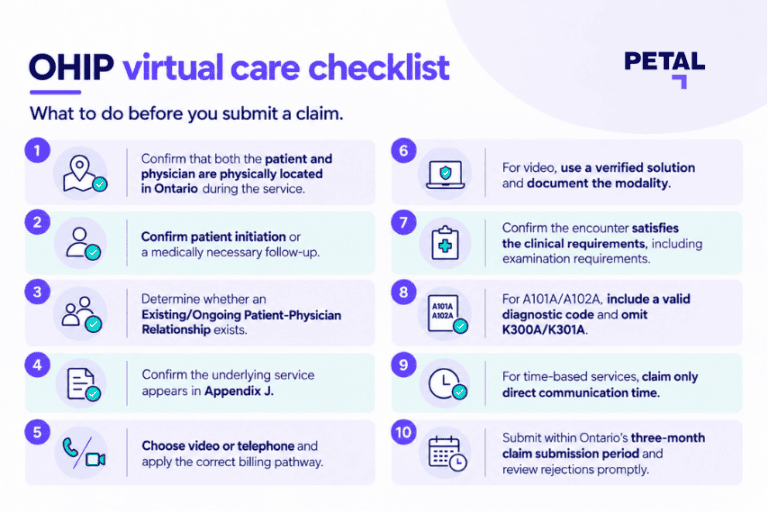
The Ministry of Health recommends frequent claim submission, which gives practices more time to identify and correct errors before claims become stale-dated.
Five virtual care situations worth checking twice
- Routine result reporting: A physician-initiated call to report a normal result usually forms part of the original insured service. A new medically necessary assessment that changes management follows different rules.
- A hands-on examination becomes necessary: If the physician determines that the service requires a direct physical encounter, the virtual service doesn’t qualify for separate payment. Arrange the in-person assessment within a clinically appropriate timeframe.
- Video loses its image: If audio remains but the physician no longer sees the patient, the encounter doesn’t meet the video definition. Use the telephone modality where the audio encounter supports an eligible service.
- An older virtual fee already describes the service: Ontario retained pre-existing codes for certain telephone or virtual services, such as G271 for long-term anticoagulant supervision. Use the code that best describes the service under the Schedule.
- Secure messaging follows a different status in 2026: Ontario’s two-year Secure Messaging Proof-of-Concept ended March 31, 2026. Don’t treat its K303A pilot process as a current general virtual-care billing pathway for services delivered after that date.
Starting to bill in Alberta, British Columbia, or Ontario?
Make virtual care billing part of your OHIP workflow
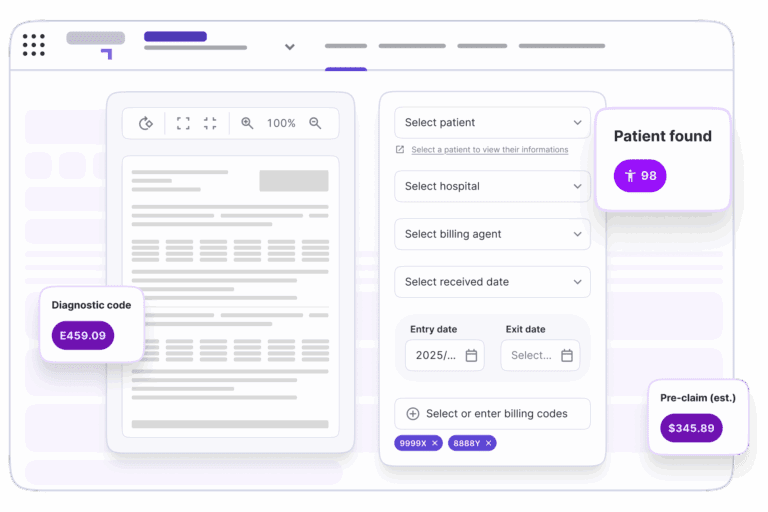
A reliable Ontario virtual care workflow follows the same sequence every time: verify the relationship, identify the insured service, confirm virtual eligibility, apply the modality, and document the encounter.
Petal Medical Billing Ontario combines OHIP expertise, claim management, and reconciliation support for physicians and groups across more than 40 specialties.
- For a broader review, pair this guide with Petal’s Ontario OHIP billing optimization checklist. Review the current Schedule before relying on any saved cheat sheet, since payment rules and eligible services change.
Reach out to see how expert billing support helps reduce administrative work and strengthen revenue capture.
FAQs: Ontario virtual care billing codes
What are the main OHIP virtual care billing codes in Ontario?
For comprehensive virtual care, physicians submit an eligible Appendix J fee schedule code plus K300A for video or K301A for telephone. For limited virtual care outside an existing/ongoing relationship, use A101A for video or A102A for telephone.
What’s the difference between K300A/K301A and A101A/A102A?
K300A and K301A identify the visit format—or modality—used for an eligible comprehensive virtual care service and carry a $0 value. A101A and A102A are stand-alone limited virtual care services for patients who don’t meet OHIP’s existing/ongoing relationship criteria.
How much do A101A and A102A pay?
The current Schedule lists A101A Limited Virtual Care by Video at $20.00 and A102A Limited Virtual Care by Telephone at $15.00.
Does OHIP pay telephone and video virtual visits at the same rate?
For comprehensive virtual care, eligible video services generally receive 100% of the corresponding in-person fee. Telephone services generally receive 85%, while K005, K007, K197, and K198 receive 95%.
Do both the physician and patient need to be in Ontario?
Yes. Both the physician and patient must be physically located in Ontario during the virtual service for the service to qualify as insured and payable under OHIP.
Are K080A, K081A, K082A, and K083A still valid for current virtual visits?
No. Ontario ended the temporary pandemic virtual-care K-codes on November 30, 2022. Claims using those codes for service dates on or after December 1, 2022 will lead to rejection.
Does OHIP require an approved platform for video visits?
OHIP requires eligible video services to use a Verified Video Solution. Ontario Health maintains the current Verified Virtual Visit Solutions list.
What’s the OHIP submission deadline for a virtual care claim?
The standard submission period for insured physician services rendered in Ontario is three months from the date of service.