







Points clés à retenir
- Each province follows similar billing journeys: While Alberta, BC, and Ontario use different organizations and terminology, new physicians complete many of the same steps before their first payment.
- Setting up billing early prevents payment delays: Registering with your provincial payer and obtaining your billing identifiers, as well as choosing a billing workflow, before your first clinic day supports promptly paid claims.
- Documentation supports every payment: Clear clinical notes, accurate coding, and complete patient information strengthen billing accuracy while simplifying claim corrections.
New physicians in Alberta, British Columbia, and Ontario follow a similar path to getting paid. After becoming licensed to practice, you register with your provincial health insurer, then set up your billing workflow, submit your first claims, and review remittances to affirm you’ve been paid correctly.
Graduating from residency is a major milestone. Getting paid as a physician is too.
Medical billing isn’t something most physicians learn in depth during training, yet it quickly becomes one of the most important responsibilities you’ll have.
Before your first payment arrives, you’ll need to complete several administrative steps, understand your province’s billing requirements, and establish a workflow that fits your practice.
Without this, you’ll waste time and start behind your peers.
- In Canada, providers are burdened with nearly 20 million hours on unnecessary administrative tasks annually. As this total continues to increase, wasting time on billing processes and claim rejections will stunt your practice’s growth.
Although provinces and territories have their own regulatory bodies, payment systems, and billing rules, they all follow the same broad journey. Understanding that shared framework makes it much easier to navigate your own province’s requirements.
This guide compares how physician billing setup works across Alberta, BC, and Ontario to help you successfully transition from residency to first payment.
Although provinces and territories have their own regulatory bodies, payment systems, and billing rules, they all follow the same broad journey. Understanding that shared framework makes it much easier to navigate your own province’s requirements.
This guide compares how physician billing setup works across Alberta, BC, and Ontario to help you successfully transition from residency to first payment.
| Alberta | Colombie-Britannique | Ontario |
Medical regulator | College of Physicians and Surgeons of Alberta (CPSA) | College of Physicians and Surgeons of British Columbia (CPSBC) | College of Physicians and Surgeons of Ontario (CPSO) |
Provincial payer | Alberta Health (AHCIP) | Medical Services Plan (MSP) | Ontario Health Insurance Plan (OHIP) |
Billing identifier | Practitioner ID (Prac ID) | MSP practitioner enrolment | OHIP billing number |
Primary billing reference | Schedule of Medical Benefits (SOMB) | MSP Payment Schedule | OHIP Schedule of Benefits |
After submitting claims | Review remittance statements and correct rejected or reduced claims | Review MSP payment reports and claim responses | Review remittance advice and resolve rejected claims |
Step 1: Become eligible to bill
Before you can submit your first claim, you need two things:
- Authorization to practice medicine
- Authorization to receive payment from your province’s health insurance plan
Many graduating residents assume these happen automatically. They don’t.
Your medical license allows you to practice independently, while your provincial billing registration allows the government to recognize you as an eligible provider and reimburse insured services. Missing either step will delay your first payments even if you’re already seeing patients.
Here’s how the process works across the three provinces.
Alberta
In Alberta, your first milestone is obtaining your practice permit through the College of Physicians and Surgeons of Alberta (CPSA). Once licensed, you’ll apply for your Practitioner Identification Number (Prac ID) through Alberta Health.
Think of these as serving two different purposes:
- CPSA authorizes you to practice medicine.
- Alberta Health authorizes you to bill insured services.
You’ll also need to provide information, such as your practice location and other registration details, before your Prac ID can be linked to Alberta’s billing system. Once everything is active, you’re eligible to submit AHCIP claims.
Colombie-Britannique
BC physicians begin by registering with the College of Physicians and Surgeons of British Columbia (CPSBC) before enrolling with the province’s Medical Services Plan (MSP).
MSP registration establishes you as a participating physician and connects you to BC’s provincial payment system. From there, you’ll complete the remaining enrolment steps needed to begin submitting insured claims.
Because MSP administers physician payments province-wide, completing registration before your first day of independent practice helps avoid unnecessary administrative delays.
Ontario
Ontario physicians first obtain independent registration with the College of Physicians and Surgeons of Ontario (CPSO) before applying for their OHIP billing number.
Once approved, physicians become eligible to submit insured claims through the Ontario Health Insurance Plan. Depending on your practice setting, additional administrative requirements may apply, but your OHIP billing number serves as the foundation for physician payment throughout your career.
Prepare before your first clinic day
Regardless of province, there are several practical tasks worth completing before your schedule fills up.
Here’s a billing checklist to get started during your first 90 days:
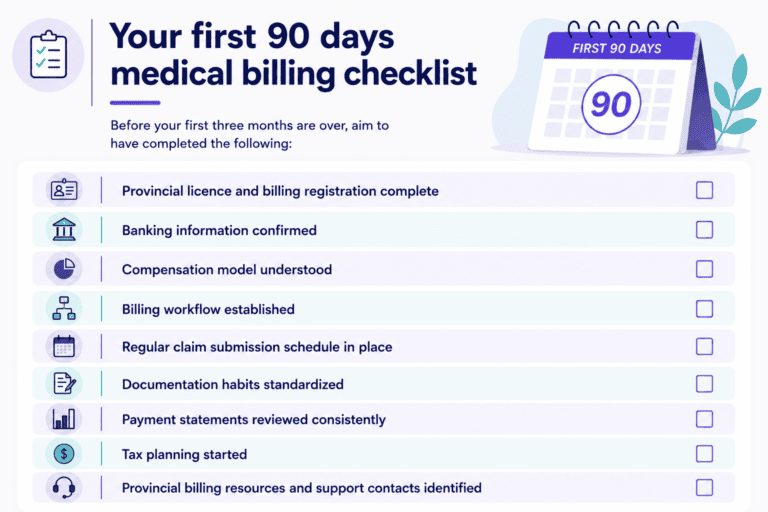
Completing these steps early allows you to focus on patients instead of paperwork during your first weeks in practice.
Physicians reported 9.4% more revenue and 161 hours saved on average
annually using Petal Billing.
Step 2: Set up your billing workflow
Once you’re eligible to bill, you’ll need to decide how your claims will be prepared, submitted, and monitored.
This decision often receives less attention than licensing, yet it affects your daily administrative workload for years to come.
- Whatever route you choose, don’t make simple mistakes in your billing. Check out the Top reasons for medical billing rejections in AB, BC, and ON.
Although every physician remains responsible for the accuracy of their claims, there are several ways to manage the billing process.
Self-managing with billing software
Some physicians prefer entering and submitting claims using dedicated billing software.
This approach provides direct visibility into every claim and payment while giving physicians complete control over their billing. It also requires learning provincial billing rules, reviewing remittances regularly, and correcting rejected claims independently.
Many new physicians choose this route when they want to become highly familiar with billing early in their careers.
Working with clinic staff
In many group practices and hospitals, administrative staff (Medical Office Assistants or MOAs) assist physicians by preparing or submitting claims.
This can limit administrative work for busy clinicians, although workflows vary considerably between organizations. Even when staff handle submissions, physicians remain responsible for ensuring claims accurately reflect the care they provided.
Using a billing agency
Some physicians outsource claim preparation and submission to specialized billing agencies.
Billing agencies often manage data entry, claim submission, payment tracking, and rejected claim follow-up. This option saves time, particularly during the first year of practice when physicians are still becoming comfortable with provincial billing requirements.
Combining software with expert support
Many physicians choose a hybrid approach that combines billing software with professional oversight.
This allows physicians to enter clinical information directly while experienced billing professionals review claims, identify potential issues, and assist with payment follow-up.
Regardless of which approach you choose, your billing workflow should make it easy to:
- Submit claims consistently
- Review payments regularly
- Identify rejected claims quickly
- Maintain accurate documentation
Those habits become increasingly valuable as your patient volume grows.
Step 3: Submit your first claim
Once your billing infrastructure is in place, you’re ready to begin the part most physicians associate with medical billing: submitting claims.
Although every province has its own billing codes and submission systems, the overall workflow looks remarkably similar.
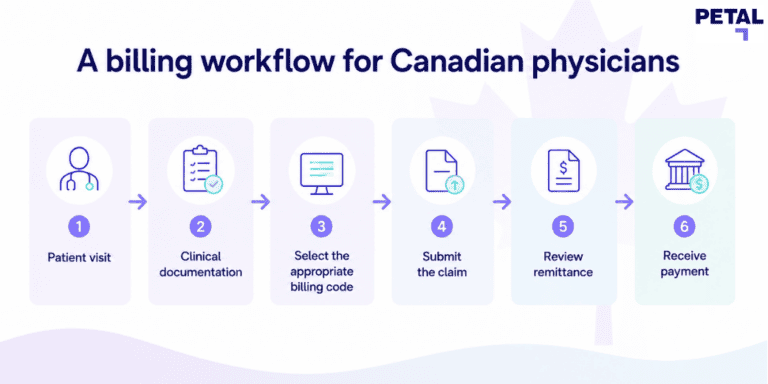
Every step matters.
Accurate billing begins long before you open billing software. Good documentation supports appropriate code selection, while consistent claim submission guides predictable cash flow and lessens the risk of missed deadlines.
Here’s what that process looks like across Alberta, BC, and Ontario.
Alberta
Alberta physicians submit insured claims to Alberta Health using the Schedule of Medical Benefits (SOMB) as their primary billing reference.
Choosing the correct base code is only part of the process. Many services also require physicians to consider applicable modifiers, including factors such as timing, location, patient complexity, or other qualifying circumstances.
Submitting claims regularly—ideally daily or weekly rather than waiting months—helps reduce coding errors while encounters remain fresh.
Alberta physicians should also review their remittance statements carefully because some claims may be accepted but paid at a lower value if an eligible modifier was missed. This type of “silent underbilling” is a common source of lost revenue for new physicians.
Colombie-Britannique
BC physicians bill insured services through MSP using the province’s payment schedule and billing requirements.
As with Alberta, accurate documentation remains essential. Patient eligibility, appropriate billing codes, and any required supporting information should all be confirmed before submission.
Virtual care provides a good example of province-specific differences.
- Use the BC virtual care billing codes cheat sheet and MSP checklist to streamline your virtual care billing.
BC physicians must follow MSP’s telehealth requirements, including using designated telehealth codes where available and adding claim notes when required. Certain services also have restrictions regarding patient consent, billing frequency, and documentation, making it important to understand the specific rules before submitting virtual claims.
Ontario
Ontario physicians submit insured services through OHIP using the Schedule of Benefits.
Documentation requirements influence whether claims are accepted. Referral information, diagnostic codes, counselling duration, and virtual care eligibility may all be required depending on the service provided.
For example, counselling services frequently require physicians to document time spent with the patient, while specialist consultations usually depend on complete referral information. Missing these details can result in reduced or rejected payments even when the clinical care itself was appropriate.
56,000+ providers and administrators trust Petal to simplify their billing.
Step 4: Review payments and manage rejected claims
Submitting a claim is only half the billing process.
The next step—reviewing your remittance—often determines whether you receive your full compensation.
Every province provides physicians with a remittance statement (sometimes called a payment report or remittance advice) that summarizes which claims were paid, reduced, rejected, or require follow-up.
- Tip: Review these reports regularly to identify issues early and correct errors within applicable deadlines. This is a strong billing habit worth developing.
For new physicians, this is one of the most valuable routines you can establish.
Here’s what that looks like across Alberta, BC, and Ontario.
Alberta
After Alberta Health processes your claims, you’ll receive a remittance statement outlining payments, adjustments, and rejected claims.
Common outcomes include:
- Claims paid exactly as submitted
- Claims paid at a reduced amount
- Claims rejected because additional information or corrections are required
Reduced payments deserve just as much attention as outright rejections. A claim may have been accepted, but if an eligible modifier wasn’t included or another billing requirement wasn’t met, you’ll receive less compensation than expected.
- And remember—audits happen to even the best Alberta physicians. Here’s how to stay prepared and navigate an audit if it occurs.
If vousr claim is rejected, read the associated error information carefully, determine what needs to be corrected, and resubmit it promptly where permitted.
Colombie-Britannique
BC physicians should review each MSP payment report to confirm claims have been processed as expected.
Rejected or adjusted claims often point to documentation issues, coding errors, or billing rules that weren’t fully met.
Virtual care is one area where careful remittance review becomes especially valuable. Requirements surrounding patient consent, telehealth coding, claim notes, and billing frequency continue to evolve, making it worthwhile to monitor payment reports for recurring issues.
Ontario
Ontario physicians receive remittance advice showing the outcome of each submitted claim.
When reviewing these reports, pay particular attention to services that involve:
- Referrals
- Counselling time requirements
- Preventive care incentives
- Virtual care eligibility
- Diagnostic coding
Many OHIP rejections result from incomplete documentation rather than incorrect clinical care. Missing referral information or insufficient counselling documentation, for example, delay or prevent payment until corrections are made.
Good billing doesn't eliminate every rejection
Even experienced physicians occasionally receive rejected claims.
Your goal should be having a consistent process for identifying issues and correcting them, to learn for the next claim.
A simple claim rejection response workflow looks like this:
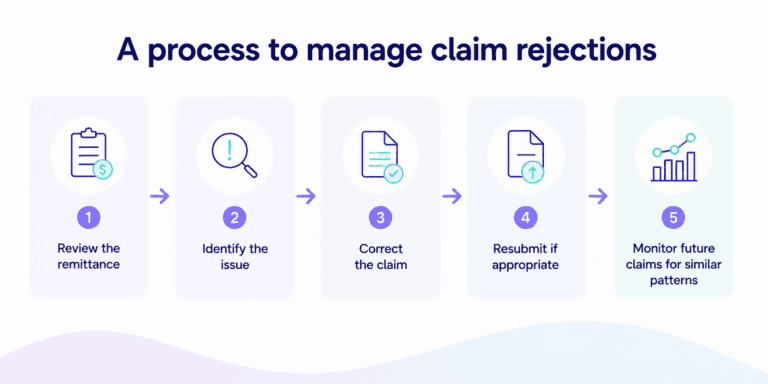
Over time, this approach transforms rejected claims from frustrating surprises into useful feedback that strengthens your billing accuracy.
Step 5: Common billing mistakes that new physicians make
Although Alberta, BC, and Ontario each use different billing systems, many of the mistakes made by new physicians are remarkably similar.
Fortunately, they’re also preventable.
By understanding where physicians most commonly lose revenue, you’ll establish good habits from the beginning of your career.
Waiting too long to submit claims
Most provinces allow physicians a defined window to submit claims, but that doesn’t mean you should wait until the deadline approaches.
As weeks pass, details become harder to remember. Documentation may require clarification, coding decisions become less obvious, and administrative backlogs begin to grow.
Submitting claims consistently—whether daily or weekly—supports accuracy and more predictable cash flow.
Choosing the wrong billing code
Every province publishes detailed billing schedules. Learning them takes time.
New physicians commonly focus on selecting the closest code rather than confirming they’ve chosen the most appropriate one.
Developing familiarity with the services you bill most often will improve both accuracy and confidence.
Missing eligible premiums or modifiers
Underbilling is often a bigger issue than overbilling.
Physicians frequently overlook premiums, modifiers, or incentive payments because they’re focused on documenting the primary service.
For example:
- Alberta physicians may forget applicable modifiers.
- Ontario physicians may overlook preventive care incentives.
- BC physicians may miss province-specific telehealth requirements.
Small omissions may only affect a single claim, but repeated over hundreds of encounters, they have a meaningful impact on annual income.
Incomplete documentation
Documentation supports every billing claim.
Your clinical notes should explain what happened during the encounter and support the service you’ve billed.
Across all three provinces, documentation commonly needs to reflect factors such as:
- Assessment complexity
- Procedures performed
- Counselling time
- Referrals
- Follow-up planning
- Virtual care requirements where applicable
Strong documentation also simplifies claim corrections and potential audits later in your career.
Ignoring remittances
Receiving payment doesn’t necessarily mean you’ve been paid correctly.
Some physicians rarely review remittance reports, assuming accepted claims require no further attention.
However, remittances provide valuable information about rejected claims, reduced payments, recurring documentation issues, and workflow improvements.
A five-minute review every billing cycle can prevent recurring errors from becoming long-term revenue loss.
Trying to learn everything at once
Medical billing is a professional skill.
No physician masters it during their first month of independent practice.
Instead of trying to memorize every billing rule, focus on building a repeatable workflow:
- Understand your province’s billing system
- Submit claims consistently
- Document thoroughly
- Review remittances regularly
- Learn from rejected claims
These habits create a strong foundation that becomes easier to build as your practice grows.
Save time for patients by simplifying billing
Your future self will be glad you invested in medical billing today.
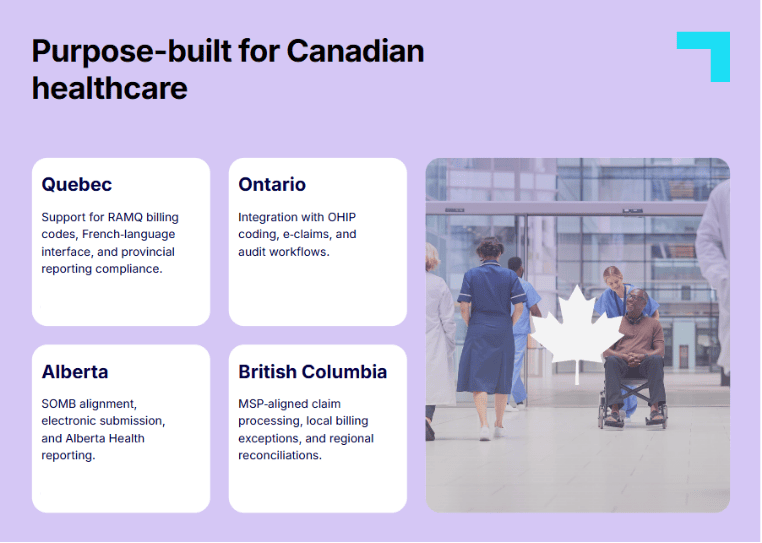
Facturation médicale provides tailored medical billing solutions for physicians in Alberta, Colombie-Britannique, Ontario, and Québec.
Achieve a higher claim acceptance rate for more stable revenue, fewer hours managing rejected claims, and greater confidence that your delivered services will be correctly compensated.
- Physicians using Petal Billing reported an average revenue increase of 9.4% and 3.1 hours saved per week compared to manual billing.
Enjoy the compounding benefits of effective billing by starting strong.
Build your thriving practice:
FAQs: New physician billing set-up
Is physician billing different in Alberta, British Columbia, and Ontario?
Yes. Each province has its own billing authority, fee schedule, billing codes, and administrative requirements. Alberta physicians bill through Alberta Health, BC physicians use the Medical Services Plan (MSP), and Ontario physicians bill through the Ontario Health Insurance Plan (OHIP). While the terminology differs, the overall process—from registration to claim submission and payment—is very similar.
What do new physicians need before submitting their first billing claim?
Before submitting claims, physicians should obtain their license to practice, register with their provincial payer, receive any required billing identifiers, confirm their banking and practice information, and establish a billing workflow for submitting and monitoring claims.
How often should physicians submit billing claims?
Although submission deadlines vary by province, most billing experts recommend submitting claims daily or weekly whenever possible. Frequent submissions improve cash flow, reduce administrative backlog, and make it easier to correct errors while patient encounters remain fresh.
Why are physician billing claims rejected?
Common reasons include incorrect billing codes, missing documentation, incomplete referral information, patient eligibility issues, omitted modifiers or premiums, and virtual care claims that don’t meet provincial billing requirements. Regular remittance reviews help physicians identify and correct these issues quickly.
How can new physicians improve billing accuracy?
Start by learning the billing codes you use most often, document every encounter thoroughly, submit claims consistently, review remittance reports each billing cycle, and investigate rejected claims promptly. Building these habits early helps reduce administrative burden and supports more predictable reimbursement throughout your career.