








Points clés à retenir
- Look beyond claim submission: A good medical billing provider delivers accurate claims, captures eligible earnings, manages rejections, and verifies that you were paid correctly.
- Choose support that fits the way you’ll practice: Residents may move between hospitals, clinics, locums, and different practice settings. Your billing provider should be able to move with you.
- Local expertise matters: Provincial fee schedules and billing rules change. Look for experts who understand your specialty, your province, and the billing environment you work in.
Graduating from residency means becoming responsible for much more than patient care.
Licensing, contracts, practice decisions, finances, and medical billing all arrive at once. And while you spent years learning how to practice medicine, billing probably received considerably less attention during training.
That makes choosing the right medical billing provider an important early-career decision.
Billing services differ significantly in their expertise, technology, reporting, performance measurement, and level of physician support.
There are a lot of options out there, and asking the right questions gives you a way to better understand whether you’re choosing a tool that meets your needs or one that does the bare minimum.
Before making such an important decision, ask your potential provider these 10 questions.
1. What percentage of claims are successfully paid without needing correction or resubmission?
Don’t settle for a vague promise of “high accuracy.”
Ask how the provider measures successful claims and what happens after submission. A useful metric should help you understand how often claims are paid correctly without requiring additional work.
Remember that an accepted claim isn’t necessarily a complete claim. A claim could still be underpaid if an eligible modifier, premium, or other billing opportunity was missed.
Here to help: Petal’s own new-physician billing guidance emphasizes reviewing payments for both rejected and reduced claims. This means claim documentation and reporting options are important for your own standards.
2. How quickly do you submit my claims after I send you my billing information?
Claim submission shouldn’t become a bottleneck.
Ask about the provider’s typical turnaround time from receiving your information to submitting a claim. Consistent submission management supports predictable cash flow. This, while reducing the risk of documentation questions emerging weeks later when an encounter is no longer fresh in your mind.
For a new physician managing new responsibilities and financial commitments, getting paid on time matters. You don’t want to worry about something that happened two weeks before.
3. What happens when one of my claims is rejected or refused?
Even strong billing processes don’t prevent every rejection. It happens. Managing those rejections separates the top-tier from the mediocre service providers.
The more revealing question is what happens next.
Does your provider identify the cause, make appropriate corrections, resubmit the claim, and follow up when necessary? Or do you receive an error message and have to figure it out yourself after it gets lost in the shuffle of everyday work?
Rejection management shouldn’t be another administrative task added to your list.
4. How do you make sure I'm billing for everything I'm eligible to receive?
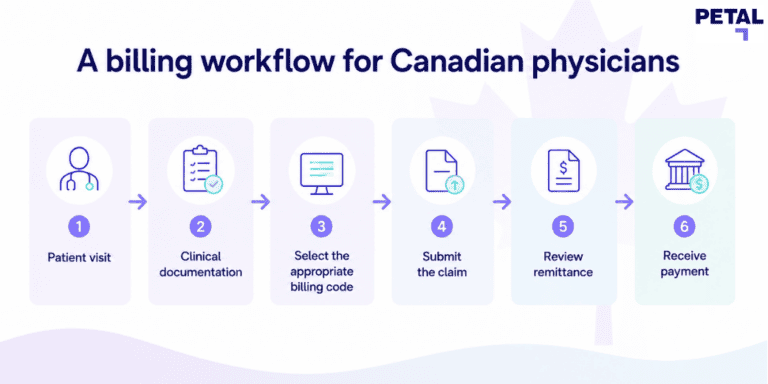
Correct billing isn’t only about avoiding errors. It’s also about capturing the compensation you’re entitled to for the care you delivered.
Depending on your province, specialty, location, schedule, and type of service, a patient encounter may involve:
- Eligible modifiers
- Premiums
- Stipends
- Or other billing considerations
Ask whether your provider actively reviews for these opportunities. Petal’s resident billing model, for example, combines billing expertise with checks designed to help capture eligible codes and modifiers rather than simply processing the information entered by the physician.
Tip: Ask for examples to the inevitable, “We routinely do regular reviews of all codes and combinations.” Dig into specialty experience or trends in code changes over the past several years.
5. Do you have billing expertise in my specialty?
Medical billing isn’t one-size-fits-all.
An emergency physician’s billing patterns may look very different from those of an anesthesiologist, pediatrician, obstetrician, or family physician.
Ask whether the provider has people who regularly work with physicians in your specialty and understand the codes, rules, premiums, and common billing scenarios associated with your work.
Petal’s local billing teams have expertise spanning more than 40 specialties.
6. Can you support me if I work as a locum or across multiple hospitals, clinics, or practice settings?
Your first year after residency may not involve one job at one location.
You might combine hospital shifts with clinic work, pick up locums, cover different facilities, or change practice settings as opportunities arise. Not every physician experience is a straight line. That’s just reality.
Your billing provider shouldn’t limit that flexibility. Ask whether it can manage different locations and types of work while still giving you a clear picture of your claims and earnings.
The easier your billing follows you, the easier it is to build the career you want.
7. Will you help me with registration and getting set up to bill independently?
Before your first claim can be submitted, you need to be properly registered to bill your provincial health insurer.
For residents, this is an especially important question because you may be navigating the process for the first time.
Ask whether the billing provider helps with registration, required identifiers, paperwork, and the transition to your first independent claims—or whether you’re expected to arrive with everything already completed.
Here to help: Petal’s resident support is designed to guide physicians from provincial registration through first claim submission.
8. How easy is it to send you the information and documentation you need?
A billing service should reduce administration, not simply move it somewhere else.
Ask how you’ll submit billing information and supporting documents. For example:
- Can you upload documents digitally?
- Can information be sent from your EMR or EHR?
- Can you submit information from your phone when moving between practice locations?
Look at the whole workflow. A convenient, secure intake process makes the difference between billing becoming a quick routine and another task waiting for you after your shift.
9. Can I see the status of my claims and what I've actually been paid?
Billing support is at its best when you can send over your documents and you trust everything to happen from there. You still should have the option and ability to review your claim status. There should be no black boxes or hidden timelines.
This means understanding what’s been submitted, what’s been paid, what’s outstanding, and which claims require follow-up.
Ask what reporting is available and how easily you can verify your earnings. Transparency matters because receiving a payment doesn’t automatically confirm that every service was billed and paid as expected.
Physicians using Petal earned $34,346 more annually on average compared to manual billing.
10. Who do I contact when I have a billing question—and how quickly will they respond?
Especially early in your career, billing questions are inevitable.
Find out whether you’ll have a dedicated billing expert who understands your practice or whether every question enters a general support queue. Ask how support works—phone, email, chat, or another channel—and what response times you can expect.
The best support shouldn’t only solve today’s problem. Over time, having someone who understands your practice can help you become more confident about how your billings work.
Bonus question: How do you stay current when provincial billing rules and fee schedules change?
Billing rules don’t stand still.
Provincial policies, fee schedules, programs, codes, and requirements evolve, and keeping track of every update shouldn’t become another job for a busy physician.
That’s why local expertise is worth asking about.
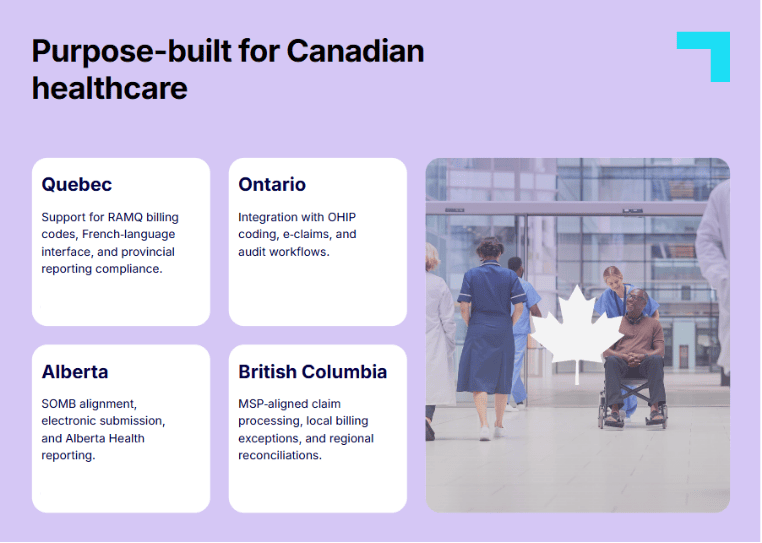
Look for a provider whose billing professionals aren’t simply applying a generic national process. Ideally, the same team supporting your claims every day should understand your provincial payer, local billing requirements, and the realities of practicing medicine in your province.
Here to help: Petal’s approach combines dedicated support with province-specific billing expertise, including local specialists who continuously monitor changing policies, fee schedules, and coding requirements.
Start independent practice with a billing partner behind you
You trained to become a physician. Leave the billing expertise to us.
Facturation médicale helps make the transition from residency to independent practice simpler.
- Access dedicated billing experts, specialty-specific knowledge, proactive claim and rejection management, digital document intake, transparent reporting, and deep local expertise.
That means support before your first claim, assistance when something doesn’t go as expected, and a billing workflow that evolves alongside your career.
Most importantly, Petal provides something software alone can’t: an experienced billing partner working behind the scenes to help ensure your claims are accurate, complete, and followed through to payment.
Start your career with greater confidence in your billings:
FAQs: Choosing a medical billing provider after residency
When should residents choose a medical billing provider?
Ideally, start evaluating billing options before entering independent practice. This gives you time to complete provincial billing registration, establish your workflow, and understand how claims will be submitted before your first shifts as an independent physician.
Is billing software the same as using a medical billing service?
Not necessarily. Billing software generally gives physicians tools to prepare, submit, and monitor claims. A full-service billing provider can add human expertise by reviewing billings, managing submissions, helping resolve rejections, identifying eligible billing opportunities, and answering questions.
Do medical billing providers handle rejected claims?
Services differ, so always ask. Strong billing support should include identifying rejected or reduced claims, determining what needs to be corrected, resubmitting eligible claims, and following up when necessary rather than leaving the entire process to the physician.
Why does specialty expertise matter when choosing a billing provider?
Different specialties have different billing patterns, codes, modifiers, premiums, and documentation requirements. A billing professional who regularly works with your specialty is better positioned to recognize common billing scenarios and potential missed opportunities.
Why should I choose a billing provider with local provincial expertise?
Medical billing requirements differ by province and change over time. Local experts understand the provincial payer, fee schedule, programs, billing rules, and common issues physicians encounter where they practice. That expertise can help residents spend less time interpreting billing rules and more time focusing on their patients and careers.