






Points clés à retenir
- Administrative work is consuming the margins of the clinical day: 69% of physicians surveyed identified documentation and charting as a major source of time or effort.
- Unfinished work becomes administrative debt: More than half of physicians (54%) said personal time or leaving on time suffers when their workday runs behind.
- Physicians want reclaimed time to create relief, not simply more volume: 80% prioritized finishing earlier, protecting personal time, or reducing cognitive load.
Data shows how documentation, billing, and fragmented workflows keep physicians working long after the clinical day should be over.
There is a familiar assumption behind many conversations about physician productivity: if we make administrative work faster, physicians will have more capacity.
More capacity to see patients. More capacity to respond to demand. Increased capacity to grow their practice.
A recent survey of physicians by Petal suggests something more fundamental is happening.
Physicians are running out of hours in a day.
When Petal asked what happens when the workday falls behind, 54% said their personal time or ability to leave on time suffers. Yet the work competing with that personal time remains, as 43% said billing gets delayed or missed.
That combination reveals an important dynamic.
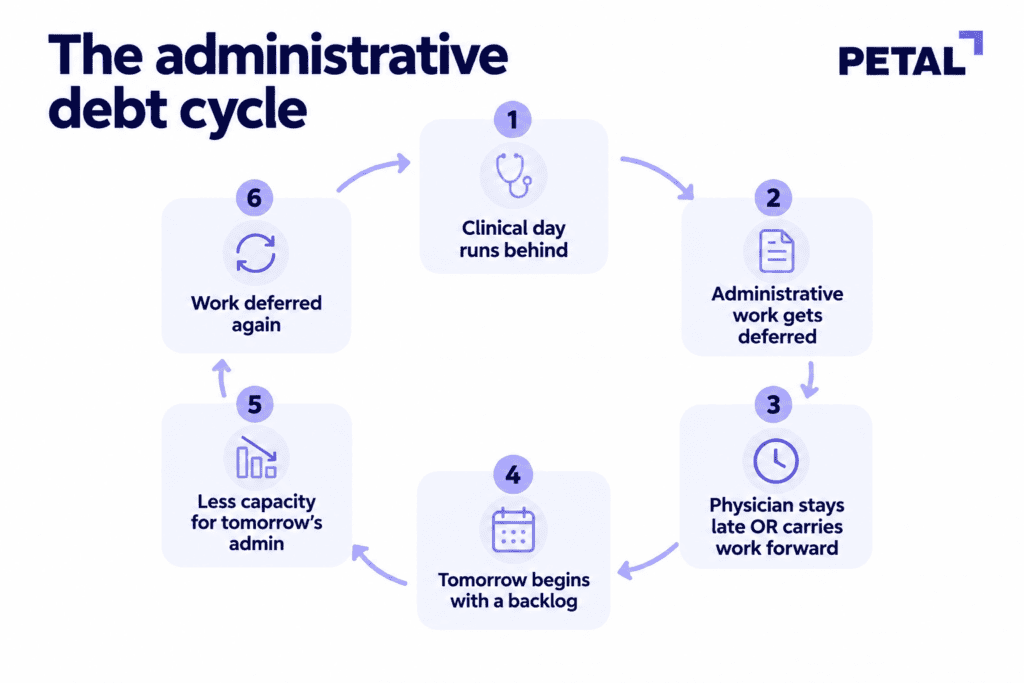
A physician can stay late and sacrifice personal time to finish the work. Or they can leave and carry unfinished work into tomorrow, the day after, or ultimately the weekend.
Either way, they take the brunt of this inefficiency.
And over time, that creates something healthcare organizations should be paying much more attention to: administrative debt.
The clinical day is surrounded by administrative work
Administrative burden is too often treated as though it were one discrete task. A chart that takes too long to close, a form that needs to be completed, or a billing process that could be simplified.
Physicians experience it differently.
It’s the accumulation of dozens of small obligations wrapped around patient care.
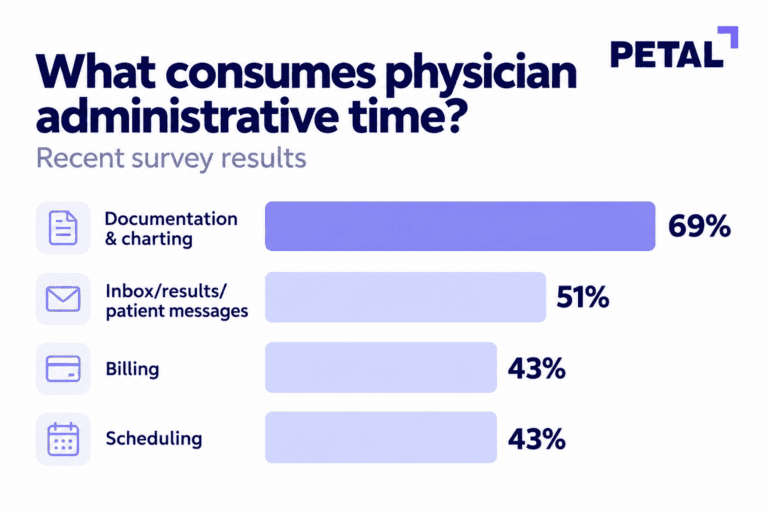
Results from Petal’s survey found that 69% of physicians identified documentation and charting as one of the tasks requiring the most time or effort in their workflow. That makes documentation the clearest pain point, but hardly the only one.
51% pointed to inbox management, lab results, and patient messages. Billing and scheduling were each selected by 43%.
The significance is that these tasks compete for the same limited pockets of time. For example:
- A physician may need to document the previous encounter while preparing for the next one.
- Results arrive while the schedule is already running behind.
- Billing accumulates while the immediate priority remains the patient in front of them.
- Messages, forms, and follow-ups wait in the background.
What this means: There isn’t enough time for everything and administrative work gets compressed into the margins of the day.
And eventually, those margins disappear.
The friction is built into the workflow
Indicators from the survey also help explain why this work is so difficult to contain.
51% of respondents said information being spread across systems makes administrative work harder to solve. Another 43% cited too many manual steps, while 37% said their EMR or EHR is too slow or limited.
These responses point to a workflow problem rather than any single administrative task when taken together.
The physician absorbs an additional amount of friction every time information is found in another system, a task completed manually, or work reconstructed after an interruption.
A minute here may not sound consequential.
But healthcare workflows operate at enormous frequency. Small amounts of friction repeated throughout the day become meaningful amounts of time.
Eventually, work that should have fit inside the clinical day no longer does.
Petal’s survey reflects that reality directly: 40% said administrative work is difficult to solve because it happens after hours.
That is where an efficiency problem becomes a work-life problem; and where administrative burden starts turning into administrative debt.
Did you know Petal helped one hospital save 8,000 hours a year in administrative burden?
When physicians fall behind, there is no clean reset tomorrow
Imagine a physician whose afternoon clinic runs late.
Documentation is still open. There are results to review. Several billing items still need attention. The physician could stay and finish everything.
But doing so comes at the expense of dinner, family time, exercise, sleep, or simply having an evening that doesn’t belong to work. Or the physician can leave.
That protects tonight but the unfinished work doesn’t reset overnight.
This is what makes administrative burden so difficult to solve through individual effort alone.
The work compounds.
One respondent described the reality in five words: “Doing my billing at midnight.”
That comment captures the trap particularly well.
Billing is delayed because the physician wants to leave on time. But eventually that billing has to be completed.
The same is true of documentation. And inbox management. And follow-ups.
Physicians today are stuck paying down yesterday’s administrative debt while simultaneously accumulating today’s.
Personal time becomes healthcare’s overflow capacity
When the workday runs behind, 54% of physicians said personal time or leaving on time is what gets delayed or missed most often.
That finding deserves to be viewed as more than a work-life balance statistic. It shows where excess administrative demand ultimately goes.
When the system cannot absorb the work, the physician does.
Personal time becomes overflow capacity—used to close charts, finish billing, review results or catch up on messages that could not fit into the clinical day.
If that work isn’t completed tonight, it becomes tomorrow’s backlog instead. Either way, the cost remains with the physician.
The value of an extra hour isn’t necessarily another appointment
Petal asked physicians what they would most want to do if administrative improvements could return meaningful time to their day.
The response was striking.
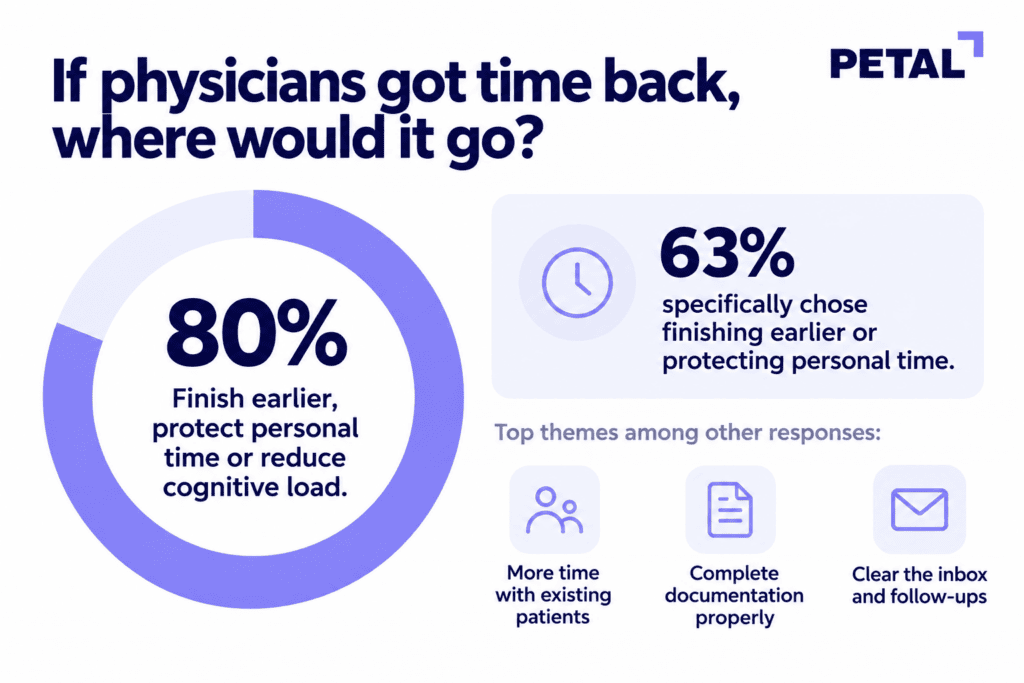
63% said they would finish work earlier or protect their personal time. Another 17% said they would use the time to reduce stress or cognitive load.
Combined, that’s 80% of physician respondents who prioritized some form of balance or relief.
Only a small percentage prioritized seeing more patients. Others wanted more time with the patients they already have or enough capacity to complete documentation and follow-ups properly.
This doesn’t mean physicians are unconcerned with productivity. It suggests we may be defining productivity too narrowly.
If a physician can finish documentation while the encounter is still fresh, complete billing without revisiting the day at night, and leave without an inbox hanging over them, the benefit isn’t simply that a task took less time.
The goal should be to stop work from following physicians home
Healthcare has spent years looking for ways to help physicians move faster.
There is another question worth asking: What would it take for physicians to actually be finished when the workday ends?
That means looking beyond isolated productivity gains and addressing the friction that creates administrative debt in the first place. For starters:
- Documentation shouldn’t unnecessarily compete with patient care.
- Billing shouldn’t depend on physicians reconstructing their day hours later.
- Schedule development and maintenance shouldn’t add stress or time to a clinic day.
- Information shouldn’t require navigating multiple disconnected systems.
The promise of better physician workflows isn’t that every reclaimed minute gets converted into another unit of productivity.
Sometimes the most meaningful outcome is much simpler. The chart is closed. The billing is done. The inbox is under control.
Fixing administrative debt means reducing the fragmented systems, manual steps, and disconnected workflows that cause work to spill beyond the clinical day in the first place.
Reclaiming physician time is more than a capacity consideration for the system. It’s about making sure that when the last patient leaves, the physician can too.
And the physician gets to go home without taking the rest of the workday with them.
Looking to find out how to trim your administrative burden?
FAQs: Physician administrative debt trends
What is physician administrative burden?
Physician administrative burden refers to the non-clinical work physicians complete alongside patient care, including documentation, charting, billing, scheduling, reviewing results, managing patient messages and completing forms or follow-ups.
Petal’s survey suggests the burden is rarely caused by a single task. Instead, multiple administrative workflows compete for the same limited periods of time throughout the clinical day.
What administrative tasks take the most time for physicians?
In Petal’s survey, 69% of physicians identified documentation and charting as one of the tasks requiring the most time or effort.
Other commonly identified administrative demands included:
- 51%: Inbox management, results and patient messages
- 43%: Medical billing
- 43%: Scheduling
How does administrative burden affect physicians’ personal time?
When the workday runs behind, 54% of physicians surveyed said their personal time or ability to leave on time is delayed or missed most often.
Administrative work that cannot be completed during the clinical day may therefore be finished after hours or carried into the following day, creating an ongoing backlog.
Why is physician administrative work difficult to reduce?
Petal’s survey identified several sources of workflow friction.
51% of respondents said information being spread across different systems makes administrative work harder to address. 43% cited too many manual steps, while 37% said their EMR or EHR was too slow or limited.
These issues mean physicians may need to repeatedly search for information, switch between systems or manually complete tasks that could otherwise be streamlined.
How much physician administrative work happens after hours?
In Petal’s survey, 40% of physicians said administrative work is difficult to solve because it happens after hours.
This finding reinforces the relationship between workflow efficiency and physician work-life balance: when administrative work does not fit into the clinical day, it frequently moves into personal time.
What would physicians do with more time in their day?
Most physicians surveyed did not identify seeing more patients as their first priority.
63% said they would finish work earlier or protect their personal time, while another 17% would use reclaimed time to reduce stress or cognitive load.
Combined, 80% prioritized some form of balance or relief. Other physicians indicated that additional time could be spent with existing patients or used to properly complete documentation and follow-ups.