







Key takeaways
- Provincial billing rules change regularly. Fee schedules, codes, modifiers, submission requirements, payment models, and explanatory rules can change throughout the year.
- Strong billing processes combine official monitoring with real-world claim intelligence. Bulletins matter, but rejected claims and adjudicator feedback reveal how rules are actually being applied.
- A network of billing experts reduces the burden on physicians. When one agent learns how a rule affects a claim, that knowledge is shared across the team.
Medical billing rules in Canada change throughout the year and differ by province, making ongoing monitoring essential for accurate physician billing. Updates to fee schedules, billing codes, modifiers, submission requirements, and payment models affect claims in Quebec, Ontario, Alberta, British Columbia, and beyond.
That’s why medical billing isn’t a static administrative task.
A code that was appropriate six months ago may be revised. A modifier may have new conditions. New code combinations are implemented for maximum claim opportunities.
For physicians, keeping up with every change becomes another layer of administrative work.
These challenges are present for administrative staff like medical office assistants as well. For a medical billing team, it’s part of the job.
Physicians should understand the fundamentals of how they are paid, but they shouldn’t have to spend clinical time monitoring government bulletins and comparing fee schedules.
- This is especially true given that physicians collectively spent nearly 20 million hours on administrative tasks last year and burnout is near record highs.
The goal at Petal is to make that complexity operational: monitor the change, interpret what it means, apply it to billing workflows, and share what the team learns.
Why provincial medical billing rules require continuous monitoring
Canada doesn’t have one national physician billing system. Each province maintains its own schedules, codes, payment rules, submission processes, and communication channels.
Even within one province, changes arrive in different forms and at different times:
- Ontario’s Ministry of Health uses OHIP INFOBulletins to communicate payment, policy, program, and software changes. In 2026, Ontario introduced new fee schedule codes, delisted others, revised existing codes, and changed fee values effective April 1. Related claims-processing changes were then implemented in stages through May, June, and July.
- In Quebec, RAMQ billing manuals are updated repeatedly as agreements and administrative rules change. The family physician fee-for-service manual alone saw multiple revisions during the first half of 2026, alongside Info-RAMQ updates and more targeted Acte-info notices.
Additional processes are seen in Alberta and in BC.
The practical lesson: checking the rules once a year isn’t enough.
How Petal billing teams respond to change
A strong billing operation needs more than access to a fee schedule. It needs a process for turning new information into day-to-day action.
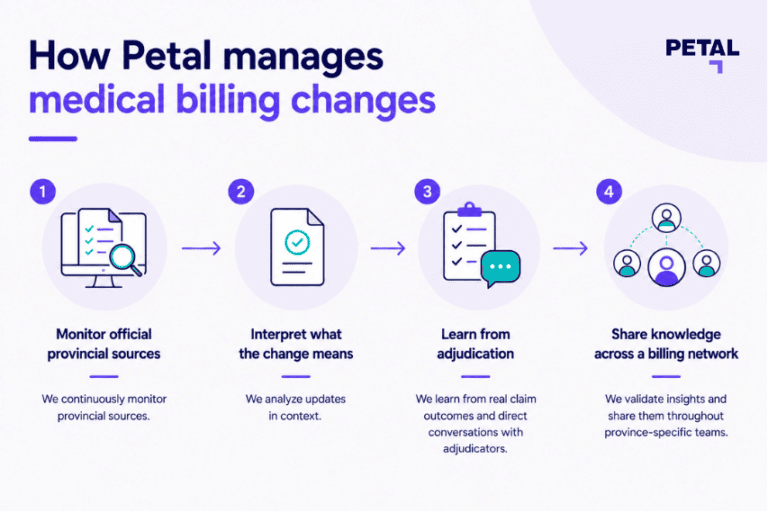
1. Monitor official provincial sources
The first layer is watching the sources where provinces publish changes.
In Alberta, Alberta Health publishes AHCIP bulletins and maintains the Schedule of Medical Benefits (SOMB). Accredited H-Link submitters also retrieve bulletins and other information electronically.
- Example: Petal’s Alberta team adds another layer of internal automation with an in-house developed program that crawls and then prompts agents to review changes as they are immediately published publicly.
The team also monitors the Alberta Medical Association’s Fee Navigator, which brings together SOMB information, governing rules, explanatory codes, and practical billing advice. Alberta also makes regular updates public through its Bulletins for health professionals.
- Get more from your Alberta virtual care with our cheat sheet and AHCIP checklist.
Ontario teams operate in a different information environment. OHIP INFOBulletins cover everything from new fee codes and diagnostic codes to primary care payment changes, security requirements, and claims-processing adjustments.
The source changes by province. The principle doesn’t: monitor continuously.
2. Interpret what the change means for claims
A bulletin explains what has changed. It doesn’t always explain every scenario a physician or billing agent will encounter.
A change may affect only certain specialties, locations, service dates, payment models, or combinations of codes. It may also require a software update or different documentation.
Ontario’s 2026 changes are a good example. The April update added codes, removed codes, revised descriptions and values, and changed rules for certain services. Later bulletins clarified or implemented specific items through staged system updates.
- Billing in Ontario? Optimize your claim process using this guide.
A billing team has to translate that sequence into the right action for the right claim.
Physicians using Petal earned $34,346 more annually on average compared to manual billing.
3. Learn from adjudication, not just announcements
Official communications are essential, but teams also learn from what happens after claims are submitted.
This is especially relevant in Alberta. Petal’s billing team may encounter a rejected or reduced claim, from which they speak with an Alberta Health claims adjudicator.
This allows the team to identify a more specific interpretation of a rule before sharing that learning with other agents.
Some smaller billing rules become clear through this hands-on process before they appear in broader educational material. As one Petal billing leader described it, the team “learns and shares in real time.”
A single agent’s learning then becomes a team-wide improvement.
For physicians, the benefit’s straightforward: they don’t have to personally discover the same issue through their own rejected claims.
4. Share knowledge across a billing network
Medical billing expertise becomes more valuable when it’s shared. No billing agent is an island.
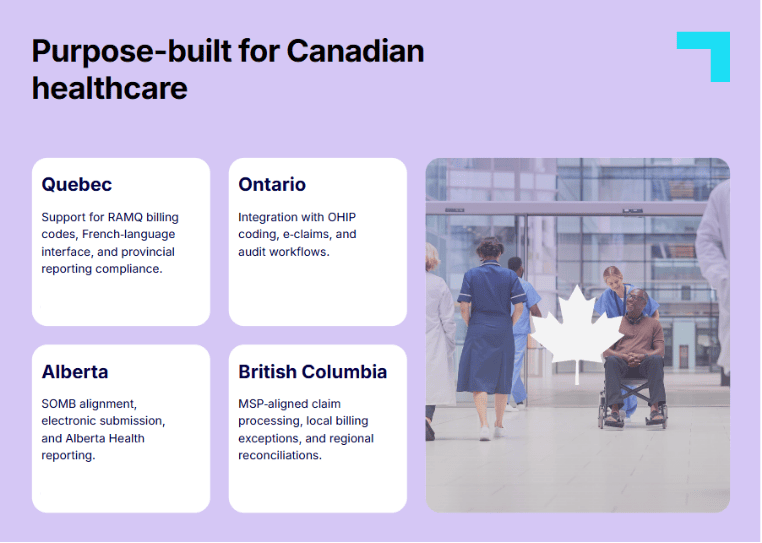
Petal supports physicians across Quebec, Ontario, Alberta, and BC with province-specific workflows for RAMQ, OHIP, AHCIP, and MSP billing. Billing isn’t treated as an individual agent working alone.
When a new interpretation or practical billing tip emerges, the goal is to validate it and make that knowledge available to the people handling claims.
That network effect is difficult to replicate when a physician is managing billing alone.
Fun fact: Petal billing agents often discover small changes and code modifiers before health authorities make them public, because our team submits thousands of claims weekly.
What provincial billing change looks like in practice
The details vary substantially by region.
In Quebec, RAMQ publishes physician billing manuals, Info-RAMQ communications, and Acte-info notices. Changes may relate to agreements, administrative instructions, location codes, supplements, or billing conditions. In 2026 alone, RAMQ published numerous revisions to its family physician manuals and communications.
In Ontario, a single policy initiative can trigger several months of fee schedule and claims-system updates. Billing teams may need to track both the effective date of a rule and when the claims system can process it correctly.
In Alberta, teams monitor AHCIP bulletins, the SOMB, H-Link communications, and AMA Fee Navigator while also learning from claim adjudication. The current SOMB became effective April 1, 2026, but accurate billing still depends on understanding governing rules, modifiers, explanatory codes, and practical guidance.
In BC, the Medical Services Commission publishes the MSP Payment Schedule and summaries of changes, while Doctors of BC maintains Fee Guide resources and billing updates. Changes aren’t always linear: planned changes to virtual Group Medical Visit fees, for example, were postponed, meaning teams needed to recognize that a previously announced implementation date no longer applied.
Keeping the physician experience simple no matter what
Medical billing will continue to evolve as healthcare does.
A capable billing partner should be monitoring the rules, understanding how they apply, responding when adjudication reveals something new, and sharing that knowledge across the team.
That doesn’t replace the physician’s responsibility to document care accurately. It does reduce the amount of provincial billing administration that has to sit on the physician’s desk.
Petal Billing combines medical billing technology with hundreds of billing experts across Canada, supporting province-specific workflows in Quebec, Ontario, Alberta, and British Columbia.
Because when billing rules change, the best outcome isn’t simply knowing that they changed.
It’s having a process that makes the change feel almost invisible to the physician.
Stay ahead of billing changes impacting your revenue:
FAQs: Medical billing rules in Canada
How often do medical billing rules change in Canada?
Medical billing rules can change throughout the year. Provincial governments and medical associations may introduce new billing codes, revise fee values, change eligibility requirements, update modifiers, or clarify how existing rules should be applied. This is why medical billing requires ongoing monitoring rather than an annual review of the fee schedule.
Who sets medical billing rules in Canada?
Physician billing rules are primarily managed at the provincial level. Ontario physicians bill through OHIP, Alberta physicians through AHCIP, Quebec physicians through RAMQ, and British Columbia physicians through MSP. Each province maintains its own fee schedules, billing codes, submission requirements, and communications about changes.
How do medical billing teams keep up with provincial billing changes?
Medical billing teams monitor official government bulletins, provincial fee schedules, medical association guidance, claims-processing updates, and other billing communications. They also learn from rejected claims and interactions with provincial claims adjudicators. At Petal, billing knowledge can then be shared across teams so individual agents and physicians don’t have to solve the same issue independently.
What happens when a physician billing code changes?
When a billing code or rule changes, the appropriate response depends on the province and the nature of the change. A billing team may need to use a new code, adjust a modifier, change how a service is submitted, or review claims affected by the new rule. In some cases, billing agents can recognize what a physician intended to bill and apply the updated billing requirements.
Can a medical claim be rejected because billing rules have changed?
Yes. Claims can be rejected, reduced, or returned when they no longer meet current provincial billing requirements. A rejection can also reveal how a provincial payer is interpreting a newer or more specific rule. Experienced billing teams investigate these responses, correct claims where appropriate, and use what they learn to improve future submissions.
Do physicians need to monitor OHIP, RAMQ, AHCIP, or MSP billing updates themselves?
Physicians should understand the billing requirements relevant to their practice, but they don’t necessarily need to personally monitor every provincial bulletin or fee schedule update. A medical billing service can take on much of that administrative work by tracking changes, interpreting their impact, and applying them to the physician’s billing workflow.
Are medical billing rules the same across Ontario, Quebec, Alberta, and British Columbia?
No. Each province operates its own physician payment system. Ontario uses OHIP, Quebec uses RAMQ, Alberta uses AHCIP and the Schedule of Medical Benefits, and British Columbia uses MSP. The codes, fees, modifiers, submission processes, and documentation requirements can differ considerably between provinces, which makes province-specific billing expertise important.
How does Petal respond when provincial medical billing rules change?
Petal combines billing technology with province-specific billing expertise across Quebec, Ontario, Alberta, and British Columbia. Billing teams monitor relevant provincial sources, review how changes affect claims, investigate new adjudication patterns, and share practical knowledge across the organization. The goal is to manage billing complexity behind the scenes so physicians can remain focused on patient care.