




Points clés à retenir
- Better patient flow improves access to care: Data helps healthcare organizations identify bottlenecks and move patients through the system more efficiently.
- Healthcare analytics enables proactive planning: Forecasting tools help organizations anticipate demand and address constraints before they affect patients.
- The right metrics guide better decisions: Tracking patient flow and capacity indicators helps leaders focus on what matters most.
Healthcare organizations use data to improve patient flow and capacity by identifying bottlenecks, forecasting demand, allocating resources more effectively, and supporting faster operational decisions.
Patient demand continues to grow while healthcare organizations face mounting, systemic challenges.
- In Canada, 5.9 million adults lack access to primary care while 79% of the health workforce reports feeling burnt-out.
Ongoing staffing shortages, financial pressures, and patient expectations pressure healthcare leaders and providers. They’re being asked to improve access and efficiency without proportionally increasing resources.
To meet these challenges, many organizations turn to data-driven approaches that describe how care is delivered and how services can optimize.
Explore how healthcare organizations use data to improve patient flow, strengthen healthcare capacity management, measure performance, and turn insights into meaningful operational improvements.
1) How data improves patient flow
Patient flow affects nearly every aspect of healthcare delivery.
When patients encounter delays moving between care settings, waiting for appointments, or accessing treatment, the impacts extend beyond individual experiences. Bottlenecks place burden on already stretched care teams, limit access for other patients, and make it harder for organizations to use their resources effectively.
This is why healthcare organizations increasingly rely on data to improve patient flow management.
Data provides real-time visibility into how patients move through a network, whether that network includes hospitals, primary care clinics, specialty services, community providers, or virtual care programs.
These insights support better operational decisions. When healthcare delivery organizations adjust workflows and direct patients toward the most appropriate care setting, patients and providers see long-term benefits.
The result is a more coordinated care experience.
Since 2022, the Hub Patient has operationalized connected care toward smarter patient flow across Quebec. The results:
- 814,000 avoided ED visits and 353,000 redirected to primary care clinics.
- 12.5% fewer low-acuity ED visits (CTAS 4–5) compared to pre-Patient Hub levels.
In practice: A regional health network sees that patients entering through 811, emergency departments, or online booking channels are waiting too long for appropriate follow-up care. The network redirects patients to available primary care capacity by analyzing demand and appointment availability, helping them access the right care sooner.
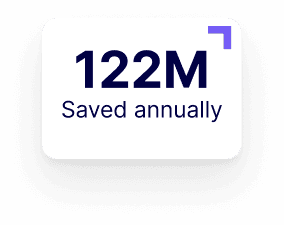
Quebec saved $339 cumulatively since 2022 using Patient Hub.
2) How data eases capacity management
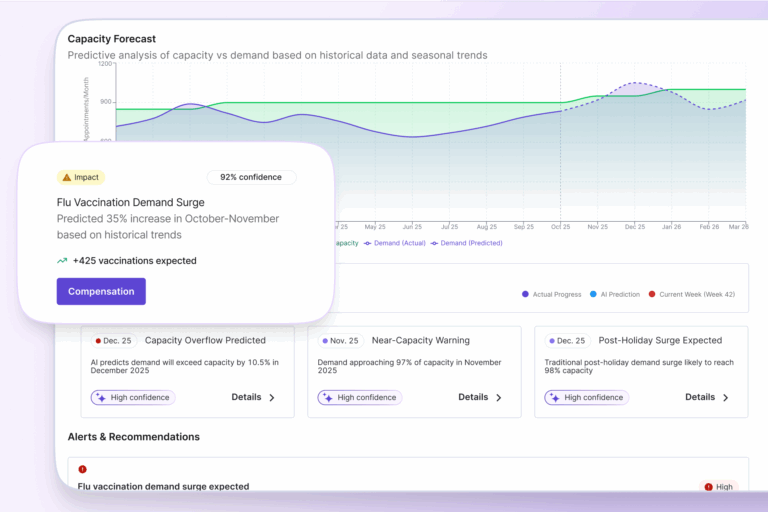
While every healthcare organization operates with finite resources, this reality rarely satisfies patients facing declining care quality.
One key issue across Canadian care systems: care settings are overcapacity.
This frustrates patients and worsens care outcomes. Today, 49% of family physicians in Canada reported working beyond their desired capacity; 90% of nurses report some level of burnout; and more than 50% of physicians plan to cut their hours.
Fundamentally, many healthcare organizations struggle to match supply and demand.
When demand exceeds available capacity, wait times grow, providers become overextended, and access to care suffers.
Rather than relying solely on historical assumptions or manual planning, healthcare leaders use data to understand how capacity is being utilized across their organization. Effective teams stay on top of:
- Occupancy rates
- Appointment utilization
- Staffing patterns
- Referral volumes
Insights gleaned around capacity management vary across care settings. For example, hospitals may focus on inpatient capacity and emergency department demand, while clinics often concentrate on appointment availability, provider utilization, and scheduling efficiency.
Regardless of the setting, the objective remains the same: matching available resources with patient needs.
In practice: A hospital that experiences recurring capacity pressures every winter uses historical patient volumes and staffing data to proactively adjust staffing schedules and coordinate resources across care teams. This includes more than forecasting for volume, but also types. Which care needs are likely to rise? For how long? Refined data makes all difference when staffing correctly.
3) How metrics help improve performance
With a deficit of 22,800+ family physicians and a projected shortage of 117,000+ nurses by 2030, Canada needs every node of its healthcare system working in tandem.
This requires strategically allocated resources—and such allocation requires intelligent analysis of current impacts.
For healthcare organizations, metrics provide a practical way to understand performance. Identifying trends and evaluating improvement efforts is nearly impossible without meaningful measurement.
For example, organizations focused on patient flow management track indicators, such as:
- Wait times
- Referral completion rates
- Length of stay
- Throughput
- Transition delays
These measures help leaders understand how efficiently patients move through the system and where bottlenecks are limiting access.
The goal is not to track every available metric. Too many indicators make it difficult to identify what requires attention. High-performing healthcare organizations typically focus on a smaller set of measures tied directly to strategic priorities.
However, metrics only create value when they inform action.
When the Hub Patient combines performance metrics with real-time capacity data, health networks better coordinate care to efficiently match patients with system-wide resources. Depending on patient needs, this may include primary care providers, specialists, mental health services, pharmacists, or other community-based resources.
Strong performance management begins with selecting metrics that reflect organizational priorities and using those insights to guide action.
In practice: A multi-site clinic network struggles to improve patient access. Once leaders begin tracking appointment utilization, no-show rates, and referral completion rates, they discover that appointment availability varies widely between locations. In turn, they adjust schedules, open unused capacity, and redirect bookings to sites with availability, reducing avoidable delays for patients.
3,000+ worldwide customer deployments benefit from Petal’s top-grade security.
4) How analytics turns data into decisions
Healthcare organizations collect large volumes of operational data every day. The challenge is transforming that information into meaningful improvements.
Many organizations have access to digital tools, reports, and performance metrics. The greatest value emerges when those insights become part of daily decision-making.
- For example, real-time dashboards connected to health systems show what’s happening where. These forward-looking views enable informed decision-making without requiring a background in Statistics.
Healthcare analytics support allows leaders to identify trends, prioritize interventions, and respond to changing conditions more quickly. Operational teams monitor patient demand and resource availability rather than waiting for monthly reviews or retrospective reports.
This visibility supports faster action. It also allows for proactive planning as opposed to reactive operations.
Leaders address emerging bottlenecks across multiple care settings using a shared understanding of current conditions. Organizations that operationalize healthcare analytics are better equipped to improve patient flow, strengthen healthcare capacity management, and adapt to changing demands.
Embedding data into workflows also strengthens accountability. Teams evaluate performance against established goals and measure the impact of operational change to refine their approach based on evidence instead of assumptions.
Over time, this creates a culture of continuous improvement. Small adjustments made consistently lead to meaningful gains in patient access and provider satisfaction.
In practice: A healthcare organization begins using real-time dashboards to monitor patient demand and staffing levels. During a period of high demand, leaders identify bottlenecks in clinics earlier than in past years. Additional capacity is allocated to those locations, and patient bookings are redistributed where appropriate.
Secure your data, however it’s used

Aujourd'hui, 89% of Canadians are at least somewhat concerned about the protection of their privacy.
Fortunately, Petal’s cloud solutions are 100% Canadian-built and hosted.
Whether you’re transforming workforce operations using Gestion des effectifs, driving medical billing revenue with Facturation médicale, or managing system-wide patient capacity with Hub Patient, you’ll access reliable compliance. Each solution:
- Meets global standards in interoperability (FHIR, HL7) and security (SOC2 Type 2).
- Aligns with GDPR and other global privacy frameworks.
- Includes annual, independent audits.
Your data is ready. Now, maximize its benefit to your patients and your teams.
Manage your capacity and patient flow securely:
FAQ: Healthcare organization data use
What is patient flow management in healthcare?
Patient flow management is the process of helping patients move efficiently through healthcare services, reducing delays, and improving access to appropriate care.
What is healthcare capacity management?
Healthcare capacity management involves aligning available resources—such as staff, facilities, equipment, and appointments—with patient demand.
How do healthcare organizations use data to improve patient flow?
Organizations analyze patient volumes, wait times, referrals, scheduling data, and care transitions to identify bottlenecks and improve coordination across care settings.
Why is healthcare analytics important?
Healthcare analytics help organizations identify trends, forecast demand, allocate resources effectively, and make more informed operational decisions.
What metrics are used to measure healthcare capacity?
Common healthcare capacity management metrics include provider utilization, occupancy rates, appointment availability, staffing coverage, and resource utilization.
How does data improve healthcare operations?
Data provides visibility into performance, supports proactive planning, and helps healthcare organizations continuously improve patient access, efficiency, and care delivery.