








Points clés à retenir
- Timely submissions preventing irreversible losses will ensure steady, predictable business growth.
- Leveraging trusted resources, including provincial fee guides, government bulletins, and intuitive billing tools, helps clinicians stay current as rules evolve.
- Protecting significant earned revenue by tracking and managing rejected claims that would otherwise be left behind.
No clinician wants to discover they’ve been underbilling.
Yet, the average Canadian clinician may miss 7% of their eligible billings. This is earned revenue that cannot be claimed, leading to fewer resources for patients due to less investment in the clinician’s business. Developing billing structures that leverage advanced tools to modernize their businesses and collect deserved compensation is the best step moving forward for all clinicians.
Are you ready to maximize your medical billing? Read on for four simple ways to start.
1. Know your billing rules
If you’re going to bill correctly, know what you are eligible to claim. Keep these general rules in mind. Billing codes have compatibilities and incompatibilities—codes that can or cannot be billed together or in certain combinations. If you bill these together, your claim can be rejected. Procedures also have maximum time units and procedure units. If you go above these, your claim will be underpaid.
Further, missed modifiers consistently lead to preventable errors. Correct application of modifiers is key to improving your billing outcomes and ensuring nothing slips through the cracks. When clinicians have clarity on what they can bill, how codes pair together, and which modifiers apply, their accuracy skyrockets.
Impact: Knowing the rules means fewer rejected claims and more complete compensation, ensuring clinicians are paid fairly for the care they already provide.
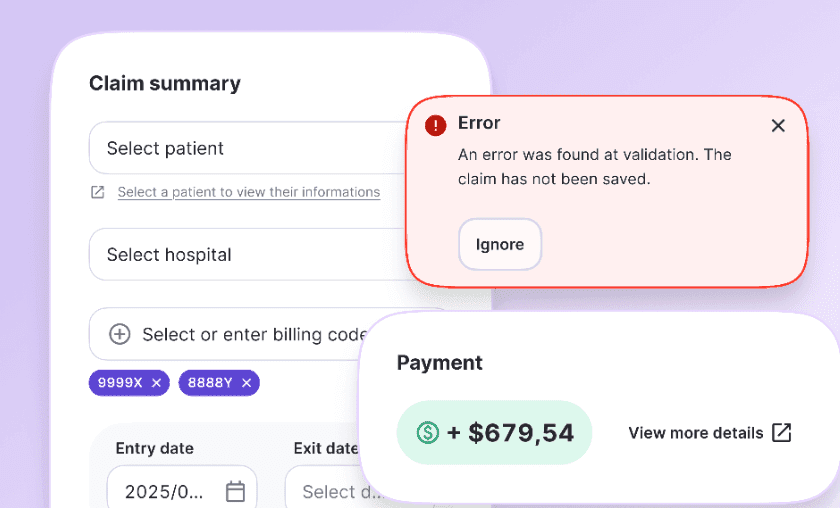
Petal Billing automates claims and displays real-time claim status.
2. Follow a timeline
Part of knowing the rules is knowing the submission timelines. It’s simple, but we’ve seen big losses because physicians didn’t submit their billings within the allowable claim timeframe. These time limits apply when resubmitting rejected claims as well, so make sure you (and your billing operations solution provider) don’t get behind on paperwork.
Here’s what your billing timeline may look like:
- ☐ Daily: Submit all encounter data to avoid backlog and missing information.
- ☐ 24–48 hours: Review automated flags to catch missing modifiers, incompatibilities, or incomplete notes.
- ☐ Weekly: Check for rejected or returned claims to stay within allowable submission windows.
- ☐ Monthly: Update your team on rule changes to ensure accuracy moving forward.
- ☐ Quarterly: Audit high-volume billing codes to spot trends or missed revenue, strengthening compliance and business health.
Build a habit of using automated billing to submit claims daily, or even in real time, drastically reduces the risk of missing your window.
Staying timely also helps stabilize cash flow and prevents bottlenecks from piling up at the end of the month.
Impact: Submitting on time protects revenue and reduces stress, giving clinicians confidence that their hard work won’t go uncompensated.
3. Use available resources
Insurance plans are complicated: complex billing rules differ across insurance companies and change regularly. Use available resources to ensure you are following the most up to date rules. These include:
- Bulletins on rule changes, code removals, and new codes; for example, Alberta’s “Bulletins for health professionals,” Ontario’s “OHIP INFOBulletins 2025,” or Saskatchewan’s “Health Care Administration and Provider Resources.”
- Directories for codes and applications; for example, Alberta’s Fee Navigator.
Pairing these resources with advanced billing tools allow clinicians to bill with confidence. They avoid mistakes, optimize claims, and ensure that every submission meets provincial standards.
Impact: Staying informed leads to higher accuracy and better billing outcomes, as well as reduced administrative burden for clinicians and their teams.
4. Manage rejections
Claims get rejected. That’s the reality of clinicians’ lives, and depending on specialty and practice type, up to 8% of manual claims get rejected on first submission.
These rejections are caused by code incompatibilities, missing text requirements, and errors made by insurance payers. Rejected claims need to be reviewed and resubmitted promptly and within allowable timelines.
Many physicians underestimate losses from rejected claims—and billers may not provide transparency into claim rejections. It takes extra effort to get rejected claims paid, so make sure your biller is doing that work. Use advanced tools to gain full visibility into claim status, reasons for rejection, and steps needed to correct errors to ensure nothing gets overlooked.
Impact: Managing rejections effectively recovers thousands of dollars per year for many clinicians, strengthening financial stability and practice sustainability.
Petal makes rejected claim processing easy.
Bonus tip: Get a trusted billing expert
A biller that knows the rules and diligently follows up on rejected claims will improve your billing outcomes.
Petal Billing specialists are here to assess your billing situation and identify opportunities for growth. Our advanced medical billing tool provides:
- EMR-connected claim automation.
- Provincial code validation and error checking.
- Real-time claim status and remittance tracking.
Proof: Our recent independent study, found physicians using Petal Billing reported an average revenue increase of 9.4% compared to manual billing. This equates to 161 hours saved annually at a value of $24,123 per year.
Simplify your billing and get paid faster without losing your earned revenue.
Grow revenue and save time for patients:
Talk to a Petal expert